Texas Minimum Wage 2026: What Employers Need to Know
The Texas minimum wage is $7.
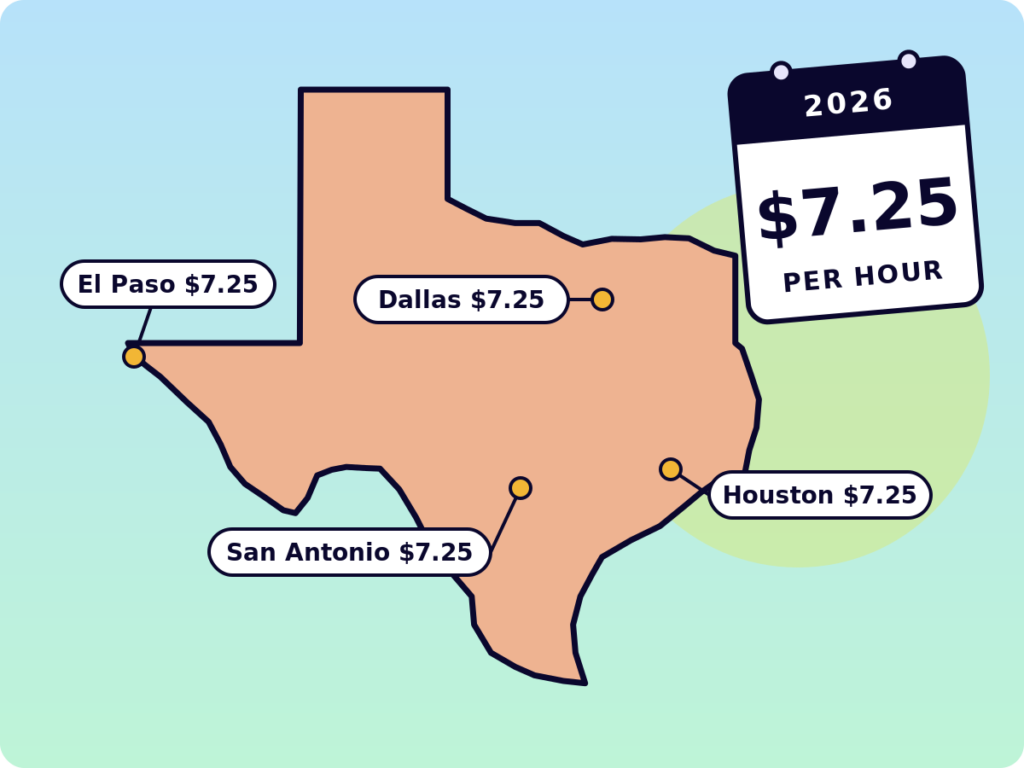
The Texas minimum wage is $7.25 per hour in 2026. Employers can pay tipped employees a cash wage of $2.13 per hour, as long as tips bring total pay to at least $7.25 per hour.
Texas doesn’t set its own dollar amount. Under Texas Labor Code §62.051, the state adopts the federal minimum wage, which has been $7.25 per hour since July 24, 2009. No increase is scheduled for 2026 or 2027.
Texas cities and counties also can’t set a higher minimum wage for private employers. The $7.25 rate applies statewide, from Houston and Dallas to El Paso and Amarillo.
Below is a complete employer guide to the Texas minimum wage, tipped wages, overtime and Texas Payday Law rules for 2026.
Texas minimum wage rules at a glance for 2026
If you just need the numbers, here’s every Texas minimum wage and pay rule covered in this guide, along with the law each one comes from.
Texas minimum wage, tipped wage and pay rules for employers in 2026, with the law behind each:
| Texas wage rule | 2026 requirement | Legal source |
|---|---|---|
| Standard minimum wage | $7.25 per hour | Texas Labor Code §62.051 (adopts FLSA §6) |
| Tipped employee cash wage | $2.13 per hour, with a maximum tip credit of $5.12 | Texas Labor Code §62.052 and FLSA §3(m) |
| Tipped employee definition | More than $20 a month in tips (Texas Act); more than $30 a month (FLSA) | Texas Labor Code §62.052(b) and FLSA §3(t) |
| Youth opportunity wage | $4.25 per hour for employees under 20, first 90 consecutive calendar days only | FLSA §6(g) |
| Overtime at minimum wage | $10.88 per hour after 40 hours in a workweek | FLSA §7 |
| City or county minimum wage | Not allowed for private employers | Texas Labor Code §62.0515 |
| Pay frequency | At least twice a month for nonexempt employees; once a month for exempt employees | Texas Labor Code §61.011 |
| Final paycheck | Within 6 calendar days if discharged; next regular payday if the employee quits | Texas Labor Code §61.014 |
| Wage claim deadline | 180 days with the Texas Workforce Commission; 2 years for a minimum wage lawsuit | Texas Labor Code §61.051 and §62.202 |
| Next scheduled increase | None | No state or federal law currently schedules one |
Why the Texas minimum wage has been $7.25 since 2009
Texas never set its own dollar amount for the minimum wage. Instead, Texas Labor Code §62.051 tells employers to pay “the federal minimum wage” under Section 6 of the Fair Labor Standards Act (FLSA). Whatever Congress sets, Texas follows.
Congress last raised the federal minimum wage to $7.25 on July 24, 2009. Because Texas law points to that federal number, the Texas rate hasn’t moved in more than 17 years. The Texas Workforce Commission (TWC) confirms Texas adopts the federal rate.
So why hasn’t Texas raised the rate on its own? Two reasons:
- The Legislature hasn’t passed a state rate. Bills to raise the Texas minimum wage are filed most sessions, but none has passed.
- Texas has no statewide citizen ballot initiative. In Florida, Missouri and Arkansas, voters raised the minimum wage through ballot measures. Texas voters can’t put a wage law on the ballot without the Legislature.
Does the Texas Minimum Wage Act or the federal FLSA apply to your business?
For most Texas businesses, the answer is the federal FLSA. The Texas Minimum Wage Act (Chapter 62 of the Texas Labor Code) works as a backup for workers the FLSA doesn’t reach. Under §62.151, the state law steps aside wherever the FLSA already applies.
Both laws set the same $7.25 floor. Where they differ is in which workers are exempt and where employees file wage claims.
How the Texas minimum wage has changed since 1972
Texas used to have its own state minimum wage, and for years it sat below the federal rate. That changed in 2001, when lawmakers tied the state rate to the federal one. Workers covered by the FLSA were owed the higher federal rate the whole time.
Texas state minimum wage by year, with the federal FLSA rate for comparison:
| Effective date | Texas state minimum wage | Federal FLSA minimum wage |
|---|---|---|
| July 24, 2009 to present | $7.25 | $7.25 |
| July 24, 2008 | $6.55 | $6.55 |
| July 24, 2007 | $5.85 | $5.85 |
| September 1, 2001 (state adopts federal rate) | $5.15 | $5.15 |
| 1988 to 2001 | $3.35 | $3.35 to $5.15 |
| 1972 to 1981 | $1.40 | $1.60 to $3.35 |
Source: U.S. Department of Labor state minimum wage history and the amendment history of Texas Labor Code §62.051.
Today’s $7.25 is the longest stretch without a federal increase since the FLSA took effect in 1938.
Is the Texas minimum wage going up in 2026 or 2027?
No. The Texas minimum wage is not scheduled to increase in 2026 or 2027. Unlike Florida, Texas has no built-in step increases or inflation adjustments, so the rate changes only if Congress raises the federal minimum wage or the Texas Legislature passes a higher state rate.
Has Texas tried to raise its minimum wage to $15?
Yes, several times. During the 2025 session of the 89th Texas Legislature, lawmakers filed bills to set a state minimum wage of $15 or even $19 an hour. None of them became law.
Texas House bills filed in 2025 to raise the state minimum wage, and the result of each:
| Bill (2025 session) | Proposed Texas minimum wage | Result |
|---|---|---|
| HB 193 | $15 per hour | Did not pass |
| HB 812 | $15 per hour | Did not pass |
| HB 5163 | $15 per hour, plus a biennial living wage study | Did not pass |
| HB 691 | $19 per hour | Did not pass |
The Texas Legislature meets in regular session only in odd-numbered years. The next regular session convenes January 12, 2027, and bill prefiling opens in November 2026. Any wage bill would need to pass both chambers and be signed by the governor before it could take effect.
Could Congress raise the minimum wage for Texas employers?
Yes, and it’s the more likely route. Because Texas law follows the federal rate automatically, any increase Congress passes would apply to Texas employers on its effective date. In June 2025, Senators Josh Hawley (R-Mo.) and Peter Welch (D-Vt.) introduced the Higher Wages for American Workers Act, which would raise the federal minimum wage to $15 and adjust it for inflation each year. Other proposals, including the Raise the Wage Act, would go higher.
None of these bills has received a floor vote. If Congress does pass an increase, Texas employers would owe the new federal rate on its effective date, with no separate state action needed.
Neighboring Oklahoma also kept its $7.25 rate when voters rejected State Question 832, a $15 minimum wage ballot measure, on June 16, 2026.
Do Houston, Dallas, Austin or San Antonio have a higher minimum wage?
No. Every Texas city and county follows the same $7.25 minimum wage for private employers. Under Texas Labor Code §62.0515, the state minimum wage supersedes any city ordinance, county order or charter provision that sets wages in private employment.
Minimum wage for private employers in major Texas cities, 2026:
| Texas city | Private employer minimum wage | Tipped cash wage |
|---|---|---|
| Houston | $7.25 per hour | $2.13 per hour |
| San Antonio | $7.25 per hour | $2.13 per hour |
| Dallas | $7.25 per hour | $2.13 per hour |
| Austin | $7.25 per hour | $2.13 per hour |
| Fort Worth | $7.25 per hour | $2.13 per hour |
| El Paso | $7.25 per hour | $2.13 per hour |
| Corpus Christi, Lubbock, Amarillo and all other Texas cities | $7.25 per hour | $2.13 per hour |
The 2023 Texas Regulatory Consistency Act (HB 2127) added broader preemption language to the Texas Labor Code, limiting city and county rules in fields the state already regulates. Houston, San Antonio and El Paso challenged the law, but the Third Court of Appeals dismissed their case in July 2025, so the law remains in effect.
What about Austin’s $22.15 living wage?
If you’ve heard about Austin’s living wage, it’s real, but it doesn’t apply to most Austin businesses. State law lets Texas cities set higher pay only for their own employees and for work done under a city contract. If you sign a city contract that includes a wage requirement, you have to pay that rate for the contracted work.
For Austin’s 2027 fiscal year (October 1, 2026 to September 30, 2027), the City of Austin Living Wage Program sets $22.15 an hour for covered service contracts performed on city property or in city vehicles. Construction contracts aren’t included. The rate was $22.05 the year before.
Bidding on public construction? Those jobs follow separate prevailing wage rules under Chapter 2258 of the Texas Government Code and, on federally funded projects, the Davis-Bacon Act. You owe the posted prevailing rate for each trade, which is usually well above minimum wage.
What is the minimum wage for servers and tipped employees in Texas?
If you run a restaurant, bar or other business where employees earn tips, Texas lets you count part of those tips toward the minimum wage. You can pay tipped employees a cash wage as low as $2.13 an hour and take a “tip credit” of up to $5.12, as long as cash wages plus tips reach at least $7.25 for every hour worked that week. Texas Labor Code §62.052 adopts the federal tip credit rules in FLSA Section 3(m).
- Minimum wage: $7.25/hr
- Less maximum tip credit: $5.12
- Cash wage due: $2.13/hr
Texas defines a tipped employee as someone who customarily and regularly receives more than $20 a month in tips. The federal FLSA threshold is $30 a month. Most servers, bartenders, bussers and delivery drivers clear both.
What happens when tips don’t add up to $7.25 an hour?
On a slow week, tips might not cover the gap. When a tipped employee’s $2.13 cash wage plus tips averages less than $7.25 an hour, you make up the difference in that week’s paycheck.
Here’s how it works for a server who puts in 30 hours during a slow week and makes $90 in tips:
- Cash wages paid: 30 hours × $2.13 = $63.90
- Cash wages plus tips: $63.90 + $90 = $153.90
- Minimum wage owed for 30 hours: 30 × $7.25 = $217.50
- Extra the employer owes: $217.50 − $153.90 = $63.60
What you have to tell tipped employees before paying $2.13 an hour
You can’t simply start paying the lower cash wage. The U.S. Department of Labor requires you to tell tipped employees five things first, and a written notice gives you proof if a wage claim ever comes up:
- The cash wage being paid ($2.13 or more)
- The tip credit amount being claimed (no more than $5.12)
- That the tip credit can’t exceed the tips the employee actually receives
- That the employee keeps all tips, except for a valid tip pool
- That the tip credit doesn’t apply unless the employee received this notice
Tip pools have their own guardrails. Tips belong to the employees who earn them, so managers and supervisors can’t take a share of the pool. A mandatory service charge added to a bill also isn’t a tip, so it can’t count toward the tip credit.
Does the 80/20 side work rule still apply to Texas restaurants?
No. If you’ve run a restaurant for a while, you may remember the 80/20 rule, which limited the tip credit when servers spent too much time on side work like rolling silverware or restocking. In August 2024, the U.S. Court of Appeals for the Fifth Circuit, which covers Texas, struck down the Department of Labor’s 2021 version of that rule in Restaurant Law Center v. U.S. Department of Labor.
The tip credit still requires that the employee works in a tipped occupation. An employee who holds a separate non-tipped job, such as a server who also works shifts as a cook, must be paid the full $7.25 for hours in the non-tipped role.
Pay your Texas team right, every payday
From GPS time tracking with job site geofencing to payroll, Fingercheck keeps every hour your crews work accurate and every paycheck on time, all in one platform.
Who can be paid less than $7.25 in Texas?
A small number of workers can legally be paid below $7.25 per hour in Texas, through federal subminimum wage programs or exemptions in the Texas Minimum Wage Act.
Can you pay teens, students or tipped workers less than $7.25?
Yes, in three situations allowed under federal law:
- Youth opportunity wage: Employers covered by the FLSA can pay employees under 20 at least $4.25 per hour during their first 90 consecutive calendar days of employment. The 90 days count calendar days, not days worked, and employers can’t displace other workers to use it, according to DOL Fact Sheet #32.
- Full-time students and student-learners: With a certificate from the Department of Labor, employers can pay full-time students 85% of the minimum wage and student-learners in vocational programs 75%.
- Tipped employees: $2.13 per hour in cash wages, as long as tips bring total pay to at least $7.25.
Which workers are exempt from the Texas Minimum Wage Act?
Texas law also lists workers who aren’t covered by the state minimum wage. These exemptions only matter for employees the federal FLSA doesn’t already cover. Under §62.151 to §62.161, the Texas Minimum Wage Act exempts:
- Executive, administrative and professional employees, and commissioned outside salespeople
- Domestic workers in a private home, including babysitters
- Employees under 18 who haven’t graduated high school, and students under 20 enrolled in high school, college or vocational training
- The employer’s spouse, child, parent, sibling or in-laws
- Seasonal amusement and recreational businesses open 7 months or less a year
- Non-agricultural employers that don’t owe Texas unemployment tax
- Dairy farming and livestock production
- Religious orders, camps and some nonprofit roles, plus inmates and sheltered workshops
Most businesses with $500,000 or more in annual sales, and most employees who handle interstate commerce, fall under the FLSA instead. For those employees, the state exemptions don’t change anything: the federal $7.25 floor still applies. If you think an exemption covers your business, confirm with an employment attorney first.
Are your salaried employees exempt from overtime in 2026?
Paying someone a salary doesn’t make them exempt from overtime. A salaried executive, administrative or professional employee is exempt only if they earn at least $684 per week ($35,568 per year) and their job passes the FLSA duties test. Salaried employees who fall short of either one are nonexempt and owed overtime after 40 hours.
The $684 threshold is the current federal standard for 2026. A 2024 Department of Labor rule would have raised it, but a federal court in Texas struck that rule down, and the DOL formally restored the $684 level in May 2026.
How does overtime work for minimum wage employees in Texas?
Texas doesn’t have its own overtime law, so you follow the federal Fair Labor Standards Act. Nonexempt employees earn 1.5 times their regular rate for every hour over 40 in a workweek. At $7.25, that’s $10.875 an hour, which most payroll systems round up to $10.88.
Texas has no daily overtime and no double-time requirement. A 12-hour shift doesn’t trigger overtime unless total hours for the workweek pass 40.
A workweek is a fixed, recurring period of 168 hours (seven consecutive 24-hour days). Employers can’t average hours across two weeks to avoid overtime, even on a biweekly pay schedule.
How to calculate overtime for tipped employees in Texas
This one is easy to get wrong. Overtime for a tipped employee is based on the full $7.25 minimum wage, not the $2.13 cash wage. The tip credit stays the same, so you pay the rest in cash.
Texas overtime rates for standard and tipped employees at the $7.25 minimum wage:
| Employee type | Regular rate | Overtime rate (1.5×) | Tip credit | Cash overtime rate due |
|---|---|---|---|---|
| Standard hourly employee | $7.25/hr | $10.88/hr | $0.00 | $10.88/hr |
| Tipped employee | $7.25/hr | $10.88/hr | $5.12 | $5.76/hr |
Calculating tipped overtime as $2.13 × 1.5 ($3.20/hr) underpays by $2.56 per overtime hour.
Do bonuses change the overtime rate?
They can. Overtime is based on an employee’s regular rate, which isn’t always the same as their hourly wage. Nondiscretionary bonuses, shift differentials and production incentives get added in before you multiply by 1.5. For example, an employee who earns $7.25 an hour plus a $40 weekly attendance bonus and works 45 hours has a regular rate of about $8.14, not $7.25.
What does “no tax on overtime” mean for Texas employers?
The One Big Beautiful Bill Act, signed July 4, 2025, lets eligible employees deduct up to $12,500 a year in qualified overtime compensation ($25,000 for joint filers) from federal taxable income for 2025 through 2028.
For employers, the change shows up at year-end. Under IRS Fact Sheet FS-2026-13 (August 2026), employers must report qualified overtime on 2026 Forms W-2 in Box 12 using code TT. Qualified overtime is only the FLSA-required premium: the “half” in time-and-a-half. For a minimum wage employee, that’s $3.63 of each $10.88 overtime hour.
Keep withholding federal income tax, Social Security and Medicare on all overtime as usual. The deduction is claimed on the employee’s return, and payroll can change withholding only if the employee submits a new Form W-4. Restaurants and bars should also note new code TP for qualified tips, reported with a tipped occupation code in Box 14b.
Texas Payday Law: when and how you have to pay employees
Minimum wage rules cover how much you pay. The Texas Payday Law (Chapter 61 of the Texas Labor Code) covers when and how you pay it. The Texas Workforce Commission enforces it for private employers of every size.
How often do you have to pay employees in Texas?
It depends on whether the employee is exempt from overtime:
- Nonexempt employees: at least twice a month, with pay periods as close to equal in length as possible (§61.011). Weekly and biweekly schedules both meet this rule.
- Exempt employees: at least once a month.
- Designated paydays: employers must set paydays and post them in conspicuous places at work. If no paydays are set, the law treats the 1st and 15th of each month as paydays.
In other words, you can’t pay hourly staff once a month in Texas. Weekly, biweekly and semimonthly pay periods all comply.
How fast do you have to pay a final paycheck in Texas?
It depends on how the job ended. Under Texas Labor Code §61.014:
- Fired or laid off: full final pay is due within 6 calendar days of the discharge date.
- Quit or resigned: full final pay is due by the next regularly scheduled payday.
Commissions and bonuses follow the terms of the written agreement, but must still be paid on time once earned (§61.015). Accrued vacation or sick pay counts as wages only if a written agreement or written policy promises it.
What can you deduct from an employee’s paycheck in Texas?
Texas allows three kinds of paycheck deductions: ones a court orders, ones state or federal law requires (like tax withholding) and ones the employee authorizes in writing for a lawful purpose (§61.018). Even with written permission, deductions for uniforms, tools or cash shortages can’t drop a minimum wage employee below $7.25 an hour for the workweek.
What do Texas pay stubs have to include?
Texas requires a written earnings statement every pay period under §62.003. It has to show the employee’s name, rate of pay, total pay earned, each deduction and its purpose, net pay and hours worked (or units produced for piece-rate pay). A standard pay stub or check voucher works.
Employers can pay by direct deposit or payroll card, but must notify employees in writing at least 60 days before switching to either method (§61.017).
How much does a minimum wage employee earn and cost in Texas?
A full-time employee earning the Texas minimum wage makes $290 per week, about $1,256.67 per month and $15,080 per year before taxes (40 hours × 52 weeks = 2,080 hours).
Texas has no state income tax, so take-home pay reflects federal income tax withholding, Social Security and Medicare only. You can estimate net pay for any hourly rate with Fingercheck’s free Texas Payroll Tax Calculator.
Total annual employer cost of one full-time Texas employee paid $7.25 per hour in 2026:
| Employer cost item | Annual amount per employee |
|---|---|
| Gross wages ($7.25 × 2,080 hours) | $15,080.00 |
| Employer FICA (6.2% Social Security + 1.45% Medicare) | $1,153.62 |
| Federal unemployment tax (FUTA, 0.6% on the first $7,000) | $42.00 |
| Texas unemployment tax (SUTA, 2.7% new employer rate on the first $9,000) | $243.00 |
| Total annual employer cost | $16,518.62 |
New Texas employers pay a 2.7% SUTA rate. Experienced employers receive a rate from the Texas Workforce Commission based on their layoff history.
What would a $15 minimum wage cost your business?
If Texas or Congress raised the minimum wage to $15, each full-time minimum wage employee would add $16,120 in annual wages ($7.75 × 2,080 hours) plus $1,233.18 in employer FICA.
Added annual cost of a $15 minimum wage for Texas employers, by number of full-time minimum wage employees:
| Full-time minimum wage employees | Added annual gross wages | Added employer FICA (7.65%) | Total added annual cost |
|---|---|---|---|
| 1 employee | $16,120.00 | $1,233.18 | $17,353.18 |
| 5 employees | $80,600.00 | $6,165.90 | $86,765.90 |
| 10 employees | $161,200.00 | $12,331.80 | $173,531.80 |
| 25 employees | $403,000.00 | $30,829.50 | $433,829.50 |
FUTA and Texas SUTA wage bases are already met at $7.25 per hour, so those taxes wouldn’t rise for full-time staff.
What Texas wage rules mean for construction, field service, restaurant and healthcare businesses
Even if you pay everyone well above $7.25, these rules still shape your payroll. They set the floor for tipped pay and overtime, and they’re what a wage audit checks first. Where the risk shows up depends on your industry:
- Construction and specialty trades: City-contract living wages and prevailing wage rates on public jobs often sit far above $7.25. Track which hours fall on covered projects so each rate is applied correctly, and keep labor cost tracking tied to the job.
- Field services (landscaping, pest control, HVAC, cleaning): Drive time between job sites counts as hours worked. Long days across multiple properties can push crews past 40 hours without anyone noticing until payday.
- Restaurants and bars: Every week a tipped employee falls short of $7.25 is a wage claim waiting to happen. Track tips by shift and check totals per workweek, not per pay period.
- Staffing agencies: Overtime is owed based on total hours worked for the agency, even when an employee splits the week across two client sites.
- Skilled nursing and long-term care: 12-hour shifts are common, and overtime is still based on the 40-hour workweek, not the shift length. Healthcare scheduling that flags overtime before it’s worked keeps labor costs predictable.
Texas crews that work jobs in Oklahoma, Louisiana or New Mexico may also owe those states’ income tax on those hours. Fingercheck’s Multi-State Payroll and Same Pay Cycle Tax Calculation handles withholding for each state in the same paycheck.
What happens if you underpay employees in Texas?
Wage mistakes get expensive quickly, because Texas employees can bring claims under state law, federal law or both:
- Double back pay in a minimum wage lawsuit: Under the Texas Minimum Wage Act, an employer owes the unpaid wages plus an equal amount as liquidated damages, plus the employee’s reasonable attorney’s fees and court costs (§62.201 and §62.205). Employees have 2 years from the date wages were due to sue.
- Federal FLSA claims: The FLSA also allows unpaid wages plus an equal amount in liquidated damages. Employees have 2 years to file, or 3 years for willful violations, and can file a complaint with the U.S. Department of Labor Wage and Hour Division.
- TWC wage claims: Employees can file a wage claim with the Texas Workforce Commission within 180 days of when wages were due (§61.051). If TWC finds the employer acted in bad faith, it can add a penalty of up to the lesser of the wages owed or $1,000 (§61.053).
- Liens and bonds: A final TWC wage order becomes a lien on the employer’s property. Employers with repeat violations can be required to post a bond to guarantee future payroll.
- Criminal liability: Intending to avoid paying wages owed, then failing to pay after a demand, is a third-degree felony in Texas (§61.019). Each unpaid pay period can count as a separate offense.
Do Texas employers need to display labor law posters?
Yes. Texas employers must display these notices where employees can easily see them, at every work location:
- Texas Payday Law poster: Most employers use the combined Texas Payday Law and Unemployment Compensation Act poster, available free from the Texas Workforce Commission.
- Payday notice: Your designated paydays, posted at the workplace under Texas Labor Code §61.012.
- Federal FLSA minimum wage poster: Available from the U.S. Department of Labor.
- Workers’ compensation notice: Whether or not you carry coverage, from the Texas Department of Insurance.
Employers with multiple job sites, including field offices and trailers, need a set of posters at each location.
Texas minimum wage compliance checklist for employers
Use these eight steps to keep Texas payroll compliant in 2026:
- Check every workweek, not just every paycheck. Minimum wage compliance is measured per workweek. Divide each nonexempt employee’s straight-time pay by hours worked to confirm the average is at least $7.25.
- Give written tip credit notices. Before paying tipped staff $2.13 per hour, tell them the cash wage, the tip credit amount and their right to keep their tips. Make up any weekly shortfall.
- Calculate overtime on the full rate. Pay $10.88 per hour for overtime at minimum wage, or $5.76 in cash for tipped employees. Add nondiscretionary bonuses into the regular rate.
- Set a compliant pay schedule. Pay nonexempt employees at least twice a month and post your paydays at each work location.
- Build final pay into offboarding. Pay discharged employees within 6 calendar days and employees who quit by the next regular payday.
- Review exempt classifications. Confirm salaried exempt employees earn at least $684 per week and pass the duties test.
- Prepare for 2026 W-2 reporting. Track the FLSA overtime premium separately so you can report it in Box 12, code TT. Restaurants should also track qualified tips for code TP.
- Keep records for at least 3 years. The FLSA requires payroll records for 3 years and time cards for 2 years. Those records are your defense in a TWC or DOL wage claim.
Texas Minimum Wage FAQs
This article is for general informational purposes only and isn’t legal or tax advice. Minimum wage and payroll rules can change. Confirm current requirements with the Texas Workforce Commission, the U.S. Department of Labor or an employment attorney.
Spend less time on admin & more time growing your business
From onboarding to time tracking and payroll, Fingercheck gives hourly teams one platform to manage it all.