Ohio Minimum Wage 2026: What Employers Need to Know
Effective January 1, 2027, Ohio’s minimum wage rises to $11.
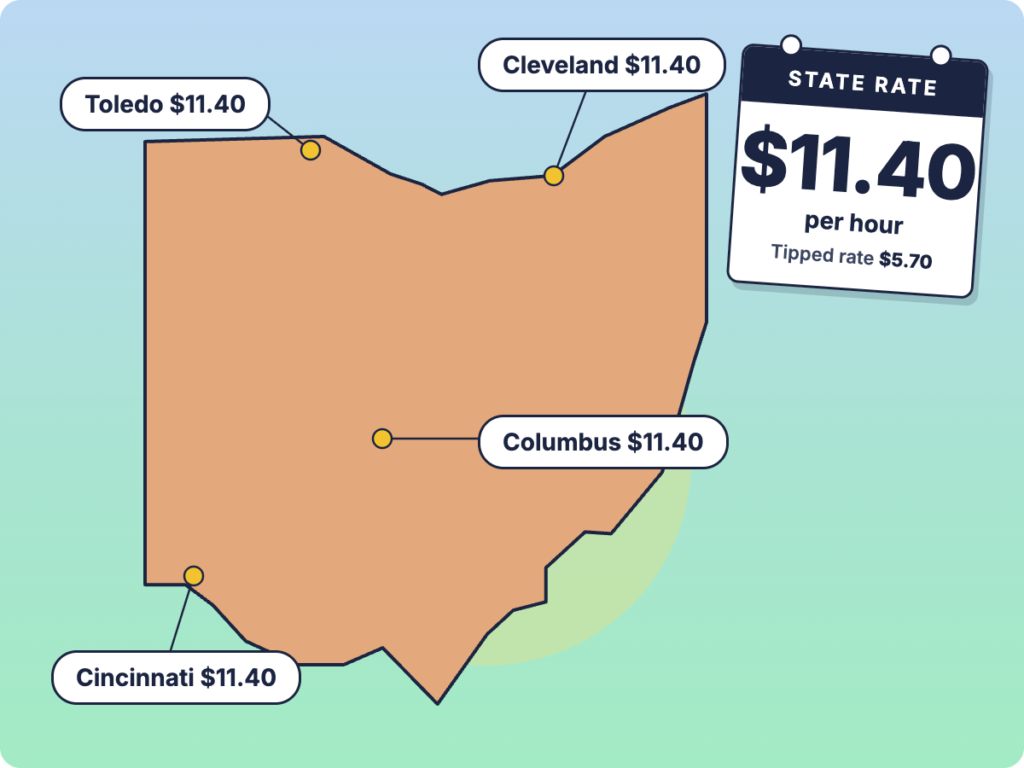
Effective January 1, 2027, Ohio’s minimum wage rises to $11.40 per hour for non-tipped employees and $5.70 per hour for tipped employees. That’s a 3.5% increase over the 2026 rates of $11.00 and $5.50.
The new rate applies to employers with annual gross receipts of more than $419,000, up from $405,000 in 2026. Employees with lower gross receipts, and all employers of 14 and 15 year-olds, follow the federal minimum wage of $7.25 per hour.
The Ohio Department of Commerce’s Bureau of Wage and Hour Administration announced the 2027 rates on September 30, 2026. Below is a complete employer guide to Ohio’s minimum wage rules for 2027.
What is the minimum wage in Ohio in 2026?
Ohio sets its minimum wage by one statewide number. Where your employee physically works decides the rate, not where your business is headquartered. Instead of varying by region, Ohio’s rates vary by employer and employee type:
Overtime: employers grossing less than $150,000 are exempt from Ohio’s overtime rule.
Employer size: employers grossing more than $419,000 pay $11.40, and smaller employers pay $7.25.
Age: 14- and 15-year-olds get $7.25 at any employer.
Ohio minimum wage:
| 2027 Ohio minimum wage rate | Amount |
|---|---|
| Non-tipped minimum wage | $11.40 per hour |
| Tipped cash wage | $5.70 per hour |
| Maximum tip credit | $5.70 per hour |
| Gross receipts threshold | More than $419,000 |
| Small employers and 14–15 year-olds | $7.25 per hour (federal) |
Ohio minimum wage rate history (2020 to 2027)
Ohio’s minimum wage changes every January 1. Since voters approved Article II, Section 34a of the Ohio Constitution in 2006, the rate has been indexed to inflation using the Consumer Price Index for Urban Wage Earners and Clerical Workers (CPI-W).
| Effective date | Minimum wage | Tipped cash wage | Gross receipts threshold |
|---|---|---|---|
| January 1, 2020 | $8.70 per hour | $4.35 per hour | — |
| January 1, 2021 | $8.80 per hour | $4.40 per hour | — |
| January 1, 2022 | $9.30 per hour | $4.65 per hour | — |
| January 1, 2023 | $10.10 per hour | $5.05 per hour | — |
| January 1, 2024 | $10.45 per hour | $5.25 per hour | $385,000 |
| January 1, 2025 | $10.70 per hour | $5.35 per hour | $394,000 |
| January 1, 2026 | $11.00 per hour | $5.55 per hour | $405,000 |
| January 1, 2027 | $11.40 per hour | $5.70 per hour | $419,000 |
The tipped cash wage is always half the standard minimum wage. The federal minimum wage remains $7.25 per hour, so covered Ohio employers must pay the higher state rate.
How the annual adjustment works
- August 31: The 12-month CPI-W measurement period ends. The 2027 increase reflects CPI-W growth from September 1, 2025, to August 31, 2026.
- September 30: The Ohio Department of Commerce announces the new rate and gross receipts threshold.
- January 1: The new rate takes effect, rounded to the nearest five cents.
Expect the 2028 rate to be announced around September 30, 2027.
Does the $11.40 rate apply to your business?
Ohio uses a two-tier system based on annual gross receipts, and the threshold rises with inflation each year. For 2027, the cutoff is $419,000.
| Who | 2027 minimum wage |
|---|---|
| Employers with annual gross receipts over $419,000 | $11.40 per hour ($5.70 tipped) |
| Employers with annual gross receipts of $419,000 or less | $7.25 per hour (federal |
| Employees age 14 and 15, at any employer | $7.25 per hour (federal) |
The Ohio Constitution measures gross receipts for the preceding calendar year. A business that grew past $419,000 in 2026 should plan to pay $11.40 starting January 1, 2027.
The lower tier doesn’t override federal law. If a small business or an individual employee is covered by the FLSA, at least $7.25 is still required, along with federal overtime.
Who is exempt from Ohio’s minimum wage?
The 2027 Ohio Minimum Wage poster lists these exempt individuals:
- Anyone employed by the United States
- Babysitters in the employer’s home, and live-in companions to sick, convalescing or elderly people whose main duties don’t include housekeeping
- Outside salespeople paid by commission, and bona fide executive, administrative, professional or computer professional employees
- Public agency volunteers who receive no pay, or only expenses, reasonable benefits or a nominal fee, for services unlike any job they hold with that agency
- Unpaid charitable workers in hospitals or health institutions
- Employees of nonprofit camps or recreational areas for children under 18
- Family members of an owner who work in a solely family-owned and operated business
The Ohio Department of Commerce can also authorize a sub-minimum wage for individuals whose earning capacity is impaired by a physical or mental disability or injury.
Tipped wages and overtime: how to do the math at $11.40/hr
Ohio lets employers pay tipped employees as little as half the minimum wage, as long as tips make up the rest. A tipped employee is anyone in an occupation where they customarily and regularly receive more than $30 per month in tips. Ohio’s tip credit grows with the minimum wage.
- Minimum wage: $11.40/hr
- Less maximum tip credit (50%): $5.70
- Cash wage due: $5.70/hr
If a tipped employee’s cash wage plus tips doesn’t reach at least $11.40 for every hour worked, the employer must pay the difference.
Calculating tipped overtime correctly
Ohio follows the federal FLSA standard: 1.5 times the regular rate for hours worked beyond 40 in a workweek. Employers grossing less than $150,000 per year are exempt from Ohio’s overtime requirement, but FLSA overtime may still apply to them. Overtime for a tipped employee is calculated on the full $11.40 minimum wage, not the $5.70 cash wage.
| Employee type | Regular rate | Overtime rate (1.5x) | Tip credit | Cash overtime rate due |
|---|---|---|---|---|
| Standard hourly employee | $11.40 per hour | $17.10 per hour | $0.00 per hour | $17.10 per hour |
| Tipped employee | 11.40 per hour | $17.10 per hour | $5.70 per hour | $11.40 per hour |
Calculating tipped overtime as $5.70 × 1.5 ($8.55/hr) underpays by $2.85 per overtime hour.
Ohio minimum wage payroll checklist
January 1, 2027 falls on a Friday, so most pay periods that include that date need to be split. Use these seven steps to stay compliant:
- Confirm your tier. Check whether your 2026 gross receipts exceed $419,000. That decides whether you pay $11.40 or $7.25.
- Pay by date worked. Minimum wage compliance is based on the date work was performed, not the date the paycheck is issued.
- Split pay periods that include January 1. Hours worked through December 31 are paid at $11.00/hr ($5.50 tipped cash wage). Hours worked on or after January 1 are paid at $11.40/hr ($5.70 tipped).
- Example: A biweekly paycheck with 36 hours worked Dec. 25 to 31 and 40 hours worked Jan. 1 to 7 equals (36 × $11.00 = $396.00) + (40 × $11.40 = $456.00) = $852.00 in gross wages.
- Update overtime rates. Make sure your time tracking or payroll system calculates minimum wage overtime at $17.10/hr ($11.40/hr cash wage for tipped staff).
- Display required posters. Download and display the official 2027 Ohio Minimum Wage poster in a conspicuous place at every work location. You must also display the federal U.S. Department of Labor FLSA poster.
- Keep records for three years. Ohio requires each employee’s name, address, occupation, pay rate, daily hours and each amount paid, kept for at least three years after their last day. Give employees your business name, address and phone number at hire.
- Review wage compression. Check pay for employees earning between $11.40 and $13.00 per hour. Adjusting pay for longer-tenured staff keeps experience-based pay gaps in place.
Employer cost breakdown: wages and payroll tax impact
Moving a full-time employee from $11.00 to $11.40 per hour adds $832.00 in annual gross wages (40 hours/week × 52 weeks = 2,080 hours). Employer FICA taxes (6.2% Social Security + 1.45% Medicare = 7.65%) add another $63.65 per year per employee.
| Full-time minimum wage employees | Added annual gross wages | Added employer FICA (7.65%) | Total added annual cost |
|---|---|---|---|
| 1 employee | 832.00 | $63.65 | $895.65 |
| 5 employees | $4,160.00 | $318.24 | $4,478.24 |
| 10 employees | $8,320.00 | $636.48 | $8,956.48 |
| 25 employees | $20,800.00 | $1,591.20 | $22,391.20 |
Ohio unemployment tax applies only to a capped amount of each employee’s annual wages, so the increase won’t raise it for most full-time staff already above the cap.
How Ohio’s minimum wage increase affects hourly workforces
The $11.40 rate applies statewide, but the operational impact depends on how you price work and staff shifts:
- Construction and specialty contractors: Fixed-price bids signed in 2026 were likely estimated at $11.00/hr labor. Review jobs running into 2027 for margin loss, and update job costing and labor tracking rates for new estimates.
- Field services (HVAC, landscaping, cleaning, pest control): Recurring maintenance contracts often lock in pricing months ahead. Review January renewals to make sure pricing covers $11.40 labor and overtime.
- Staffing agencies: Client bill rates need to rise with pay rates to protect margins. A $0.40 pay increase requires more than $0.40 in bill rate, since employer taxes and workers’ comp costs rise with wages.
- Restaurants and businesses with tipped staff: The cash wage rises to $5.70 per hour. On slow winter shifts, check that tips still bring every tipped employee to at least $11.40 per hour, since the employer covers any shortfall.
- Growing small businesses: If your gross receipts crossed $419,000, you move from $7.25 to $11.40 which is a $4.15 jump per hour. Budget for it before your first January payroll.
Penalties for noncompliance
Article II, Section 34a of the Ohio Constitution sets out these penalties for failing to pay the minimum wage:
- Triple back pay: An employer found in violation owes the back wages plus damages of two times that amount, plus the employee’s costs and reasonable attorney’s fees.
- 30-day deadline: Payment is due within 30 days of the finding and isn’t paused during an appeal.
- Retaliation damages: Retaliating against an employee who exercises their rights carries damages of at least $150 for each day the violation continues.
- Three-year lookback: Employees, the Ohio Attorney General or others acting for employees can sue within three years of the violation, or of when a continuing violation ended.
- No exhaustion requirement: Employees can go straight to court; they don’t have to file a state complaint first.
Federal FLSA penalties, including back wages and equal liquidated damages, can apply on top of state remedies.
Pay every Ohio employee the right rate
Whether your team works downstate, upstate or across state lines, Fingercheck brings time tracking, scheduling and payroll into one platform so every paycheck matches the hours your team worked.
Ohio Minimum Wage FAQs
This article is for general informational purposes only and isn’t legal or tax advice. Minimum wage and payroll rules can change. Confirm current requirements with the Ohio Department of Commerce, or an employment attorney.