Missouri minimum wage 2026: What employers need to know
Missouri’s minimum wage stays at $15.
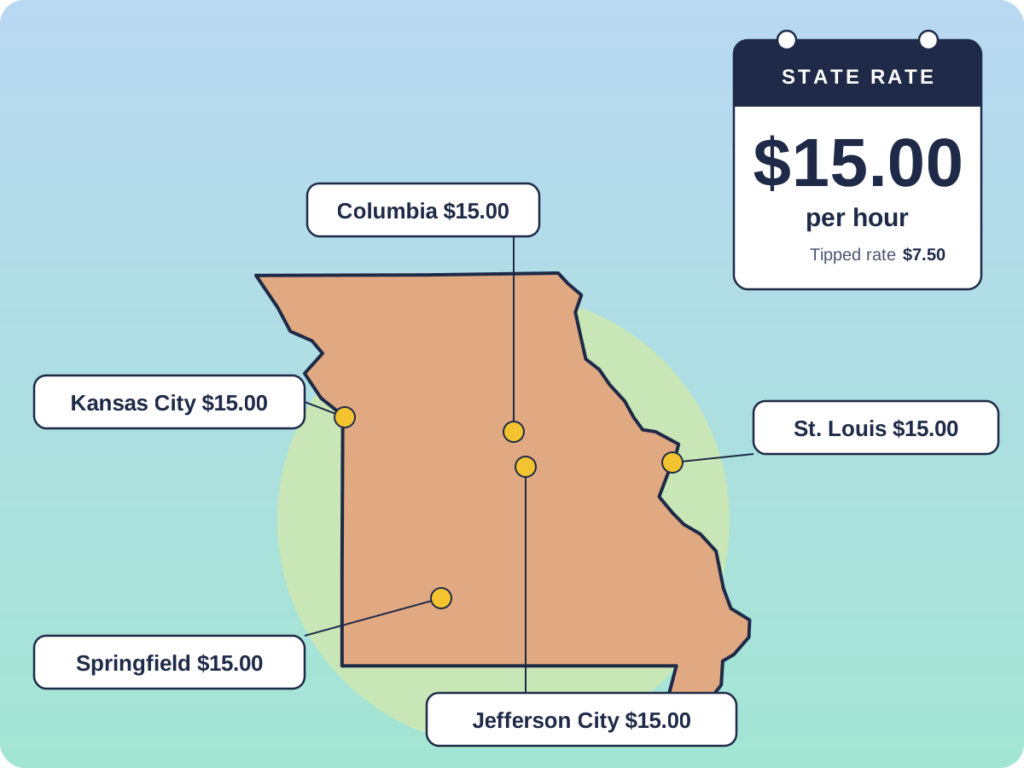
Missouri’s minimum wage is $15.00 per hour in 2026, and it stays at $15.00 per hour on January 1, 2027. The minimum cash wage for tipped employees is $7.50 per hour in both years.
That makes 2027 the first year without an increase since 2016. A 2025 law removed the yearly inflation adjustments voters approved in 2024, so the $15.00 rate has no scheduled end date.
Below is a complete employer guide to Missouri’s minimum wage rules for 2026, 2027 and beyond.
What is the minimum wage in Missouri in 2026 and 2027?
The Missouri Department of Labor and Industrial Relations lists the same rates for both years:
| Rate type | 2026 rate | 2027 rate |
|---|---|---|
| Standard minimum wage | $15.00 per hour | $15.00 per hour |
| Tipped cash wage (50% of minimum) | $7.50 per hour | $7.50 per hour |
| Maximum tip credit | $7.50 per hour | $7.50 per hour |
| Overtime rate at minimum wage (1.5x) | $22.50 per hour | $22.50 per hour |
| Federal minimum wage | $7.25 per hour | $7.25 per hour |
When state and federal rates differ, employers must pay the higher one. For most Missouri employers, that means $15.00 per hour is the baseline for nonexempt workers.
Why Missouri’s minimum wage isn’t increasing in 2027
Missouri’s minimum wage stays at $15.00 in 2027 because the state no longer adjusts it for inflation.
Here’s how it got there:
- November 2024: Voters approved Proposition A, which raised the minimum wage to $13.75 on January 1, 2025, and $15.00 on January 1, 2026. It also called for yearly inflation adjustments starting January 1, 2027.
- July 10, 2025: Gov. Mike Kehoe signed House Bill 567. It kept the $15.00 rate but repealed the inflation adjustments. It also repealed Proposition A’s paid sick leave requirement, effective August 28, 2025.
- January 1, 2027: With no adjustment in the law, the rate stays at $15.00. The state’s 2027 minimum wage poster confirms the $15.00 rate for January 1 through December 31, 2027.
Any future increase now requires new legislation or a new ballot measure.
What about Amendment 6? Missouri voters approved Amendment 6 on November 3, 2026. It makes it harder for lawmakers to change laws passed by citizen initiative. It doesn’t automatically bring back the inflation adjustments that HB 567 removed. Watch for legal challenges and new legislation in 2027.
Missouri minimum wage rate history (2015 to 2027)
Missouri’s minimum wage has roughly doubled since 2015, with the biggest jumps coming after voter-approved measures in 2018 and 2024. Rates take effect January 1 each year.
| Effective date | Minimum wage | Tipped cash wage |
|---|---|---|
| January 1, 2015 | $7.65 per hour | $3.825 per hour |
| July 1, 2016 | $7.65 per hour | $3.825 per hour |
| January 1, 2017 | $7.70 per hour | $3.85 per hour |
| January 1, 2018 | $7.85 per hour | $3.925 per hour |
| January 1, 2019 | $8.60 per hour | $4.30 per hour |
| January 1, 2020 | $9.45 per hour | $4.725 per hour |
| January 1, 2021 | $10.30 per hour | $5.15 per hour |
| January 1, 2022 | $11.15 per hour | $5.75 per hour |
| January 1, 2023 | $12.00 per hour | $6.00 per hour |
| January 1, 2024 | $12.30 per hour | $6.15 per hour |
| January 1, 2025 | $13.75 per hour | $6.875 per hour |
| January 1, 2026 | $15.00 per hour | $7.50 per hour |
| January 1, 2027 | $15.00 per hour | $7.50 per hour |
Minimum wage rates are from the Missouri Department of Labor and Industrial Relations. Tipped cash wages are 50% of each year’s minimum wage, as Missouri law requires.
Who must pay Missouri’s minimum wage?
Most Missouri employers must pay $15.00 per hour, with a few key exceptions.
- Small retail and service businesses: Retail or service businesses with annual gross income under $500,000 don’t have to pay the state minimum wage, according to the state.
- Employers covered by federal law: The small-business exemption doesn’t override federal law. Employers covered by the federal Fair Labor Standards Act (FLSA) must still pay at least the $7.25 federal minimum wage, and some employees are covered individually, such as those who regularly handle interstate goods or communications.
- Public employers: HB 567 extended the state minimum wage to public employers, including the state, cities, counties and school districts, starting August 28, 2025. Earlier versions of the law didn’t apply to public employers.
- Exempt employees: Missouri follows federal FLSA exemptions, such as those for certain executive, administrative and professional employees. Missouri doesn’t set its own salary threshold for these exemptions.
Minimum wage applies to all hours worked in Missouri, including by employees of companies based in other states.
Tipped wages and overtime: how to do the math at $15/hr
Missouri employers can pay tipped employees a cash wage of $7.50 per hour, which is 50% of the minimum wage. That’s a tip credit of $7.50 per hour:
- Minimum wage: $15.00/hr
- Less maximum tip credit: $7.50
- Cash wage due: $7.50/hr
If a tipped employee’s cash wage plus tips doesn’t reach at least $15.00 per hour, the employer must pay the difference, according to the state. Federal rules for taking a tip credit also apply, including telling employees in advance and letting them keep all their tips outside of a valid tip pool.
Calculating tipped overtime correctly
Missouri requires overtime at 1.5 times the regular rate for hours over 40 in a workweek, under Section 290.505 of the Missouri statutes. Employees of certain seasonal amusement or recreation businesses get overtime after 52 hours instead.
Overtime for a tipped employee is calculated on the full $15.00 minimum wage, not the $7.50 cash wage.
| Employee type | Regular rate | Overtime rate (1.5x) | Tip credit | Cash overtime rate due |
|---|---|---|---|---|
| Standard hourly employee | $15.00 per hour | $22.50 per hour | $0.00 | $22.50 per hour |
| Tipped employee | $15.00 per hour | $22.50 per hour | $7.50 | $15.00 per hour |
Calculating tipped overtime as $7.50 x 1.5 ($11.25/hr) underpays by $3.75 per overtime hour.
Do Missouri cities have their own minimum wage?
No. Missouri law bars cities and counties from setting a minimum wage higher than the state rate. Section 290.528 of the Missouri statutes, in effect since August 28, 2017, also stops them from requiring employment benefits beyond state law.
That means the $15.00 rate applies the same way in Kansas City, St. Louis, Springfield, Columbia and every other Missouri city. Multi-site employers in Missouri can use one rate for all locations.
Missouri minimum wage payroll checklist
Since the rate doesn’t change on January 1, 2027, most of this checklist is about confirming your setup rather than changing it.
- Confirm your 2027 rates. Keep the $15.00 standard rate and $7.50 tipped cash wage in your payroll system. Don’t apply an inflation increase that some older payroll guides still predict.
- Check overtime rates. Minimum wage overtime is $22.50/hr, and $15.00/hr cash for tipped staff.
- Review coverage if you’re near $500,000. Retail and service businesses close to the $500,000 gross income line should confirm whether the state rate applies. If you’re also covered by the FLSA, you still owe at least $7.25 per hour.
- Display the 2027 poster. Missouri requires employers to post a summary of the minimum wage law in a conspicuous place under Section 290.522. Download the free 2027 English poster or Spanish poster. You must also display the federal FLSA poster.
- Give tip credit notices. Tell tipped employees about the $7.50 cash wage and $7.50 tip credit before you apply the credit.
- Review wage compression. With no automatic increase in 2027, check pay for employees earning between $15.00 and $17.00 per hour. Planned raises for experienced staff help keep pay gaps in place.
Employer cost breakdown: wages and payroll tax impact
Because the rate stays at $15.00, a full-time minimum wage employee costs the same in base wages in 2027 as in 2026: $31,200 a year (40 hours/week x 52 weeks = 2,080 hours).
Employer FICA taxes (6.2% Social Security + 1.45% Medicare = 7.65%) add $2,386.80 per year per employee.
Annual base wage and FICA cost of full-time minimum wage employees in Missouri, 2026 and 2027:
| Full-time minimum wage employees | Annual gross wages | Added employer FICA (7.65%) | Total annual cost |
|---|---|---|---|
| 1 employee | $31,200.00 | $2,386.80 | $33,586.80 |
| 5 employees | $156,000.00 | $11,934.00 | $167,934.00 |
| 10 employees | $312,000.00 | $23,868.00 | $335,868.00 |
| 25 employees | $780,000.00 | $59,670.00 | $839,670.00 |
For comparison, the 2026 increase from $13.75 to $15.00 added $2,600.00 in wages and $198.90 in FICA per full-time employee. Missouri’s state unemployment tax applies only to a capped amount of each employee’s wages, so the rate itself doesn’t raise it for most full-time staff.
How Missouri’s flat 2027 rate affects hourly workforces
A flat rate makes labor costs easier to predict in 2027, but the impact still depends on how you price work and staff shifts:
- Construction and specialty contractors: Bids for 2027 jobs can use the same $15.00 floor as 2026. Review job costing in case wage pressure from competitors pushes your actual starting rates higher.
- Field services (HVAC, landscaping, cleaning, pest control): Recurring contracts priced for 2027 don’t need a built-in state wage increase. Make sure pricing still covers $22.50 overtime during peak seasons.
- Staffing agencies: Bill rates don’t need to rise for a state wage change in 2027. Margins still depend on employer taxes and workers’ comp costs, which rise with any pay increase you choose to give.
- Restaurants and businesses with tipped staff: The $7.50 cash wage and $7.50 tip credit stay the same. On slow shifts, check that tips still bring every tipped employee to at least $15.00 per hour.
- Multi-site employers: With no local minimum wages in Missouri, one rate applies at every location. Employers with sites in other states still need to track each state’s rate separately.
Penalties for noncompliance
Section 290.527 of the Missouri statutes sets out what employers owe when they pay less than the minimum wage:
- Triple back pay: The employer owes the unpaid wages plus liquidated damages equal to twice the unpaid wages, less anything already paid.
- Costs and attorney’s fees: The employer also owes court costs and reasonable attorney’s fees.
- No waivers: An agreement to work for less than the minimum wage isn’t a defense.
- Three-year lookback: Employees have three years to file a claim for unpaid wages.
Employees can also file a minimum wage complaint with the Missouri Division of Labor Standards. Federal penalties under the FLSA can apply on top of state penalties, including back wages, an equal amount in liquidated damages and civil money penalties for willful or repeated violations.
Spend less time on admin and more time growing your business
From onboarding to time tracking and payroll, Fingercheck gives hourly teams one platform to manage it all.
Missouri minimum wage FAQs
This article is for general informational purposes only and isn’t legal or tax advice. Minimum wage rules can change. Confirm current requirements with the Missouri Department of Labor and Industrial Relations or an employment attorney.
Sources
- Missouri Department of Labor and Industrial Relations: Minimum wage
- Missouri Department of Labor and Industrial Relations: 2027 minimum wage poster (English)
- Missouri Department of Labor and Industrial Relations: File a minimum wage complaint
- Missouri Department of Labor and Industrial Relations: Mandatory posters
- Missouri House of Representatives: HB 567 bill summary
- Revised Statutes of Missouri, Section 290.505: Overtime
- Revised Statutes of Missouri, Section 290.522: Posting requirements
- Revised Statutes of Missouri, Section 290.527: Underpayment of wages
- Revised Statutes of Missouri, Section 290.528: Limits on local minimum wages
- U.S. Department of Labor: Minimum wage
- U.S. Department of Labor: FLSA poster