Oregon minimum wage increase 2026: What employers need to know
Oregon’s minimum wage depends on where employees work, with three different rates across the state.
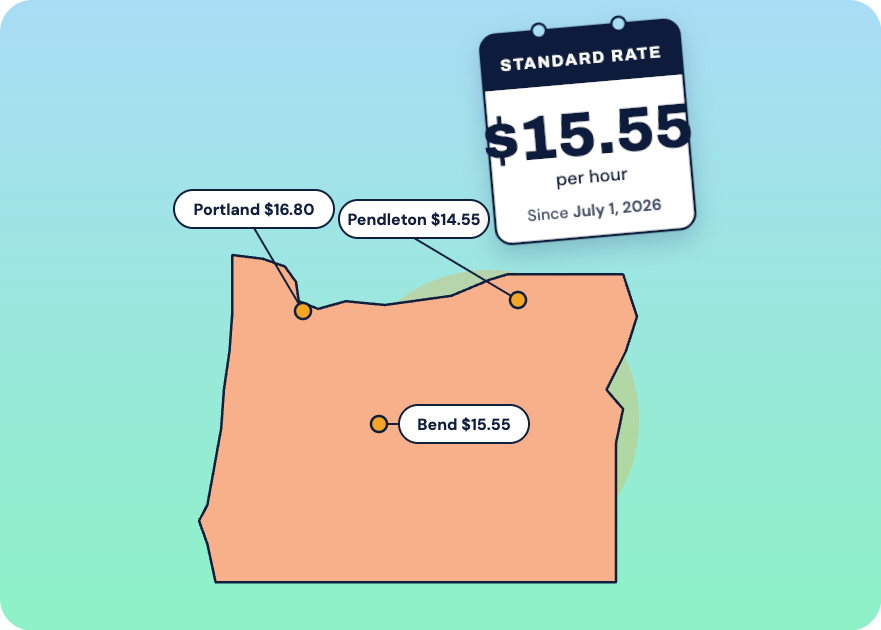
Oregon’s minimum wage depends on where employees work, with three different rates across the state. From July 1, 2026, through June 30, 2027, the rates are $16.80 per hour in the Portland metro area, $15.55 in standard counties, and $14.55 in nonurban counties.
Oregon does not allow a tip credit, so tipped employees earn the full minimum wage before tips. Minors earn the same rate as adults. The rates adjust for inflation every July 1, and the 2027 rates will be announced by April 30, 2027.
Below is a complete employer guide to Oregon’s minimum wage for 2026 and 2027, including which rate applies, overtime rules, and a payroll checklist. For other states, our minimum wage by state guide.
Oregon minimum wage by county (July 1, 2026 to June 30, 2027)
Oregon has three minimum wage tiers, and the rate depends on the county where an employee works. The Portland metro rate is $1.25 above the standard rate, and the nonurban rate is $1.00 below it.
| Region | Minimum wage | Where it applies |
|---|---|---|
| Portland metro | $16.80/hr | Inside the Portland urban growth boundary, including parts of Clackamas, Multnomah, and Washington counties |
| Standard | $15.55/hr | Benton, Clatsop, Columbia, Deschutes, Hood River, Jackson, Josephine, Lane, Lincoln, Linn, Marion, Polk, Tillamook, Wasco, and Yamhill counties, plus parts of Clackamas, Multnomah, and Washington counties outside the urban growth boundary |
| Nonurban | $14.55/hr | Baker, Coos, Crook, Curry, Douglas, Gilliam, Grant, Harney, Jefferson, Klamath, Lake, Malheur, Morrow, Sherman, Umatilla, Union, Wallowa, and Wheeler counties |
Portland metro isn’t defined by county lines. It’s defined by the urban growth boundary, so an address in Clackamas, Multnomah, or Washington County could fall in either the Portland or standard tier. Use Metro’s urban growth boundary lookup to check each work address.
Which rate applies?
Pay the rate for the county where the employee works 50% or more of their hours each week. A few situations come up often:
- Inside the urban growth boundary: Any work location inside the boundary must be paid at least the Portland metro rate.
- Employees who travel: The employer can pay the rate for each county worked, tracking hours by location.
- Delivery drivers and mobile workers: Pay the rate for the county where the employee starts and ends the day.
Source: Oregon Bureau of Labor and Industries (BOLI).
Oregon minimum wage rate history (2016 to 2026)
Oregon moved to three regional rates in 2016 and has raised them every July 1 since. Since July 1, 2023, increases have been tied to inflation instead of a fixed schedule.
Oregon minimum wage by effective date:
| Effective date | Portland metro | Standard | Nonurban |
|---|---|---|---|
| July 1, 2026 (current) | $16.80/hr | $15.55/hr | $14.55/hr |
| July 1, 2025 | $16.30/hr | $15.05/hr | $14.05/hr |
| July 1, 2024 | $15.95/hr | $14.70/hr | $13.70/hr |
| July 1, 2023 | $15.45/hr | $14.20/hr | $13.20/hr |
| July 1, 2022 | $14.75/hr | $13.50/hr | $12.50/hr |
| July 1, 2021 | $14.00/hr | $12.75/hr | $12.00/hr |
| July 1, 2020 | $13.25/hr | $12.00/hr | $11.50/hr |
| July 1, 2019 | $12.50/hr | $11.25/hr | $11.00/hr |
| July 1, 2018 | $12.00/hr | $10.75/hr | $10.50/hr |
| July 1, 2017 | $11.25/hr | $10.25/hr | $10.00/hr |
| July 1, 2016 | $9.75/hr | $9.75/hr | $9.50/hr |
| January 1, 2016 | $9.25/hr | $9.25/hr | $9.25/hr |
The federal minimum wage is $7.25 per hour, so Oregon’s rates apply to virtually every employer in the state.
Source: BOLI minimum wage increase schedule.
Will Oregon’s minimum wage increase in 2027?
Most likely, yes. Oregon’s minimum wage adjusts for inflation every July 1, so new rates are expected on July 1, 2027, as long as prices keep rising.
Here’s how the 2027 rates will be set:
- By April 30, 2027: BOLI calculates the new standard rate based on the change in the Consumer Price Index (CPI-U, U.S. city average) from March 2026 to March 2027, rounded to the nearest 5 cents.
- Regional rates follow: The Portland metro rate is set at $1.25 above the new standard rate, and the nonurban rate at $1.00 below it.
- July 1, 2027: The new rates take effect statewide.
If prices don’t rise, the rates stay the same. The minimum wage never goes down.
Another 2027 change: farm overtime drops to 40 hours
Starting January 1, 2027, Oregon agricultural workers earn overtime after 40 hours in a workweek, down from 48 hours in 2025 and 2026. This is the final step of HB 4002 (2022):
| Years | Agricultural overtime threshold |
|---|---|
| 2023 to 2024 | After 55 hours/week |
| 2025 to 2026 | After 48 hours/week |
| January 1, 2027 onward | After 40 hours/week |
gricultural employers can claim a refundable state tax credit for part of the overtime they pay through 2028.
Tipped wages and overtime: how to do the math in Oregon
Tip credits are illegal in Oregon, so tipped employees must earn the full regional minimum wage before tips. A server in Portland earns at least $16.80 per hour, and tips are paid on top.
Employers can require tip pooling among workers, but managers, supervisors, and the business itself can’t take part in the pool. Oregon’s minimum wage is also the same for minors and adults, and employees can’t agree to work for less.
Oregon overtime rules
Most Oregon employees earn 1.5 times their regular rate for hours over 40 in a workweek. Some industries have extra rules:
- Manufacturing: Mills, factories, and manufacturing plants owe overtime after 10 hours in a day, in addition to weekly overtime.
- Canneries, driers, and packing plants: Overtime after 10 hours in a day for nonfarm operations.
- Agriculture: Overtime after 48 hours a week in 2026, dropping to 40 hours on January 1, 2027.
Oregon overtime rates at the minimum wage:
| Region | Minimum wage | Overtime rate (1.5x) |
| Portland metro | $16.80/hr | $25.20/hr |
| Standard | $15.55/hr | $23.33/hr |
| Nonurban | $14.55/hr | $21.83/hr |
Because there’s no tip credit, tipped employees’ overtime rate is the same as everyone else’s. Shift differentials and nondiscretionary bonuses raise the regular rate, so calculate overtime on the higher figure.
Other Oregon rules hourly employers need to know
Oregon has several rules beyond the minimum wage that affect how you schedule and pay hourly staff:
| Rule | What it requires |
| Predictive scheduling | Retail, hospitality, and food service employers with 500+ employees worldwide must post schedules 14 days in advance, pay extra for last-minute changes, and give 10 hours of rest between shifts or pay 1.5x for the shortened rest. |
| Meal breaks | An unpaid 30-minute meal break for shifts of 6 hours or more. |
| Rest breaks | A paid 10-minute rest break for every 4 hours worked, or major part of 4 hours. |
| Sick time | Employees earn 1 hour for every 30 hours worked, up to 40 hours a year. It’s paid for employers with 10 or more Oregon employees (6 or more in Portland). |
| Final pay | Employees who are fired are paid by the end of the next business day. Employees who quit with 48 hours’ notice are paid on their last day. |
| Required posters | Display BOLI’s required posters, available in 7 languages, plus the federal FLSA poster. |
Predictive scheduling is the rule most likely to catch large multi-location employers. Missing the 14-day notice or the 10-hour rest requirement creates extra pay owed on top of regular wages.
Oregon exempt salary threshold
Salaried employees in Oregon must earn at least $684 per week ($35,568 per year) to be exempt from overtime. Oregon has its own salary test, but it’s lower than the federal level everywhere in the state, so the federal threshold is the one that counts.
| Region | Oregon test (minimum wage x 2,080 hours) | Federal threshold | Threshold that applies |
| Portland metro | $34,944/yr | $35,568/yr | $35,568/yr |
| Standard | $32,344/yr | $35,568/yr | $35,568/yr |
| Nonurban | $30,264/yr | $35,568/yr | $35,568/yr |
As the Portland rate rises, the Oregon test will catch up to the federal level, so check the threshold again each July 1. The employee must also pass the duties test for the exemption.
Oregon minimum wage payroll checklist
Oregon’s rates change every July 1 and vary by location, so payroll setup matters. Use these eight steps to stay compliant:
- Map every work location to a tier. Check each address in Clackamas, Multnomah, and Washington counties against the urban growth boundary.
- Assign each employee a rate. Use the county where they work 50% or more of their hours. For travelers, either track hours by county or pay the highest rate.
- Split pay periods that include July 1. Pay is based on the date work is performed.
- Example: A standard-county employee on a biweekly pay period in 2026 worked 24 hours June 24 to 30 at $15.05 ($361.20) and 40 hours July 1 to 7 at $15.55 ($622.00), with no overtime, for $983.20 in gross wages. Read our guide on how pay periods work for more on pay period math.
- Turn off tip credits. Tipped employees earn the full regional rate before tips.
- Update overtime rules. Set daily overtime after 10 hours for manufacturing, and change agricultural overtime to 40 hours on January 1, 2027.
- Check exempt salaries. Every exempt employee needs at least $35,568 a year plus a qualifying job description.
- Follow predictive scheduling if you’re covered. Post schedules 14 days ahead and track rest periods between shifts.
- Watch for the April announcement. BOLI publishes the next year’s rates by April 30, giving you two months to update payroll before July 1.
How Oregon’s minimum wage affects hourly workforces
The biggest challenge in Oregon is location: a business with sites in Portland, Salem, and Pendleton runs three different minimum wages. Here’s how that plays out by industry:
- Health care and long-term care: Operators with facilities in more than one tier need location-based pay rates. Home health aides who drive between clients are paid the rate for the county where they start and end the day, and every visit hour must add up to at least minimum wage.
- Restaurants and hospitality: With no tip credit, every rate increase applies to tipped staff in full. Large chains also need to follow predictive scheduling rules.
- Agriculture and food processing: Farm overtime drops to 40 hours a week on January 1, 2027. Canneries and packing plants owe daily overtime after 10 hours.
- Construction and field services: Crews that work across the Portland urban growth boundary should track hours by job site, or pay the Portland rate for all hours.
- Staffing agencies: Bill rates need to reflect the tier where each worker is placed and rise each July 1.
Penalties for noncompliance
Oregon gives employees and the state several ways to recover underpaid wages:
- Unpaid wages plus attorney’s fees: Employees can recover unpaid minimum wages and overtime, plus attorney’s fees, through a BOLI wage claim or a lawsuit.
- Penalty wages: If wages are still unpaid after the final paycheck is due, the employer can owe the employee’s daily wage for each day late, for up to 30 days.
- Civil penalties: BOLI can assess civil penalties for each minimum wage or overtime violation.
- No retaliation: Employers can’t punish employees for asking about pay or filing a complaint.
The easiest way to avoid all of these is accurate time tracking and the right rate for every location. When every hour is recorded and paid correctly, there’s nothing to recover.
Pay every Oregon rate correctly with Fingercheck
Oregon employers can owe three different minimum wages, daily overtime, and predictive scheduling pay in the same pay period. Fingercheck brings time tracking, scheduling, and payroll together for hourly teams, so location-based rates and July 1 changes are handled in one place.
Oregon minimum wage FAQs for employers
This article is for general informational purposes only and isn’t legal or tax advice. Minimum wage rules can change. Confirm current requirements with the Oregon Bureau of Labor and Industries or an employment attorney.
Sources
- Oregon BOLI: Minimum Wage
- Oregon BOLI: Minimum wage increase schedule
- Oregon BOLI: Minimum wage and overtime in agriculture
- Oregon BOLI: Required worksite postings
- Oregon Metro: Urban growth boundary lookup
- U.S. Department of Labor: FLSA Employee Rights poster (WH1088)
Spend less time on admin and more time growing your business
From onboarding to time tracking and payroll, Fingercheck gives hourly teams one platform to manage it all.