Illinois minimum wage 2026: What employers need to know
Illinois’ minimum wage is $15.
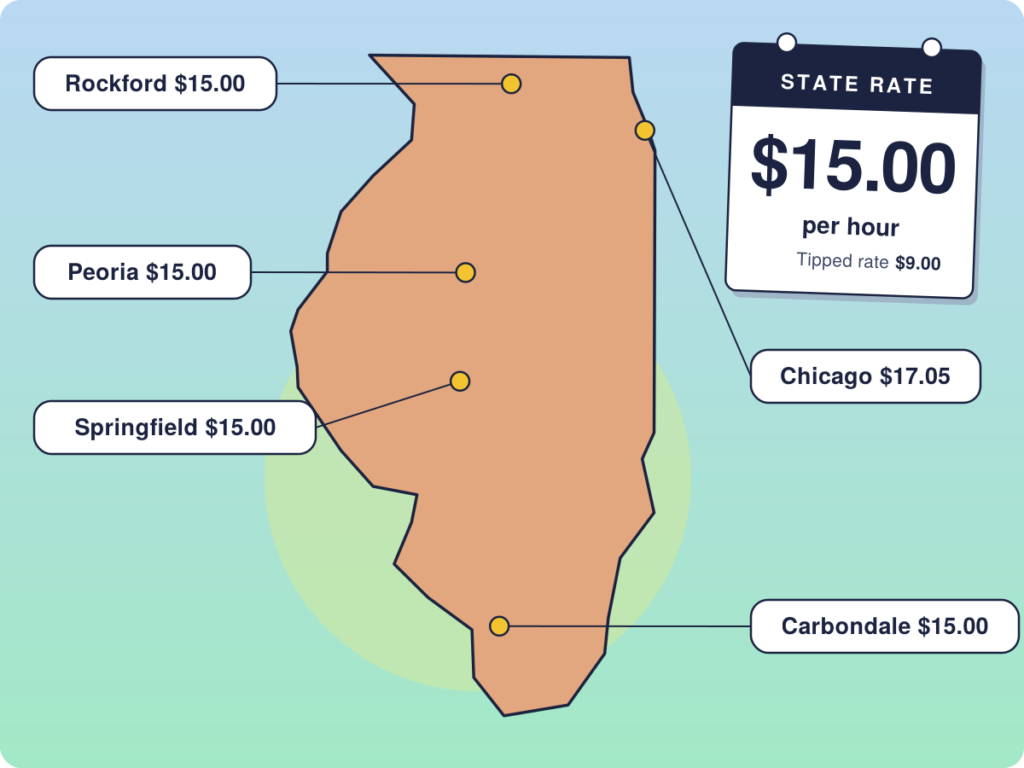
Illinois’ minimum wage is $15.00 per hour for employees 18 and older, $9.00 per hour for tipped employees, and $13.00 per hour for workers under 18 who work fewer than 650 hours in a calendar year. These rates took effect January 1, 2025, and stayed the same for 2026.
The $15.00 rate is the final step of the phased schedule set by the Lifting Up Illinois Working Families Act, signed in 2019. The law raised the state rate from $8.25 to $15.00 over six years and set no automatic increases after that.
Below is a complete employer guide to Illinois minimum wage rules for 2026, 2027, and beyond, including the higher local rates in Chicago and Cook County.
What is the minimum wage in Illinois in 2026?
The Illinois minimum wage in 2026 is $15.00 per hour for employees 18 and older. That rate took effect January 1, 2025, and did not change on January 1, 2026.
Illinois minimum wage rates for 2026:
| Employee type | 2026 rate | Effective date |
|---|---|---|
| Standard (18+) | $15.00 per hour | January 1, 2025 |
| Tipped cash wage | $9.00 per hour | January 1, 2025 |
| Youth (under 18, fewer than 650 hours per year) | $13.00 per hour | January 1, 2025 |
| Chicago (employers with 4+ employees) | $17.05 per hour ($12.96 tipped) | July 1, 2026 |
| Cook County (participating municipalities) | $15.40 per hour ($9.25 tipped) | July 1, 2026 |
Employers must pay the highest rate that applies where the work is performed. Statewide, overtime is due at $22.50 per hour for minimum wage employees who work more than 40 hours in a workweek. Employers can also pay non-tipped new hires 18 and older a $14.50 training wage for their first 90 days.
Illinois minimum wage rate history (2020 to 2026)
Illinois’ minimum wage rose roughly $1.00 every January 1 from 2020 to 2025, with an extra step on July 1, 2020. The tipped cash wage is set at 60% of the standard rate, so it rose in step with every increase.
Illinois minimum wage, tipped cash wage, and youth wage by effective date, 2020 to 2026:
| Effective date | Minimum wage | Tipped cash wage | Youth wage (under 18/650 hrs per year) |
|---|---|---|---|
| January 1, 2020 | $9.25 per hour | $5.55 per hour | $8.00 per hour |
| July 1, 2020 | $10.00 per hour | $6.00 per hour | $8.00 per hour |
| January 1, 2021 | $11.00 per hour | $6.60 per hour | $8.50 per hour |
| January 1, 2022 | $12.00 per hour | $7.20 per hour | $9.25 per hour |
| January 1, 2023 | $13.00 per hour | $7.80 per hour | $10.50 per hour |
| January 1, 2024 | $14.00 per hour | $8.40 per hour | $12.00 per hour |
| January 1, 2025 | $15.00 per hour | $9.00 per hour | $13.00 per hour |
| January 1, 2026 | $15.00 per hour (no change) | $9.00 per hour | $13.00 per hour |
Before 2020, the state rate sat at $8.25 per hour for nearly a decade, from July 1, 2010, through December 31, 2019.
The federal minimum wage remains $7.25 per hour. When state, local, and federal rates differ, employers must pay the highest one, so $15.00 per hour is the floor for most nonexempt adult workers in Illinois.
Sources: IDOL Minimum Wage Law, IDOL Minimum Wage Rates History
Will Illinois’ minimum wage increase in 2027?
No. The statewide rate stays at $15.00 per hour on January 1, 2027. The tipped cash wage stays at $9.00, and the youth rate stays at $13.00.
There is no automatic inflation adjustment. The 2019 law fixed $15.00 as the final step, so the state rate only changes if the General Assembly passes new legislation.
Two things employers should still watch:
- Local rates change July 1, 2027. Chicago and Cook County adjust their minimum wages every July 1.
- Pending state legislation. SB 3821, filed in February 2026, and its House companion HB 5367 would raise the state rate in steps to $27.00 by 2032, index it to inflation after that, and phase out the tip credit. Neither bill had passed the General Assembly as of this writing.
Sources: Chicago BACP Minimum Wage, Illinois General Assembly: SB 3821 bill status, Illinois General Assembly: HB 5367 bill text
Tipped wages, youth wages, and overtime: how to do the math at $15/hr
Illinois lets employers pay tipped employees 60% of the minimum wage in cash, which works out to a maximum tip credit of $6.00 per hour:
- Minimum wage: $15.00/hr
- Less maximum tip credit (40%): $6.00
- Cash wage due: $9.00/hr
If a tipped employee’s cash wage plus tips doesn’t reach at least $15.00 per hour, the employer must pay the difference.
The youth wage and the 650-hour rule
Employees under 18 can be paid $13.00 per hour, but only until they work 650 hours for the same employer within a year. After that, they must be paid the full $15.00 rate for the rest of the year, and the adult rate applies the day they turn 18.
The Illinois Department of Labor counts the 650 hours over the 12 months starting on the worker’s hire date, not January through December. A worker hired April 30 who reaches 650 hours the following April 15 must be paid $15.00 from April 15 on.
A part-time student working 20 hours a week hits 650 hours in about 33 weeks, so a teen hired in the spring can cross the threshold before the end of the year. Track cumulative hours from each youth worker’s hire date, not just by pay period.
Calculating overtime correctly
Illinois requires overtime at 1.5 times the regular rate for hours worked beyond 40 in a workweek, matching the federal Fair Labor Standards Act (FLSA).
Overtime for a tipped employee is calculated on the full $15.00 minimum wage, not the $9.00 cash wage. The tip credit stays fixed at $6.00 per hour on overtime hours.
Illinois overtime rates at state minimum wage:
| Employee type | Regular rate | Overtime rate (1.5x) | Tip credit | Cash overtime rate due |
|---|---|---|---|---|
| Standard hourly employee | $15.00 per hour | $22.50 per hour | $0.00 | $22.50 per hour |
| Tipped employee | $15.00 per hour | $22.50 per hour | $6.00 | $16.50 per hour |
| Youth employee (under 650 hours) | $13.00 per hour | $19.50 per hour | $0.00 | $19.50 per hour |
Calculating tipped overtime as $9.00 × 1.5 ($13.50/hr) underpays by $3.00 per overtime hour.
Chicago and Cook County minimum wages
Chicago and Cook County set their own higher minimum wages, and both adjust every July 1. If you have employees working in either jurisdiction, the local rate applies, not the $15.00 state rate. Chicago’s rate also covers workers under 18, so the state’s $13.00 youth rate isn’t allowed in the city. Cook County’s ordinance covers only workers 18 and older, so the state youth rate still applies to teens in the suburbs.
Local minimum wage rates in Illinois, effective July 1, 2026:
| Jurisdiction | Standard rate | Tipped cash wage | Who it covers |
|---|---|---|---|
| City of Chicago | $17.05 per hour | $12.96 per hour | Employers with 4 or more employees |
| Cook County (outside Chicago) | $15.40 per hour | $9.25 per hour | Employees 18 and older in municipalities that haven’t opted out |
| Rest of Illinois | $15.00 per hour | $9.00 per hour | Statewide rate |
Chicago’s tipped wage phase-out
Chicago’s One Fair Wage Ordinance, passed in 2023, is phasing out the tip credit. A 2026 City Council compromise slowed the schedule: the tip credit is frozen at 24% of the city minimum wage for all employers through June 30, 2028, and the phase-out resumes after that. Because the tipped wage is a percentage of the city minimum, the dollar amount will still change on July 1, 2027, when the standard rate adjusts for inflation.
Chicago overtime for tipped workers follows the same logic as the state math above. At $17.05, the overtime rate is $25.58 per hour, and the cash overtime rate due is $21.49 after the $4.09 tip credit.
Cook County opt-outs
The Cook County ordinance doesn’t apply inside Chicago, and many suburban municipalities have opted out. In opt-out suburbs, the $15.00 state rate applies. The county notes that its opt-out list changes often, so confirm the rule for each work location with the municipality directly.
Sources: Chicago BACP Minimum Wage, Cook County Minimum Wage Ordinance, Cook County MWO FAQ (July 2026)
Illinois minimum wage payroll checklist
The state rate isn’t changing, so most Illinois compliance risk comes from location, age, and local July 1 increases. Use these steps to stay compliant:
- Set rates by work location. Assign each employee the highest rate that applies where they actually work: $17.05 in Chicago, $15.40 in participating Cook County suburbs, or $15.00 elsewhere. Employees who split time across locations need location-based pay codes.
- Track youth hours year to date. Flag employees under 18 as they approach 650 hours with your company in the 12 months since their hire date. Move them to $15.00 once they cross it, and on their 18th birthday. In Chicago, the youth rate does not apply, they must be paid the full $17.05 regardless of age.
- Split pay periods on local increase dates. Minimum wage compliance is based on the date work was performed. July 1, 2027, falls on a Thursday, so most Chicago and Cook County pay periods that week will need hours split between the old and new local rates.
- Example: A biweekly Chicago paycheck with 48 hours worked June 21 to 30, 2026, and 24 hours worked July 1 to 4, 2026, equals (48 × $16.60 = $796.80) + (24 × $17.05 = $409.20) = $1,206.00 in gross wages.
- Update overtime rates. Confirm your time tracking or payroll system calculates minimum wage overtime at $22.50/hr statewide ($16.50/hr cash wage for tipped staff), and at the higher local rates in Chicago and Cook County.
- Display required posters. Post the Illinois Department of Labor minimum wage poster and the federal FLSA poster at every work location. Chicago and Cook County employers must also display the local minimum wage notice and provide it to employees each year.
- Give tip credit notices. Employers using the tip credit must tell tipped employees the cash wage and tip credit amount before applying the credit.
- Review wage compression. Check pay for employees earning between $15.00 and $17.00 per hour, especially if you operate both inside and outside Chicago. A new Chicago hire can out-earn a longer-tenured suburban employee doing the same job.
Employer cost breakdown: wages and payroll tax impact
The statewide rate didn’t change in 2026, so the cost increases this year landed on Chicago and Cook County employers. Moving a full-time Chicago employee from $16.60 to $17.05 per hour adds $936.00 in annual gross wages (40 hours/week × 52 weeks = 2,080 hours).
Employer FICA taxes (6.2% Social Security + 1.45% Medicare = 7.65%) add another $71.60 per year per employee.
Added annual cost of Chicago’s July 1, 2026, increase by number of full-time employees:
| Full-time minimum wage employees | Added annual gross wages | Added employer FICA (7.65%) | Total added annual cost |
|---|---|---|---|
| 1 employee | $936.00 | $71.60 | $1,007.60 |
| 5 employees | $4,680.00 | $358.02 | $5,038.02 |
| 10 employees | $9,360.00 | $716.04 | $10,076.04 |
| 25 employees | $23,400.00 | $1,790.10 | $25,190.10 |
In participating Cook County suburbs, the move from $15.00 to $15.40 adds $832.00 in wages and $63.65 in employer FICA, or $895.65 per full-time employee per year.
The bigger number for multi-location employers is the gap between jurisdictions. A full-time employee in Chicago costs $4,264.00 more in annual wages than the same role at the $15.00 state rate, before payroll taxes.
Illinois unemployment insurance tax applies only to a capped taxable wage base per employee, so these increases won’t raise it for most full-time staff.
How Illinois’ minimum wage rules affect hourly workforces
The $15.00 floor is stable, but the operational impact depends on where your crews work and who you hire:
- Construction and specialty contractors: Crews that move between Chicago, Cook County, and the surrounding counties may owe a different rate on each job. Track hours by job site so labor costs and pay rates follow the work location.
- Field services (HVAC, landscaping, cleaning, pest control): Technicians who spend part of the day on routes inside Chicago or participating Cook County suburbs can trigger the local rate for those hours. Review recurring maintenance contracts that renew around July 1, when local rates change.
- Staffing agencies: Bill rates need to reflect the local rate at each client site, not just the state rate. A $0.45 pay increase requires more than $0.45 in bill rate, since employer taxes and workers’ comp costs rise with wages.
- Restaurants and businesses with tipped staff: Tipped cash wages range from $9.00 statewide to $12.96 in Chicago, and Chicago’s tip credit is frozen at 24% through June 30, 2028, before the phase-out resumes. On slow shifts, check that tips bring every tipped employee up to the full local minimum.
- Retail, grocery, and seasonal employers: Teen workers on the $13.00 youth rate often cross 650 hours during the summer season. Build an hours alert into your scheduling so raises happen on time.
Penalties for noncompliance
Illinois’ minimum wage penalties go well beyond the federal standard. Sections 11 and 12 of the Illinois Minimum Wage Law (820 ILCS 105/12), strengthened in 2019, sets out these consequences:
- Treble damages: An underpaid employee can sue to recover three times the amount of the underpayment, plus court costs and attorney’s fees.
- 5% monthly damages: On top of that, employers owe 5% of the underpayment for every month it remains unpaid.
- State penalty: Employers that violate the law can owe an additional $1,500 penalty to the Illinois Department of Labor’s Wage Theft Enforcement Fund.
- Willful violation penalty: If the underpayment is willful, repeated, or made with reckless disregard of the law, the employer can owe the Illinois Department of Labor up to an additional 20% of the total underpayment.
- Recordkeeping penalty: Failing to keep required payroll records can cost $100 per affected employee.
- Look back period: Employees have 3 years from the date of the underpayment to sue. When the Illinois Department of Labor brings the action, the window is 5 years.
The 5% monthly damages add up fast. A $500 underpayment left unpaid for 12 months generates $300 in monthly damages alone, before trebling and attorney’s fees.
Chicago and Cook County enforce their own ordinances separately, so a single underpayment in Chicago can create both city and state exposure.
Sources: 820 ILCS 105/12, IDOL Minimum Wage Law
Spend less time on admin and more time growing your business
From onboarding to time tracking and payroll, Fingercheck gives hourly teams one platform to manage it all.
Illinois Minimum Wage FAQs
This article is for general informational purposes only and isn’t legal or tax advice. Minimum wage rules can change. Confirm current requirements with the Illinois Department of Labor, your local jurisdiction, or an employment attorney.
Sources
- Illinois Department of Labor: Minimum Wage Law
- Illinois Department of Labor: Minimum Wage Rates History
- City of Chicago BACP: Minimum Wage
- Cook County: Minimum Wage Ordinance and Regulations
- 820 ILCS 105/12
- Illinois General Assembly: SB 3821 bill status
- Illinois Department of Labor: Minimum Wage/Overtime FAQ
- City of Chicago: July 1, 2026 Labor Law Changes
- Cook County Minimum Wage Ordinance FAQ (July 2026)