What Is Time and a Half? How to Calculate It and Who Qualifies
Time and a half is an overtime pay rate equal to 1.
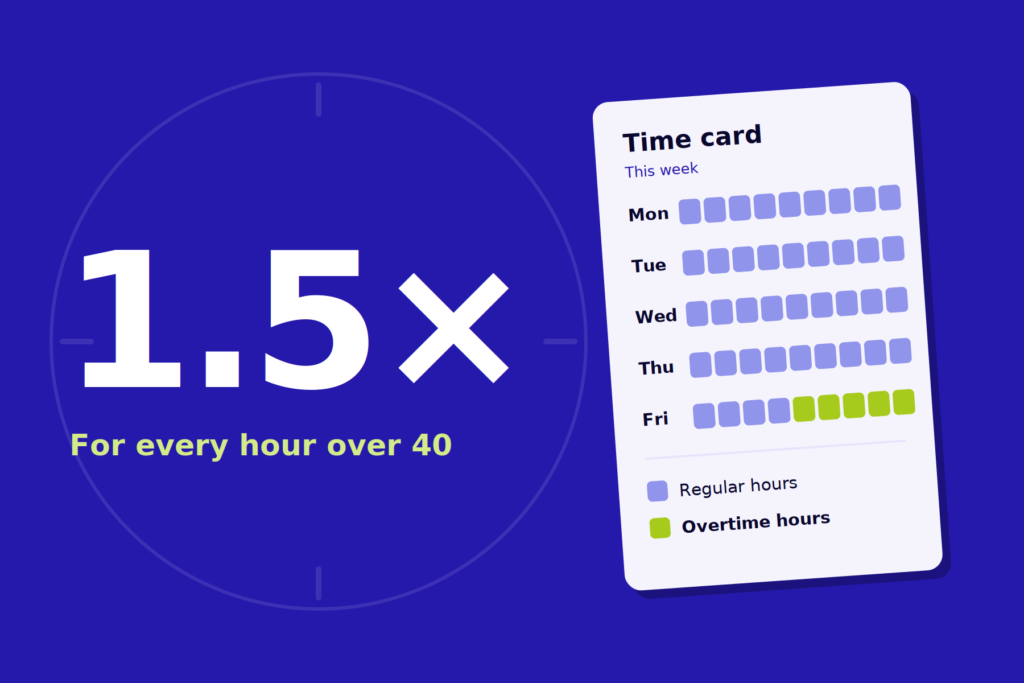
Time and a half is an overtime pay rate equal to 1.5 times an employee’s regular rate of pay, owed to non-exempt employees for every hour worked over 40 in a workweek under the federal Fair Labor Standards Act (FLSA). So an employee who earns $18 an hour makes $27 for each overtime hour.
The math looks simple, and for a straight hourly worker it is. But the rate you multiply by 1.5 isn’t always the base wage, salaried employees can be owed overtime too and a handful of states start the overtime clock before 40 hours. This guide walks through the formula, a quick-reference rate chart, salaried and bonus examples and the 2026 rule changes every employer should know about.
What does time and a half mean?
Time and a half means an employee earns their regular hourly rate plus half of that rate again for each overtime hour. In other words, overtime pays 150% of the regular rate, or 50% more than a normal hour.
The requirement comes from the FLSA, which the U.S. Department of Labor (DOL) enforces. Under the FLSA, covered non-exempt employees must receive overtime pay of at least 1.5 times their regular rate for all hours over 40 in a workweek. You’ll also hear time and a half called overtime pay or the overtime rate. The overtime premium is technically just the extra half: the 0.5x paid on top of straight time for each overtime hour.
A few details trip up a lot of employers:
- The workweek is fixed. A workweek is any fixed, recurring stretch of seven consecutive 24-hour days (168 hours). It doesn’t have to match the calendar week, but you can’t average hours across two weeks. An employee who works 50 hours one week and 30 the next is owed 10 hours of overtime.
- Overtime can’t be waived. An employee can’t agree to skip overtime pay, even in writing.
- The FLSA has no daily limit. Federal law doesn’t cap the hours an adult employee can work or require overtime after a long day. Some states do (more on that below).
What is overtime pay?
Overtime pay is the higher rate a non-exempt employee earns for hours worked past a legal threshold, which is 40 hours in a workweek under the FLSA. Federal overtime starts as soon as an employee passes 40 hours worked in the workweek, not after a set number of hours in a day, unless state law adds a daily trigger. Every federal overtime hour must be paid at time and a half or more.
How much is time and a half?
Time and a half is the regular rate multiplied by 1.5. For an employee who earns $20 an hour, time and a half is $30 an hour. For $25 an hour, it’s $37.50.
Is overtime always time and a half?
Not always. Time and a half is the federal minimum for overtime, but some state laws, union contracts and company policies require double time (2 times the regular rate) in certain situations. California, for example, requires double time after 12 hours in a workday.
How to calculate time and a half for hourly employees
To calculate time and a half, multiply the employee’s regular hourly rate by 1.5, then multiply that overtime rate by the number of overtime hours. Add the result to regular pay for the first 40 hours to get gross pay.
Time and a half formula
Overtime pay = Regular rate × 1.5 × Overtime hours
Example: $18 × 1.5 × 5 overtime hours = $135
Here’s how it works for an employee who earns $18 an hour and works 45 hours in one workweek:
- Find regular pay. Multiply the hourly rate by 40 hours: $18 × 40 = $720.
- Find the time and a half rate. Multiply the hourly rate by 1.5: $18 × 1.5 = $27 per overtime hour.
- Find overtime pay. Multiply the overtime rate by overtime hours: $27 × 5 = $135.
- Add them together. $720 + $135 = $855 in gross pay for the week.
If the overtime hours aren’t whole numbers, convert the minutes to a decimal first. Fifteen minutes is 0.25 hours, 30 minutes is 0.5 hours and 45 minutes is 0.75 hours.
Want to see what overtime costs your business across a whole team? Fingercheck’s free overtime cost calculator runs the numbers for you.
Time and a half rate chart for common hourly wages
Use this chart to look up time and a half and double time for common hourly wages. These figures assume the hourly wage is the employee’s full regular rate (no bonuses or differentials).
Time and a half and double time rates by hourly wage
| Regular hourly rate | Time and a half rate (1.5x) | Pay for 5 overtime hours at 1.5x | Double time rate (2x) |
|---|---|---|---|
| $15.00 | $22.50 | $112.50 | $30.00 |
| $16.00 | $24.00 | $120.00 | $32.00 |
| $16.50 | $24.75 | $123.75 | $33.00 |
| $17.00 | $25.50 | $127.50 | $34.00 |
| $18.00 | $27.00 | $135.00 | $36.00 |
| $19.00 | $28.50 | $142.50 | $38.00 |
| $20.00 | $30.00 | $150.00 | $40.00 |
| $22.00 | $33.00 | $165.00 | $44.00 |
| $25.00 | $37.50 | $187.50 | $50.00 |
| $30.00 | $45.00 | $225.00 | $60.00 |
What is the regular rate of pay for overtime?
The regular rate of pay is the number you multiply by 1.5, and it often isn’t the same as the employee’s base hourly wage. Under the FLSA, the regular rate includes nearly all pay for work in that workweek, such as nondiscretionary bonuses, commissions and shift differentials. Leaving these out is one of the most common overtime mistakes the DOL finds.
A nondiscretionary bonus is one the employee expects based on set criteria, such as a production, attendance or safety bonus. A discretionary bonus, like a surprise holiday gift the employer decides on at its sole discretion, generally stays out of the regular rate. Pay for holidays and vacation days not worked, expense reimbursements and overtime premiums themselves are also excluded.
How to calculate time and a half with a bonus
When a nondiscretionary bonus is earned in the same workweek, add it to straight-time pay, divide by total hours to get the regular rate, then pay an extra half of that rate for each overtime hour.
Say an employee earns $20 an hour, works 45 hours and earns a $90 production bonus that week:
- Total straight-time earnings: ($20 × 45) + $90 = $990
- Regular rate: $990 ÷ 45 hours = $22.00 per hour
- Overtime premium: $22.00 × 0.5 × 5 overtime hours = $55.00
- Gross pay: $990 + $55 = $1,045
Without the bonus in the regular rate, the employer would pay $1,040 ($950 in wages and overtime plus the $90 bonus) and short the employee $5 that week. Five dollars sounds small, but multiplied across a crew and up to three years of back pay, it adds up fast.
Why multiply by 0.5 instead of 1.5? The $990 already paid every hour, overtime hours included, at straight time. Only the extra half is still owed.
How to calculate time and a half for employees with two pay rates
When an employee works two jobs at different rates in the same workweek, the default method is a weighted average regular rate (sometimes called blended or weighted overtime).
Say a home care aide works 30 hours at $18 and 15 hours at $20 in one workweek:
- Total straight-time earnings: ($18 × 30) + ($20 × 15) = $840
- Regular rate: $840 ÷ 45 hours = $18.67 per hour
- Overtime premium: $18.67 × 0.5 × 5 overtime hours = $46.67
- Gross pay: $840 + $46.67 = $886.67
Shift differentials work the same way. A $2 night-shift differential is part of the regular rate, so it raises overtime pay for that workweek.
Do salaried employees get overtime?
Yes, salaried employees can get overtime. A salaried employee is owed time and a half for hours over 40 unless they pass every part of an FLSA exemption test, including earning at least $684 a week. Paying a salary doesn’t make someone exempt on its own, and a fixed salary for a workweek longer than 40 hours doesn’t cover the overtime owed. The calculation depends on how many hours the salary is meant to cover.
How to calculate time and a half on a salary with a fixed schedule
When a salary covers a set number of hours, divide the weekly salary by those hours to get the regular rate, then pay 1.5 times that rate for hours over 40.
Say an office coordinator earns $900 a week for a 40-hour schedule and works 46 hours:
- Regular rate: $900 ÷ 40 hours = $22.50 per hour
- Time and a half rate: $22.50 × 1.5 = $33.75 per hour
- Overtime pay: $33.75 × 6 overtime hours = $202.50
- Gross pay: $900 + $202.50 = $1,102.50
If the salary covers fewer than 40 hours (say 35), the extra hours up to 40 are owed at the straight-time rate, and only hours past 40 get time and a half. Biweekly, monthly and semimonthly salaries need to be converted to a weekly amount first.
Fluctuating workweek method for salaried employees
The fluctuating workweek method applies when a salaried non-exempt employee’s hours change from week to week and both sides clearly understand the salary covers all hours worked, whatever they are. In that case, the regular rate changes every week, and the employer owes an extra half-time premium for overtime hours.
Say a property maintenance tech earns a $1,000 weekly salary for all hours worked and works 50 hours:
- Regular rate: $1,000 ÷ 50 hours = $20 per hour
- Half-time premium: $20 × 0.5 = $10 per overtime hour
- Overtime pay: $10 × 10 overtime hours = $100
- Gross pay: $1,000 + $100 = $1,100
This method only works if the salary never drops when hours fall and the regular rate never falls below minimum wage. Some states, including California and Pennsylvania, don’t allow it, so check state law before using it.
Who qualifies for time and a half?
Non-exempt employees qualify for time and a half; exempt employees don’t. An employee is non-exempt unless they pass every part of an exemption test, so when in doubt, the default is overtime eligibility. Job titles don’t decide it, and neither does paying a salary.
Most exemptions fall under the white-collar categories: executive, administrative, professional, computer and outside sales employees. Except for outside sales and certain professionals like doctors and lawyers, an employee needs to pass all three tests below to be exempt.
Three-part test for the FLSA white-collar overtime exemption
| Exemption test | What the employee must meet | Common pitfall |
|---|---|---|
| Salary basis test | Paid a fixed, predetermined salary that doesn’t change with the quantity or quality of work | Docking pay for partial-day absences can break the salary basis |
| Salary level test | Earns at least $684 per week ($35,568 per year) under federal law | Several states set higher thresholds |
| Duties test | Primary duty is executive, administrative, professional or another exempt type | A “manager” title without real management duties doesn’t count |
What is the overtime salary threshold in 2026?
The federal salary threshold for the white-collar overtime exemption is $684 per week, or $35,568 per year, in 2026. Highly compensated employees earning at least $107,432 a year can be exempt with a lighter duties test.
If you remember a jump to $844 or $1,128 a week, that was the DOL’s 2024 overtime rule. Federal courts in Texas vacated it in November 2024, and the DOL formally rescinded it in a technical amendment effective May 15, 2026, restoring the 2019 thresholds. Employers who raised salaries or reclassified staff in 2024 aren’t required to reverse those changes.
State thresholds can be much higher. California’s exempt salary floor, for example, is tied to twice the state minimum wage and rises every January 1. Always apply whichever rule is more generous to the employee.
Which employees always get time and a half?
The white-collar exemptions never apply to these groups, regardless of pay:
- Hourly employees. An hourly worker earning $45 an hour is still non-exempt.
- Blue-collar workers. Construction workers, mechanics, electricians, plumbers, production line workers and others who do manual work are non-exempt no matter how much they earn.
- First responders. Police officers, firefighters, paramedics, emergency medical technicians and similar roles are non-exempt.
- Salaried employees who fail any test. A salaried employee earning less than $684 a week, or one whose duties don’t qualify, is salaried non-exempt.
A handful of other exemptions exist outside the white-collar rules, such as certain commissioned retail employees and some interstate truck drivers. Fingercheck’s exempt vs. non-exempt guide covers classification in more depth.
Which states require daily overtime or double time?
Four states require overtime based on hours worked in a single day: California, Alaska, Nevada and Colorado. In these states, an employee can earn time and a half before reaching 40 hours in the week. Everywhere else, the federal 40-hour weekly rule is the main trigger for private employers.
Daily overtime rules by state
| State | Daily time and a half trigger | Double time required? |
|---|---|---|
| California | Over 8 hours in a workday, plus the first 8 hours on the seventh consecutive day in a workweek | Yes: over 12 hours in a workday and over 8 hours on the seventh consecutive day |
| Alaska | Over 8 hours in a day (employers with 4 or more employees) | No |
| Nevada | Over 8 hours in a 24-hour period, only for employees earning less than 1.5 times the state minimum wage | No |
| Colorado | Over 12 hours in a workday or 12 consecutive hours | No |
California catches the most employers off guard. Take an employee on a four-day, 10-hour schedule. The weekly total is exactly 40 hours, so no federal overtime is owed, but California law requires 2 hours of daily overtime each day, or 8 overtime hours for the week. California’s labor department has a detailed overtime FAQ on how daily and weekly hours interact.
What is double time pay and how do you calculate it?
Double time pay is 2 times an employee’s regular rate. To calculate double time, multiply the regular rate by 2, then by the number of double time hours. Federal law never requires double time, but California does for hours over 12 in a workday and over 8 on the seventh consecutive workday.
Say a California employee earning $20 an hour works a 14-hour day:
- First 8 hours at the regular rate: $20 × 8 = $160
- Hours 9 through 12 at time and a half: $30 × 4 = $120
- Hours 13 and 14 at double time: $40 × 2 = $80
- Pay for the day: $160 + $120 + $80 = $360
What does double time and a half mean?
Double time and a half is 2.5 times the regular rate. No federal or state law requires it as a general rule; it usually shows up in union contracts or as a company premium for holiday work. Double time (2 times the regular rate) is the highest rate most state laws require.
If your team works across more than one of these states, payroll software that applies overtime rules by work location keeps you from configuring each rule by hand. In Fingercheck, you can set up overtime policies for weekly overtime, daily overtime, double time and seventh-day rules.
How does time and a half work in healthcare under the 8/80 rule?
Hospitals and residential care facilities, including nursing homes, skilled nursing facilities and assisted living facilities, can use the 8/80 rule instead of the standard 40-hour workweek. Under Section 7(j) of the FLSA, these employers can pay time and a half for hours over 8 in a workday and hours over 80 in a fixed 14-day work period.
The 8/80 system needs an agreement or understanding with the employee before the work is performed, and the employer can’t switch an individual employee back and forth between systems. A facility can use 8/80 for some employees and the 40-hour week for others.
Here’s how it plays out for a certified nursing assistant who works one 10-hour shift and 72 other hours in a 14-day period (82 hours total):
- Daily overtime: The 10-hour day includes 2 hours over 8, paid at time and a half.
- Period overtime: 82 total hours minus the 2 daily overtime hours already paid at the premium leaves 80 hours, so no additional overtime is owed.
- Total overtime: 2 hours at time and a half.
Under the standard 40-hour system, the same schedule could produce more overtime if most of those hours landed in one week. The DOL’s healthcare overtime fact sheet also flags two common mistakes in this industry: leaving bonuses and shift differentials out of the regular rate and miscalculating overtime for staff who work two jobs at different rates. Fingercheck’s guide to biweekly overtime explains when a two-week overtime period is allowed.
Skilled nursing and long-term care facilities juggling shift differentials, float staff and 8/80 schedules often run scheduling, time and payroll in separate tools. Fingercheck’s healthcare scheduling connects all three.
Overtime rules for holidays, PTO, comp time and mandatory overtime
Is holiday pay time and a half?
Holiday pay isn’t automatically time and a half under federal law. The FLSA doesn’t require extra pay for working Saturdays, Sundays, holidays or nights unless those hours push the employee over 40 for the workweek. Many employers pay holiday premiums anyway to staff hard-to-fill shifts, and union contracts or state rules can require it.
That’s true for every holiday, including New Year’s Day, Memorial Day, Juneteenth, Independence Day, Labor Day, Veterans Day, Thanksgiving, Christmas Eve and Christmas. Whether employees earn time and a half for working a holiday comes down to company policy, an employment or union contract or, in a few places, state or local law. If you offer holiday premium pay, put the rate and the eligible holidays in writing so payroll applies it the same way every time.
Do paid holidays and PTO count toward the 40-hour overtime threshold?
No. Under the FLSA, hours paid but not worked (holidays, vacation, sick days) don’t count as hours worked toward the 40-hour overtime threshold. An employee who takes a paid holiday Monday and works 40 hours Tuesday through Saturday has 40 hours worked, not 48, so no federal overtime is due. A company policy can count them if you choose.
Can a private employer give comp time instead of time and a half?
No. Private-sector employers can’t give compensatory time off (comp time) in place of overtime pay. Comp time is limited to public agencies such as state and local governments. A private employer can adjust an employee’s schedule within the same workweek to keep hours at 40 or under, but not across workweeks.
Can an employer require mandatory overtime?
Yes, mandatory overtime is legal under federal law. The FLSA doesn’t limit how many hours an employee 16 or older can be required to work, and an employer can discipline an employee who refuses, as long as every hour over 40 is paid at time and a half. There are exceptions: more than a dozen states restrict mandatory overtime for nurses (often in hospital settings), union contracts can limit it and federal hours-of-service rules cap driving time for commercial truck drivers.
Do employers have to pay overtime that wasn’t approved?
Yes. If an employer knows or has reason to know an employee is working, those hours count, including unapproved overtime, answering texts after a shift or prep work before clocking in. You can discipline an employee for breaking an overtime approval policy, but you still have to pay for the time. Accurate time tracking that flows straight into payroll is the simplest way to catch overtime before it becomes a dispute.
Is time and a half taxed? The no tax on overtime deduction
Yes, time and a half is still taxed like regular wages, but employees may be able to deduct part of it. The One Big Beautiful Bill Act (OBBBA) created a federal income tax deduction for qualified overtime compensation for tax years 2025 through 2028, often called “no tax on overtime.”
Here’s what employers and employees should know:
- Only the “half” counts. Qualified overtime compensation is the FLSA-required premium above the regular rate, not the full overtime paycheck. An employee earning $20 an hour who works 5 overtime hours gets $150 in overtime pay, but only $50 (5 hours × the $10 premium) is qualified overtime.
- The deduction is capped. Employees can deduct up to $12,500 a year ($25,000 for joint filers), phasing out once modified adjusted gross income passes $150,000 ($300,000 joint).
- Only FLSA-required overtime qualifies. Premiums paid only because of state law, a union contract or company policy (like California daily overtime or holiday double time) don’t qualify. When an employer pays more than required, only the amount the FLSA requires counts.
- Withholding doesn’t change. Overtime is still subject to federal income tax withholding, Social Security, Medicare and unemployment taxes.
What employers must report for overtime on 2026 Forms W-2
Starting with tax year 2026, employers must report total qualified overtime compensation on Form W-2 in Box 12 using Code TT. Employees can generally deduct only what’s reported there, so an error on your end directly affects their tax return. Report the full qualified amount even if it exceeds the employee’s deduction cap, and file a Form W-2c if you find a mistake.
That means payroll needs to separate the FLSA premium from the rest of overtime pay every workweek, on top of handling the regular rate correctly. The IRS covers the details in its qualified overtime FAQs.
Fingercheck’s guide to how overtime is reported on the W-2 walks through Box 12, Code TT with examples. Fingercheck payroll calculates the FLSA premium every pay period and prints Code TT on each W-2 that needs it.
What happens if an employer doesn’t pay time and a half?
Unpaid overtime is expensive to fix. An employer that misclassifies employees or miscalculates overtime can owe:
- Back wages for up to two years, or three years if the violation was willful.
- Liquidated damages, typically an additional amount equal to the back wages owed, which doubles the bill.
- The employee’s attorney’s fees and court costs if the employee wins a lawsuit.
- Civil money penalties of up to $2,515 per violation for repeated or willful violations.
Because back wages are calculated per employee and per workweek, a small error repeated every pay period can turn into a five- or six-figure liability. Employers who find a problem on their own can self-report through the DOL’s PAID program to resolve potential overtime violations. Talk to an employment attorney before you do.
Paying time and a half correctly for hourly teams
Time and a half starts with a simple 1.5x multiplier, but getting it right every pay period means tracking every hour, folding bonuses and differentials into the regular rate, applying the right state rules and now separating the FLSA premium for W-2 reporting. For a business with hourly crews, shift workers or staff in more than one state, that’s a lot to manage in a spreadsheet.
When time tracking and payroll live in the same system, approved hours flow straight into each pay run with overtime rules already applied. That frees up hours every payroll and lowers the risk of a costly back-pay claim.
Overtime calculated from the time clock to the paycheck
Fingercheck calculates overtime automatically from every punch, with bonuses, shift differentials and state rules built in, so every paycheck and W-2 is right without the spreadsheet.
Time and a Half FAQs
Fingercheck and any related entities do not offer tax, accounting, or legal advice. This article is for general information only, and overtime and tax rules vary by state. Talk to a qualified employment attorney or payroll professional about your specific situation.