Massachusetts minimum wage increase 2026: What employers need to know
Massachusetts’ minimum wage is $15 per hour for most employees, and no increase is scheduled for 2027.
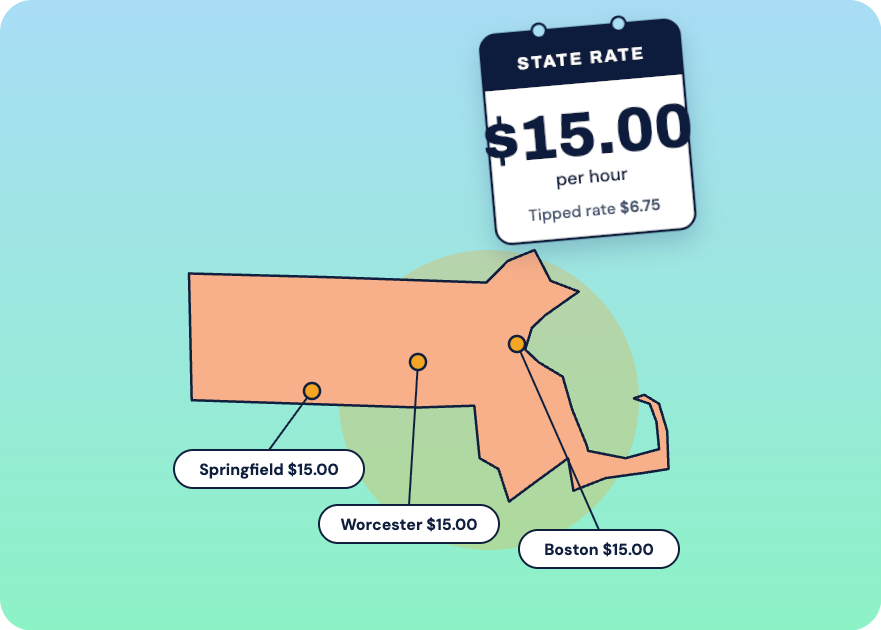
Massachusetts’ minimum wage is $15 per hour for most employees, and no increase is scheduled for 2027. The rate has been the same since January 1, 2023, and it applies to every employer in the state, regardless of size.
Tipped employees can be paid a service rate of $6.75 per hour, as long as tips bring them to at least $15.00. Agricultural workers have a separate minimum of $8.00 per hour. Massachusetts cities and towns do not set their own minimum wages, so Boston, Worcester, and Springfield all follow the state rate.
Below is a complete employer guide to Massachusetts’ minimum wage for 2026 and 2027, including tipped and overtime math, the state’s other pay rules, and a payroll checklist. For other states, see our minimum wage by state guide.
Massachusetts minimum wage rate history (2015 to 2026)
Massachusetts raised its minimum wage almost every year from 2015 to 2023, reaching $15.00 on January 1, 2023. It hasn’t changed since, because the state does not adjust its rate for inflation.
Massachusetts minimum wage and tipped service rate by effective date:
| Effective date | Minimum wage | Tipped service rate |
| January 1, 2023 (current) | $15.00/hr | $6.75/hr |
| January 1, 2022 | $14.25/hr | $6.15/hr |
| January 1, 2021 | $13.50/hr | $5.55/hr |
| January 1, 2020 | $12.75/hr | $4.95/hr |
| January 1, 2019 | $12.00/hr | $4.35/hr |
| January 1, 2017 | $11.00/hr | $3.75/hr |
| January 1, 2016 | $10.00/hr | $3.35/hr |
| January 1, 2015 | $9.00/hr | $3.00/hr |
While Massachusetts held steady, its neighbors kept rising. In 2026, Connecticut ($16.94), Rhode Island ($16.00), and Maine ($15.10) all pay more than Massachusetts’ $15.00. The federal minimum wage is still $7.25.
Source: Massachusetts Attorney General’s Office; U.S. DOL state minimum wage table.
Will Massachusetts’ minimum wage increase in 2027?
No increase is scheduled. Massachusetts’ minimum wage stays at $15.00 per hour in 2027 unless the legislature passes a new law or voters approve a ballot question.
Here’s where things stand:
- The $20 bill stalled. Bills in the 2025 to 2026 session (including S 1349) would have raised the minimum wage to $16.25 in 2026 and $20.00 by 2029, then tied it to inflation. The tipped service rate would have become 60% of the minimum wage. The bill didn’t pass before formal sessions ended.
- It’s not on the 2026 ballot. None of the nine questions on the November 3, 2026, ballot deals with the minimum wage.
- Voters kept the service rate in 2024. Question 5 in 2024, which would have phased out the tipped service rate, was rejected.
Advocates, including the Raise Up Massachusetts coalition, are expected to refile when the new legislative session begins in January 2027. A ballot campaign for 2028 is also possible.
Who must be paid the Massachusetts minimum wage?
Nearly every employee in Massachusetts must be paid at least $15.00 per hour. Massachusetts law presumes that workers are employees, so the minimum wage applies broadly, including to part-time, seasonal, and temporary staff.
The main exceptions are:
- Agricultural workers: $8.00 per hour is the minimum for most agricultural workers.
- Tipped employees: A $6.75 service rate, covered in the next section.
- Members of a religious order
- Workers in training at certain educational, nonprofit, or religious organizations
- Outside salespeople
Massachusetts has no lower rate for small businesses, minors, or students. A 16-year-old part-timer earns the same $15.00 as a full-time adult.
There are also no city or county minimum wages in Massachusetts. The state rate applies everywhere, from Boston to the Berkshires.
Tipped wages and overtime: how to do the math in Massachusetts
Massachusetts employers can pay tipped employees a service rate of $6.75 per hour (a tip credit of $8.25), as long as the service rate plus tips adds up to at least $15.00 for every shift. The service rate applies to employees who serve customers and earn more than $20 a month in tips.
Massachusetts’ tip rules are stricter than federal law:
- The check is per shift. Hourly pay plus tips must average $15.00 for each shift, not just across the workweek.
- Managers can’t share tips. Owners and employees with managerial or supervisory duties on a given day can’t take any tips.
- Tip pools are limited. Only wait staff, service bartenders, and other service employees can be in a tip pool.
- Service charges belong to staff. A service charge on a customer’s bill must be given to the wait staff, service bartenders, or service employees unless the bill clearly says it isn’t a tip.
Massachusetts overtime rules
Most Massachusetts employees earn 1.5 times their regular rate for hours over 40 in a workweek. Massachusetts has no daily overtime, and since 2023, retail employers no longer owe premium pay for Sundays and most holidays.
Massachusetts overtime rates at the minimum wage:
| Employee type | Regular rate | Overtime rate (1.5x) | Tip credit | Cash overtime rate due |
| Standard hourly employee | $15.00/hr | $22.50/hr | $0.00 | $22.50/hr |
| Tipped employee (service rate) | $15.00/hr | $22.50/hr | $8.25 | $14.25/hr |
For employees paid the service rate, overtime is based on the full $15.00 minimum wage, not the $6.75 service rate. Calculating tipped overtime as $6.75 x 1.5 ($10.13/hr) underpays by $4.12 per overtime hour.
Health care note: Massachusetts’ own overtime law exempts hospitals, nursing homes, and rest homes. But federal law still applies to these employers, so they must pay overtime after 40 hours, or use the federal 8 and 80 system if employees agree.
Other Massachusetts pay rules hourly employers need to know
Massachusetts has several pay rules that go beyond the minimum wage, and each one affects how you schedule and pay hourly staff:
| Rule | What it requires |
| Reporting pay | If an employee scheduled for 3 or more hours is sent home early, pay at least 3 hours at minimum wage. |
| Meal breaks | Employees who work more than 6 hours get a 30-minute meal break. If they must stay on duty, the break is paid. |
| Earned sick time | Employees earn 1 hour of sick time for every 30 hours worked, up to 40 hours a year. It’s paid for employers with 11 or more employees. |
| Pay frequency | Hourly employees must be paid weekly or biweekly, within 6 or 7 days after the pay period ends. |
| Final pay | Employees who are fired or laid off are paid in full on their last day. Employees who quit are paid by the next regular payday. |
| Pay stubs | Every pay statement must show the employer’s name, the dates covered, hours worked, hourly rate, and all deductions. |
| Payroll records | Keep payroll records for 3 years, including each employee’s daily and weekly hours. |
Final pay is where many employers slip. Paying a terminated employee on the next regular payday, which is fine in many states, violates the Massachusetts Wage Act.
Massachusetts exempt salary threshold
Salaried employees in Massachusetts must earn at least $684 per week ($35,568 per year) to be exempt from overtime. Massachusetts has no higher state threshold, so the federal level applies.
| Exemption | Minimum salary |
| Executive, administrative, and professional | $684/week ($35,568/yr) |
| Highly compensated employees | $107,432/yr total pay |
he Department of Labor’s 2024 rule that would have raised these levels was struck down in November 2024, so the 2019 levels still apply. The employee must also pass the duties test for the exemption. Misclassifying an hourly role as exempt is a common Wage Act claim in Massachusetts, so review job duties, not just pay.
Massachusetts minimum wage payroll checklist
Massachusetts’ rate isn’t changing in 2027, but its pay rules leave little room for error. Use these eight steps to stay compliant:
- Set $15.00 as your system minimum. Use $8.00 only for eligible agricultural workers and $6.75 only for eligible tipped staff.
- Check tipped pay every shift. Service rate plus tips must reach $15.00 per shift, not just per week. Pay the difference on any short shift.
- Calculate tipped overtime on $15.00. The cash overtime rate for service-rate employees is $14.25 per hour.
- Keep managers out of tip pools. Anyone with managerial or supervisory duties that day can’t receive tips.
- Track reporting pay. Flag shifts of 3 or more scheduled hours that end early, and pay at least 3 hours.
- Set up same-day final pay. Build a process to pay terminated or laid-off employees in full, including accrued vacation, on their last day.
- Track earned sick time. Accrue 1 hour per 30 hours worked, up to 40 hours a year.
- Display the required posters. Post the Massachusetts Wage & Hour Laws poster from the Attorney General’s Office and the federal FLSA poster where employees can easily see them.
How Massachusetts’ minimum wage affects hourly workforces
With one statewide rate and no local rates, the minimum wage itself is simple in Massachusetts. The real payroll risks come from tips, schedules, and final pay:
- Health care and long-term care: Nursing homes and rest homes are exempt from state overtime but not federal overtime, so pay overtime after 40 hours (or use 8 and 80). Reporting pay applies when shifts are cut short, which is common with census-driven staffing.
- Restaurants and hospitality: Check service rate plus tips every shift, not every week. Keep managers and supervisors out of tip pools, and give service charges to the staff who earned them.
- Retail: Sunday and holiday premium pay ended in 2023, so make sure your system isn’t still adding it. Short shifts still trigger 3-hour reporting pay.
- Construction and field services: Track hours by job site, since crews often cross into neighboring states with different rates. Public construction projects pay prevailing wage rates, not the minimum.
- Staffing agencies: Temporary workers have their own rights under Massachusetts law, including notice of pay rate and job details. Bill rates should cover reporting pay and earned sick time.
Penalties for noncompliance
Massachusetts has some of the strongest wage laws in the country. Under the Massachusetts Wage Act:
- Triple damages are automatic. Employees who win a wage claim receive three times their unpaid wages, plus attorney’s fees and costs. Courts don’t have discretion to lower this, even for honest mistakes.
- Individual liability: The company’s president, treasurer, and officers or agents who manage the business can be held personally liable for unpaid wages.
- Three years to sue: Employees generally have 3 years from the violation to file a claim.
- Attorney General enforcement: The Fair Labor Division can issue citations with civil penalties and bring criminal charges for serious violations.
- No retaliation: Employers can’t punish employees for complaining about pay, and retaliation brings its own damages.
Because even a small error, like paying a terminated employee a few days late, can trigger triple damages, accurate time tracking and payroll timing are the best protection.
Pay Massachusetts hourly teams correctly with Fingercheck
In Massachusetts, a small payroll mistake can cost three times the wages owed. Fingercheck brings time tracking, scheduling, and payroll together for hourly teams, so per-shift tip checks, reporting pay, sick time, and final paychecks are handled accurately and on time.
Spend less time on admin and more time growing your business
From onboarding to time tracking and payroll, Fingercheck gives hourly teams one platform to manage it all.
Massachusetts minimum wage FAQs for employers
This article is for general informational purposes only and isn’t legal or tax advice. Minimum wage rules can change. Confirm current requirements with the Massachusetts Attorney General’s Fair Labor Division or an employment attorney.
Sources
- Massachusetts Attorney General: Massachusetts Wage & Hour Laws poster
- Mass.gov: Massachusetts law about minimum wage
- U.S. DOL: State Minimum Wage Laws
- Ballotpedia: Massachusetts 2026 ballot measures
- Massachusetts General Laws, Chapter 149 (Wage Act) and Chapter 151 (Minimum Fair Wages)
- U.S. Department of Labor: FLSA Employee Rights poster (WH1088)