Virginia Minimum Wage 2026: What Employers Need to Know
Virginia’s minimum wage climbs to $15 an hour by 2028, and farm workers gain coverage on January 1, 2027.
Virginia’s minimum wage climbs to $15 an hour by 2028, and farm workers gain coverage on January 1, 2027.
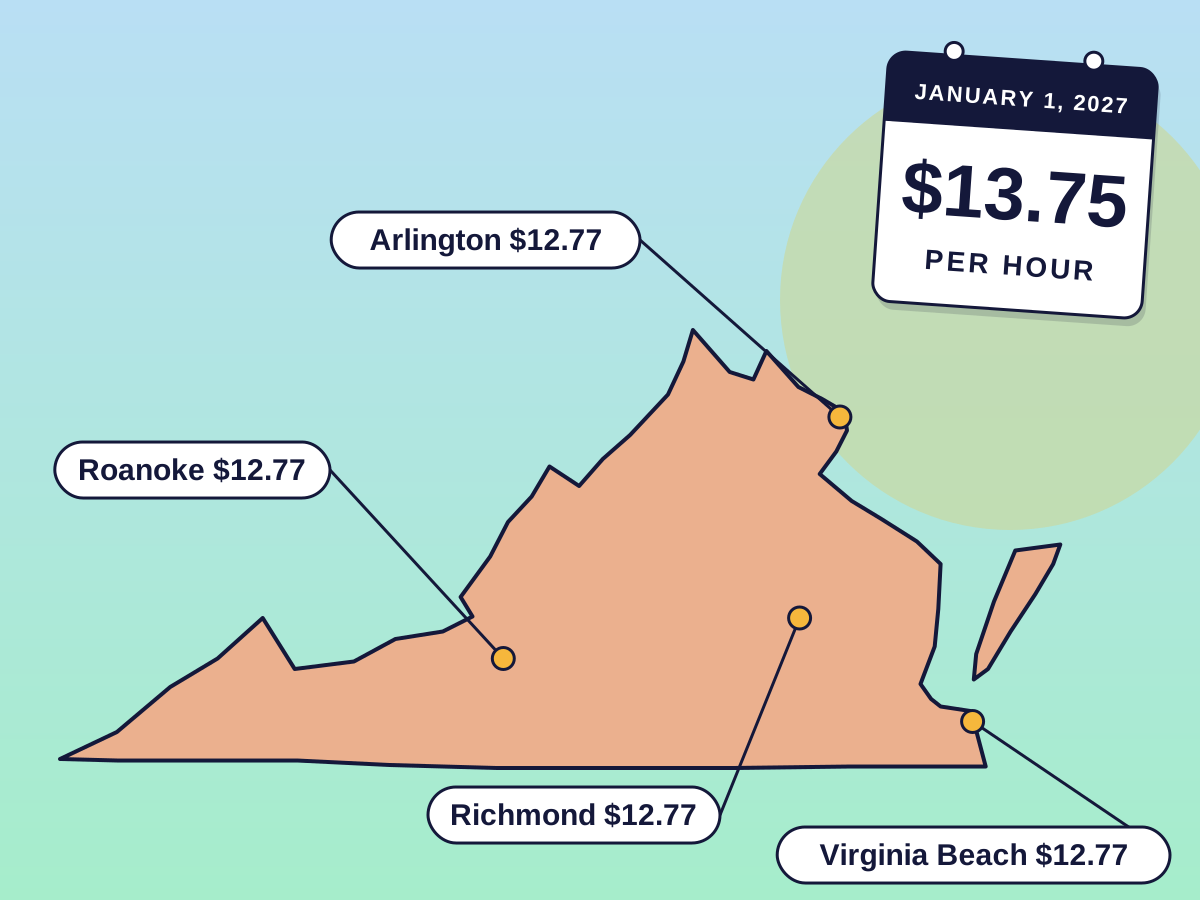
The Virginia minimum wage is $12.77 per hour in 2026. It rises to $13.75 on January 1, 2027, and to $15.00 on January 1, 2028, under HB 1 and SB 1, which Governor Abigail Spanberger signed in April 2026. Starting in 2029, the rate adjusts each year for inflation.
The raise is only part of the story for Virginia employers. The 2026 General Assembly also brought farm workers under the minimum wage, gave the Virginia Department of Labor and Industry (DOLI) authority to enforce overtime and made minimum wage violations eligible for double or triple damages. This guide covers the current and upcoming rates, tipped pay for servers, who’s exempt, local rules in cities like Richmond and Arlington, overtime and the paperwork that keeps your payroll compliant.
What is the minimum wage in Virginia in 2026?
Virginia’s minimum wage is $12.77 per hour from January 1, 2026, through December 31, 2026. The rate comes from the Virginia Minimum Wage Act, specifically Va. Code § 40.1-28.10, and it’s well above the federal minimum wage of $7.25. Virginia law requires you to pay whichever rate is higher, so the state rate is the one that counts.
The rate applies the same way across the state, whether you run a two-person landscaping crew or a 300-person staffing agency. DOLI’s 2026 minimum wage notice makes this clear: the Virginia Minimum Wage Act doesn’t exempt anyone based on the size of their employer. Part-time and seasonal employees are covered too, unless they fall into one of the specific exemptions covered later in this guide.
Virginia minimum wage rates, tipped wages and overtime, 2025 to 2028
| Effective date | Virginia minimum wage (per hour) | Tipped employee cash wage (per hour) | Maximum tip credit (per hour) | Overtime rate at minimum wage (1.5×, per hour) | Yearly pay at minimum wage (40 hours a week, 52 weeks) |
|---|---|---|---|---|---|
| January 1, 2025 | $12.41 | $2.13 | $10.28 | $18.62 | $25,812.80 |
| January 1, 2026 (current) | $12.77 | $2.13 | $10.64 | $19.16 | $26,561.60 |
| January 1, 2027 | $13.75 | $2.13 | $11.62 | $20.63 | $28,600.00 |
| January 1, 2028 | $15.00 | $2.13 | $12.87 | $22.50 | $31,200.00 |
| January 1, 2029 and later | Adjusted each year for inflation | $2.13 | Varies | Varies | Varies |
Overtime rates are rounded up to the nearest cent, since paying even a fraction of a cent below 1.5 times the regular rate falls short. The 2027 and 2028 tipped cash wage reflects DOLI’s current guidance, which follows the federal $2.13 tip credit rule.
When will the minimum wage go up in Virginia?
Virginia’s minimum wage goes up on January 1, 2027, to $13.75 per hour. That’s a $0.98 raise, or about 7.7%. One year later, on January 1, 2028, it reaches $15.00. Both dates are written directly into the Code of Virginia, so no separate DOLI announcement is needed before they take effect.
How Virginia got to $15 per hour
Until 2021, Virginia simply followed the federal minimum wage. A 2020 law set a path to $12.00 by 2023, but the steps to $13.50 and $15.00 needed the General Assembly to vote on them again by July 1, 2024. That vote never produced a law. Governor Glenn Youngkin vetoed $15 minimum wage bills in 2024 and 2025, so the rate switched to annual inflation adjustments instead.
In 2026, a new General Assembly passed HB 1 and SB 1 again, and Governor Spanberger signed them on April 9, 2026. The new law locked in $12.77 for 2026 and set fixed raises for 2027 and 2028.
Virginia minimum wage history and future schedule
| Effective date | Virginia minimum wage (per hour) | How the rate was set |
|---|---|---|
| Before May 1, 2021 | $7.25 | Matched the federal minimum wage |
| May 1, 2021 | $9.50 | 2020 legislation (HB 395 / SB 7) |
| January 1, 2022 | $11.00 | 2020 legislation |
| January 1, 2023 | $12.00 | 2020 legislation (also applied in 2024) |
| January 1, 2025 | $12.41 | Inflation adjustment by DOLI |
| January 1, 2026 | $12.77 | 2.9% inflation adjustment, later written into law by HB 1 / SB 1 |
| January 1, 2027 | $13.75 | HB 1 / SB 1 (2026) |
| January 1, 2028 | $15.00 | HB 1 / SB 1 (2026) |
| January 1, 2029 and later | Set each year by DOLI | Inflation adjustment based on the prior year’s CPI-U |
What happens to the Virginia minimum wage after 2028?
Starting in 2029, the rate goes back to automatic yearly increases. By October 1 of each year, beginning in 2028, the Commissioner of Labor and Industry sets the next year’s rate by adding the prior year’s increase in the Consumer Price Index for All Urban Consumers (CPI-U). The law doesn’t allow the adjustment to drop below zero, so the rate can stay flat in a low-inflation year but can’t go down.
That gives Virginia employers about three months’ notice each fall from 2028 on. Mark early October on your calendar so you can update pay rates, job postings and payroll settings before January 1.
Which Virginia employees are exempt from the state minimum wage?
Most Virginia employees are covered, but the Virginia Minimum Wage Act lists specific groups who aren’t. The full list lives in Va. Code § 40.1-28.9, and it’s narrower than many employers expect. In 2026, these workers are exempt from the Virginia minimum wage:
- Farm laborers and farm employees (through December 31, 2026 only)
- Volunteers for educational, charitable, religious or nonprofit organizations, where no real employer-employee relationship exists
- Golf course caddies
- Outside salespeople who work on commission, plus taxicab drivers and operators
- Workers under 18 employed by their parent or legal guardian
- Summer camp employees
- Anyone under age 16, regardless of who employs them
- Students in a bona fide educational program
- Full-time students under 18 who work no more than 20 hours per week
- Full-time students of any age in a work-study program at their own school
- Babysitters who work fewer than 10 hours per week
- Au pairs in the U.S. Department of State’s exchange visitor program
- Temporary foreign workers under 20 C.F.R. Part 655, which includes H-2A and H-2B workers
- Workers at seasonal amusement or recreational businesses that are exempt from the federal minimum wage
A few groups are worth a closer look. Home care providers, including home health aides and personal care aides, are specifically covered by the law. Babysitters who work 10 or more hours a week are covered too. The student exemption is also tighter than it sounds: a full-time college student who’s 19 and works 15 hours a week at your restaurant still earns the full minimum wage.
Keep in mind that an exemption from Virginia’s law doesn’t always mean an exemption from federal law. If a worker is exempt under Virginia’s list but covered by the Fair Labor Standards Act (FLSA), you still owe at least $7.25 per hour.
Virginia farm workers get the minimum wage starting January 1, 2027
Farm laborers have been left out of the Virginia Minimum Wage Act since it passed in 1975. That changes on January 1, 2027, under HB 20 and SB 121, which remove the farm worker exemption. From that date, farm employees must earn at least $13.75 per hour, and $15.00 in 2028.
One detail trips people up: the exemption for temporary foreign workers under 20 C.F.R. Part 655 stays in place. H-2A agricultural workers are still exempt from the Virginia rate, though federal H-2A program rules set their own wage requirements. If you run a farm, orchard, nursery or agricultural staffing business, plan this change as a separate payroll project, not just a rate update.
What is the minimum wage for servers and tipped employees in Virginia?
Virginia employers can pay servers, bartenders and other tipped employees a cash wage of $2.13 per hour, as long as tips bring each employee up to the full $12.77 minimum wage. DOLI follows the federal “tip credit” rules here, so the most you can count toward the minimum wage from tips is $10.64 per hour in 2026. That maximum tip credit grows to $11.62 in 2027 and $12.87 in 2028, while the cash wage stays at $2.13.
That growing tip credit matters for restaurants and bars. On a slow week, you cover more of the shortfall out of pocket as the minimum wage rises.
Who counts as a tipped employee in Virginia?
Under Virginia law, a tipped employee is someone who customarily and regularly receives more than $30 a month in tips. Servers, bartenders, bussers and food runners often qualify. Employees who are barred by law from soliciting tips can’t be classified as tipped, even if customers hand them cash now and then.
How do Virginia employers calculate tip makeup pay?
If an employee’s cash wage plus the tips they received doesn’t reach the minimum wage for the workweek, you pay the difference. Here’s how it works for a server who works 30 hours in a week in 2026:
- Minimum wage owed for the week: 30 hours × $12.77 = $383.10
- Cash wages paid: 30 hours × $2.13 = $63.90
- Tips reported for the week: $250.00
- Cash wages plus tips: $63.90 + $250.00 = $313.90
- Tip makeup pay owed: $383.10 − $313.90 = $69.20
If that same server reports $400 in tips, the total reaches $463.90, and no makeup pay is due. Accurate tip reporting every shift is what makes this math reliable, so it helps to capture declared tips where employees clock out.
How does overtime work for tipped employees in Virginia?
Overtime for tipped employees is based on the full minimum wage, not the $2.13 cash wage. In 2026, the overtime rate is $19.16 per hour ($12.77 × 1.5, rounded up). Subtract the $10.64 tip credit, and you owe at least $8.52 per hour in cash wages for each overtime hour.
What are the tip pooling rules in Virginia?
Virginia doesn’t have its own tip pooling statute, so federal FLSA rules apply. Owners, managers and supervisors can’t keep any part of employees’ tips, whether or not you take a tip credit. If you take a tip credit, the tip pool can include only employees who customarily receive tips, such as servers, bartenders and bussers. Cooks and dishwashers can share in a mandatory pool only if you pay everyone the full $12.77 minimum wage. Before taking a tip credit, you also have to tell tipped employees how it works. The U.S. Department of Labor’s Fact Sheet #15 covers the notice requirements in detail.
Do Virginia cities like Richmond, Arlington or Virginia Beach have their own minimum wage?
No. Every city and county in Virginia uses the state minimum wage of $12.77 per hour in 2026 and $13.75 in 2027. That includes Richmond, Virginia Beach, Norfolk, Chesapeake, Arlington County, Alexandria, Fairfax County, Loudoun County, Roanoke and every other locality.
The reason is the Dillon Rule, a legal principle Virginia follows closely. Under it, local governments only have the powers the General Assembly gives them, and the General Assembly has never given cities or counties the power to set a minimum wage for private employers. Northern Virginia lawmakers have proposed bills to change that several times, but none has passed.
Some Virginia localities, including Alexandria, do set living wage requirements for their own employees and for businesses that hold certain city service contracts. Those rules only apply if you’re working under one of those contracts. If you bid on local government work, check the contract terms for a living wage clause.
How does the Virginia minimum wage compare to DC and Maryland?
For employers in Northern Virginia, the bigger difference is across the river. Washington, D.C.’s minimum wage is $18.40 per hour as of July 1, 2026, and it adjusts every July 1. Maryland’s statewide minimum wage is $15.00, and some Maryland counties, such as Montgomery County, set higher local rates.
If your crews or staff work on both sides of the Potomac, the rate depends on where the work happens and each jurisdiction’s coverage rules. D.C.’s minimum wage, for example, covers employees who regularly spend more than half their working time in the District, or who are based there and don’t spend more than half their time in any one state. Time tracking that records each job location gives you the data to sort this out before payroll runs, instead of after a claim.
How does overtime work in Virginia?
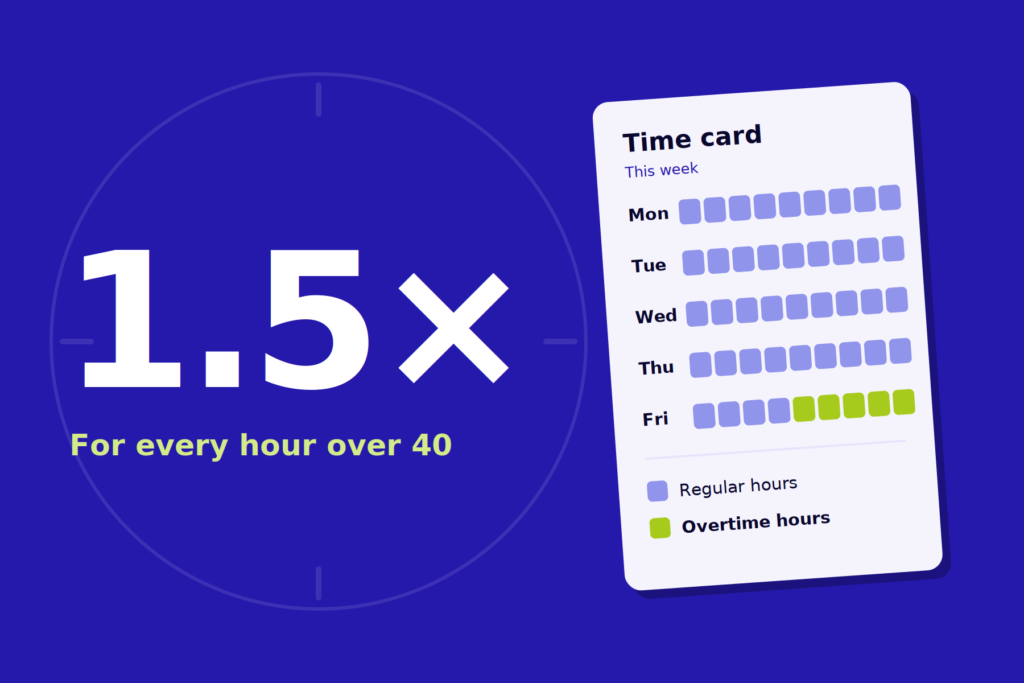
Virginia employers must pay nonexempt employees 1.5 times their regular rate for every hour worked over 40 in a workweek. That’s set by the Virginia Overtime Wage Act, Va. Code § 40.1-29.2, which since 2022 follows the federal FLSA for how to calculate the regular rate and which employees are exempt. Virginia doesn’t require daily overtime, so a 10-hour shift doesn’t trigger overtime on its own if the week stays at 40 hours or less.
The regular rate isn’t always the same as an employee’s hourly wage. Nondiscretionary bonuses, shift differentials and production incentives get folded into the regular rate before you multiply by 1.5. For an employee earning the 2026 minimum wage with no extra pay, the overtime rate is $19.16 per hour, rising to $20.63 in 2027.
Two 2026 changes raise the stakes on overtime. Since July 1, 2026, DOLI can investigate and enforce overtime claims for wages earned on or after that date. Before then, workers had to go to the U.S. Department of Labor or file a lawsuit. Under HB 238, overtime violations also now carry the same double and triple damages as other unpaid wage claims.
What is the minimum salary for exempt employees in Virginia?
Virginia doesn’t set its own salary threshold for exempt employees. It follows the federal FLSA, which currently requires executive, administrative and professional employees to earn at least $684 per week ($35,568 per year) on a salary basis to be exempt from overtime. A 2024 federal rule tried to raise this threshold, but a federal court struck it down nationwide, and in May 2026 the Department of Labor formally rescinded that rule and restored the $684 level. Employees also have to pass the duties tests for their role, so a job title and a salary alone don’t make someone exempt.
If you’re unsure where a role falls, Fingercheck’s guide to exempt vs. non-exempt employees walks through the duties tests.
Do domestic workers get overtime in Virginia?
Not yet. Domestic service workers, such as nannies, housekeepers and home health aides employed in private homes, are currently exempt from Virginia’s overtime requirement, though federal overtime rules may still apply. HB 27 and SB 28 would remove that exemption on July 1, 2028, but only if the 2027 General Assembly votes to reenact them.
What are Virginia’s rules for paydays, pay stubs and final paychecks?
Paying the right rate is only half of minimum wage compliance. The Virginia Wage Payment Act, Va. Code § 40.1-29, also controls when you pay, what goes on each pay stub and how long you keep records.
How often do Virginia employers have to pay employees?
Hourly employees must be paid at least every two weeks or twice a month. Salaried employees can be paid monthly. Two narrow groups of employees can move to monthly pay if they agree to it: students in a school work-study program and employees whose weekly wages are more than 150% of Virginia’s average weekly wage.
When is a final paycheck due in Virginia?
A departing employee must receive all wages owed by the next regular payday, the same date they would have been paid if they’d stayed. This applies whether the employee quits, is laid off or is fired.
What does a Virginia pay stub need to show?
On every payday, you have to give each employee a paystub or online pay statement showing:
- Your business name and address
- Hours worked during the pay period, for hourly employees and salaried employees paid below the federal exempt salary level
- The rate of pay
- Gross wages for the pay period
- The amount and purpose of each deduction
The statement has to include enough detail for the employee to see how gross and net pay were calculated. You must keep these pay statements for at least three years, which matches the three-year window employees have to file wage claims. Agricultural employers only have to provide a pay statement when an employee asks for one.
Deductions have limits too. Outside of taxes and other deductions required by law, you need the employee’s written, signed authorization before withholding anything from their pay.
Do Virginia employers have to post a minimum wage poster?
No. DOLI’s Payment of Wage FAQs confirm that Virginia doesn’t require employers to display a state minimum wage poster. DOLI offers an optional notice if you’d like to post one, and it publishes a new version each year. The federal FLSA minimum wage poster is still required, so make sure that one is up where employees can see it.
Do Virginia job postings have to include pay?
Yes, starting July 1, 2026. Under HB 636 and SB 215, every public and internal job posting has to include a good-faith wage, salary or pay range, and there’s no minimum company size. The same law bars you from asking applicants about their pay history or using it to set their pay. For hourly roles, any range you post for work starting in 2027 should begin at $13.75 or higher.
What are the penalties for not paying Virginia minimum wage?
Underpaying minimum wage or overtime in Virginia can cost two to three times what you originally owed. Since HB 238 took effect on July 1, 2026, minimum wage and overtime claims carry the same remedies as any other unpaid wage claim under the Virginia Wage Payment Act. An employee who wins in court receives:
- All unpaid wages
- An equal amount in liquidated damages, which doubles the bill
- Interest at 8% per year from the date the wages were due
- Reasonable attorney fees and court costs
- Triple the unpaid wages, instead of double, if the court finds you knowingly failed to pay
Employees can sue individually or as a group, and they have three years to file. On top of what employees can recover, DOLI can assess a civil penalty of up to $1,000 for each knowing violation. DOLI can now open an investigation on its own, without waiting for a complaint. Willfully refusing to pay wages is also a crime in Virginia: a Class 1 misdemeanor for less than $10,000 in unpaid wages, and a Class 6 felony for $10,000 or more or for a repeat conviction.
There’s one new safety valve. For wage claims filed on or after July 1, 2026, an employer that acted in good faith and had reasonable grounds to believe it was following the law can avoid the extra damages and penalties. To use that defense, you have to pay all the wages owed within 14 days of being notified of the violation. Virginia law also prohibits retaliating against an employee who files a wage claim.
Virginia minimum wage compliance checklist for employers
- Confirm every nonexempt employee earns at least $12.77 per hour through December 31, 2026
- Update pay rates, payroll settings and job posting ranges to at least $13.75 per hour before January 1, 2027
- Bring farm laborers and farm employees up to the Virginia minimum wage on January 1, 2027
- Recalculate tipped employees’ maximum tip credit to $11.62 for 2027 and track weekly tip shortfalls
- Review exemptions, especially students, to make sure each one fits the law’s exact wording
- Include bonuses and shift differentials in the regular rate when calculating overtime
- Pay hourly employees at least every two weeks or twice a month, and pay final wages by the next regular payday
- Give itemized pay statements every payday and keep them for at least three years
- Display the federal FLSA poster, and swap in DOLI’s optional state notice each year if you use it
- Add pay ranges to every Virginia job posting and remove pay history questions from applications
- Budget for $15.00 per hour on January 1, 2028, and watch for DOLI’s inflation-based rate announcement each October starting in 2028
Getting ready for Virginia’s next minimum wage increase
Virginia employers have a clear schedule ahead: $12.77 through the end of 2026, $13.75 on January 1, 2027, and $15.00 on January 1, 2028. Farm workers join the minimum wage in 2027, tipped employees’ makeup pay grows with each step, and every mistake now carries double or triple damages. Updating pay rates, job postings and payroll settings well before each January 1 is the simplest way to stay ahead. To see how Virginia income tax and withholding affect take-home pay at the new rates, try Fingercheck’s Virginia payroll tax calculator.
Automate payroll for your Virginia team
Fingercheck brings payroll, tax filing and time tracking together in one platform, so you spend less time on admin and more time running your business.
Virginia Minimum Wage FAQs
This article is for general informational purposes only and isn’t legal or tax advice. Minimum wage and payroll rules can change. Confirm current requirements with the Virginia Department of Labor and Industry, the U.S. Department of Labor or an employment attorney.