Michigan Minimum Wage 2026: What Employers Need to Know
Effective January 1, 2027, Michigan’s minimum wage is $15.
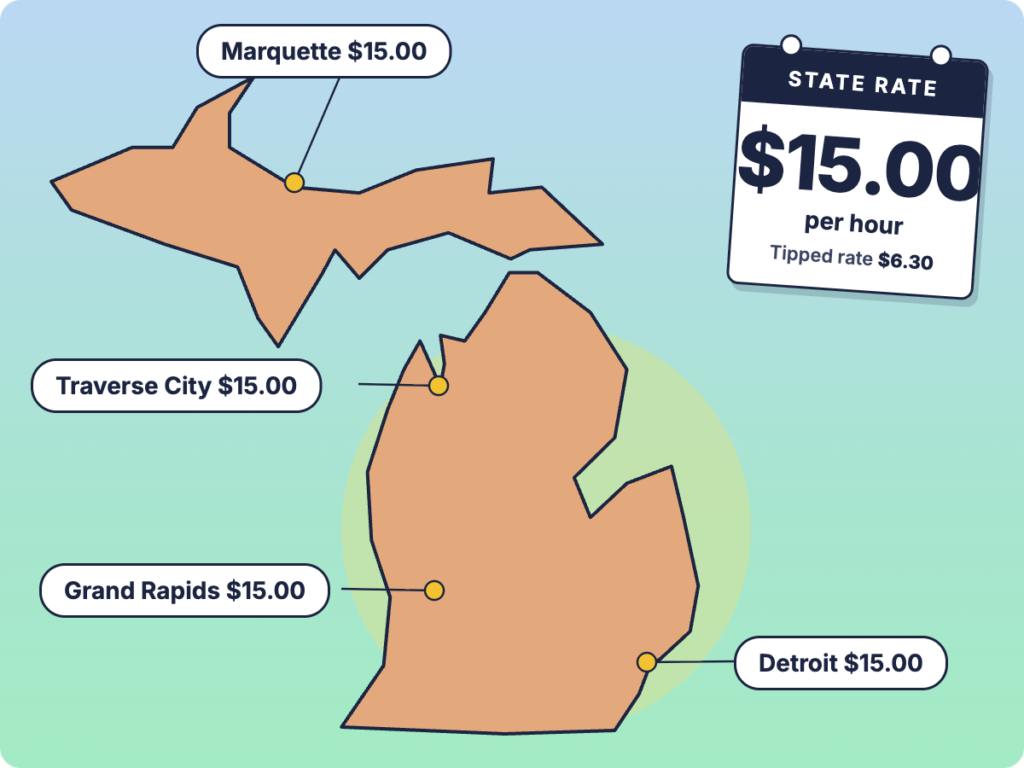
Effective January 1, 2027, Michigan’s minimum wage is $15.00 per hour for standard hourly employees and $6.30 per hour for tipped employees. Workers under 18 may be paid 85% of the standard rate, or $12.75 per hour.
This is the final fixed step of the schedule set by Senate Bill 8, which Governor Whitmer signed on February 21, 2025. SB 8 amended the Improved Workforce Opportunity Wage Act (IWOWA) and replaced the schedule set by the Michigan Supreme Court’s July 2024 ruling in Mothering Justice v. Attorney General. Starting in 2028, the rate switches to annual inflation adjustments.
The law applies to employers with 2 or more employees, for workers 16 and older. Below is a complete employer guide to Michigan’s minimum wage rules for 2027 and beyond.
What is the minimum wage in Michigan in 2026 and 2027?
Michigan’s minimum wage is $13.73 per hour through December 31, 2026, and $15.00 per hour starting January 1, 2027. The tipped cash wage rises from $5.49 (40% of the standard rate) to $6.30 (42%).
Ohio minimum wage:
| Michigan minimum wage rate type | 2026 Amount | 2027 Amount |
|---|---|---|
| Standard minimum wage | $13.73 per hour | $15.00 per hour |
| Tipped cash wage (42%) | $5.49 per hour | $6.30 per hour |
| Maximum tip credit | $8.24 per hour | $8.70 per hour |
| Minors under 18 (85%) | $11.67 per hour | $12.75 per hour |
| Training wage (new hires under 20, first 90 days) | $4.25 per hour | $4.25 per hour |
| Overtime (1.5× standard rate) | $20.60 per hour | $22.50 per hour |
The 2026 rate was a $1.25 jump from the $12.48 rate that took effect February 21, 2025. Keep paying $13.73 for every hour worked through December 31, 2026, even if the paycheck is issued in January 2027.
Michigan minimum wage rate history (2021 to 2028)
Michigan’s minimum wage rose slowly through 2024, then jumped in February 2025 after the Supreme Court ruling and SB 8. The schedule now resets every January 1.
Michigan minimum wage and tipped cash wage by effective date, 2021 to 2028:
| Effective date | Minimum wage | Tipped cash wage | Gross receipts threshold |
|---|---|---|---|
| January 1, 2021 | $9.65 per hour | $3.67 per hour | 38% |
| January 1, 2022 | $9.87 per hour | $3.75 per hour | 38% |
| January 1, 2023 | $10.10 per hour | $3.84 per hour | 38% |
| January 1, 2024 | $10.33 per hour | $3.93 per hour | 38% |
| January 1, 2025 | $10.56 per hour | $4.01 per hour | 38% |
| January 1, 2026 | $13.73 per hour | $5.49 per hour | 40% |
| January 1, 2027 | $15.00 per hour | $6.30 per hour | 42% |
| January 1, 2028 | CPI adjusted | 44% of new rate | 44% |
Unlike states with a fixed-dollar tip credit, Michigan sets the tipped cash wage as a percentage of the minimum wage. That percentage climbs 2 points a year until it reaches 50% in 2031.
The federal minimum wage remains $7.25 per hour. Employers subject to both laws must follow the stricter standard, so $15.00 per hour is the baseline for nonexempt Michigan workers.
Sources: Michigan LEO Minimum Wage & Overtime, Michigan LEO Minimum Wage and Overtime FAQ
How the annual adjustment works
After the $15.00 step, SB 8 returns Michigan to annual inflation adjustments:
October 2027: The State Treasurer calculates a new rate by applying the 12-month increase in the Consumer Price Index for the Midwest region (CPI-U).
By November 1, 2027: The Treasurer publishes the adjusted rate.
January 1, 2028: The inflation-adjusted rate takes effect.
The increase doesn’t take effect if Michigan’s unemployment rate was 8.5% or higher for the year immediately before the scheduled increase.
The tipped cash wage also keeps rising as a share of the minimum wage, regardless of inflation:
| Effective date | Tipped cash wage (% of minimum wage) |
|---|---|
| January 1, 2027 | 42% ($6.30/hr) |
| January 1, 2028 | 44% |
| January 1, 2029 | 46% |
| January 1, 2030 | 48% |
| January 1, 2031 and after | 50% |
Because both the base rate and the percentage move, expect the tipped cash wage to rise every January 1 through at least 2031.
Expect the 2028 rate to be published by November 1, 2027.
Does the $15.00 rate apply to your workers?
Michigan’s minimum wage law covers employers with 2 or more employees, for workers 16 and older.
| Who | 2027 minimum wage |
|---|---|
| Employees 18 and older at employers with 2+ employees | $15.00 per hour |
| Tipped employees who receive and report tips | $6.30 per hour cash wage, plus tips to reach $15.00 |
| Employees under 18 | $12.75 per hour (85% of the standard rate) |
| New hires under 20, first 90 calendar days | $4.25 per hour training wage |
| Employers with fewer than 2 employees | Not covered by state law; $7.25/hr (federal) if covered by the FLSA |
The training wage ends on day 91, and the 85% minor rate ends the day a worker turns 18. From then on, the full rate applies.
Overtime-exempt executive, administrative and professional employees must earn at least $684 per week ($35,568 per year), matching the federal standard.
Tipped wages and overtime: how to do the math at $15/hr
Michigan sets the 2027 tipped cash wage at 42% of the minimum wage. The rest is the maximum tip credit, so the credit grows whenever the minimum wage does:
- Minimum wage: $15.00/hr
- Tipped cash wage: (42%): $6.30/hr
- Maximum tip credit: $8.70/hr
Employers can only use the tipped wage if they inform employees of the tip provisions in writing at or before hire and get their written consent, and employees receive, report and keep their tips (voluntary tip sharing with others in the chain of service is allowed). If cash wage plus tips doesn’t reach $15.00 per hour, the employer must pay the shortfall.
Calculating tipped overtime correctly
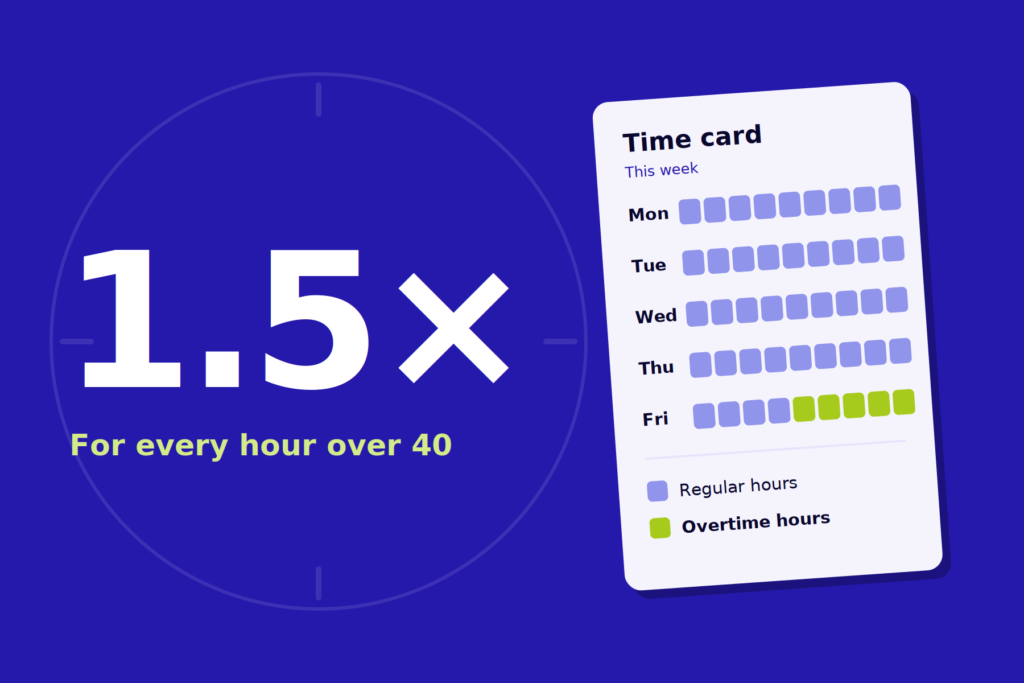
Michigan overtime is 1.5 times the regular rate for hours worked over 40 in a 7-day workweek. There is no daily overtime requirement.
Overtime for a tipped employee is calculated on the full $15.00 minimum wage, not the $6.30 cash wage.
Michigan overtime rates for standard and tipped employees at the $15.00 minimum wage:
| Employee type | Regular rate | Overtime rate (1.5x) | Tip credit | Cash overtime rate due |
|---|---|---|---|---|
| Standard hourly employee | $15.00 per hour | $22.50 per hour | $0.00 | $22.50 per hour |
| Tipped employee | $15.00 per hour | $22.50 per hour | $8.70 | $13.80 per hour |
| Minor (under 18, 85% rate) | $12.75 per hour | $19.13 per hour | $0.00 | $19.13 per hour |
Calculating tipped overtime as $6.30 × 1.5 ($9.45/hr) underpays by $4.35 per overtime hour.
Michigan minimum wage payroll checklist
January 1, 2027 falls on a Friday, so most pay periods that include that date need to be split. Use these seven steps to stay compliant:
- Pay by date worked. Minimum wage compliance is based on the date work was performed, not the date the paycheck is issued.
- Split pay periods that include January 1. Hours worked through December 31, 2026 are paid at $13.73/hr ($5.49 tipped cash wage). Hours worked on or after January 1, 2027 are paid at $15.00/hr ($6.30 tipped).
- Example: A biweekly paycheck with 32 hours worked Dec. 25 to 31 and 40 hours worked Jan. 1 to 7 equals (32 × $13.73 = $439.36) + (40 × $15.00 = $600.00) = $1,039.36 in gross wages. Read our guide on how pay periods work, for more on calculations.
- Update overtime rates. Make sure your time tracking or payroll system calculates minimum wage overtime at $22.50/hr ($13.80/hr cash wage for tipped staff).
- Update youth and training rates. Workers under 18 may be paid no less than $12.75/hr (85%). Newly hired workers under 20 may be paid $4.25/hr for their first 90 calendar days only.
- Display required posters. Download the Michigan Minimum Wage and Overtime poster(available in English, Spanish, and Arabic) and post it at every work location. You must also display the federal U.S. Department of Labor FLSA poster.
- Give tip credit notices. Michigan requires written notice of the tip provisions at or before hire, plus the employee’s written consent. Since the rate and percentage change every January 1, it’s good practice to reissue notices showing the $6.30 cash wage and $8.70 tip credit. Keep tip compliance records for at least 3 years after an employee’s last pay period.
- Review wage compression. Check pay for employees earning between $15.00 and $17.00 per hour. Adjusting pay for longer-tenured staff keeps experience-based pay gaps in place.
Employer cost breakdown: wages and payroll tax impact
Moving a full-time employee from $13.73 to $15.00 per hour adds $2,641.60 in annual gross wages (a $1.27 raise × 2,080 hours).
Employer FICA taxes (6.2% Social Security + 1.45% Medicare = 7.65%) add another $202.08 per year per employee.
Added annual cost of Michigan’s $15.00 minimum wage by number of full-time employees:
| Full-time minimum wage employees | Added annual gross wages | Added employer FICA (7.65%) | Total added annual cost |
|---|---|---|---|
| 1 employee | $2,641.60 | $202.08 | $2,843.68 |
| 5 employees | $13,208.00 | $1,010.41 | $14,218.41 |
| 10 employees | $26,416.00 | $2,020.82 | $28,436.82 |
| 25 employees | $66,040.00 | $5,052.06 | $71,092.06 |
Michigan unemployment insurance tax applies only to the first $9,000 of each employee’s annual wages in 2026 ($9,500 for delinquent employers), so the increase won’t raise it for most full-time staff.
How Michigan’s minimum wage increase affects hourly workforces
The $15.00 rate applies statewide, but the operational impact depends on how you price work and staff shifts:
- Construction and specialty contractors: Fixed-price bids signed in 2026 were likely estimated at $13.73/hr labor. Review jobs running into 2027 for margin loss and update job costing and labor tracking rates for new estimates.
- Field services (HVAC, landscaping, cleaning, pest control): Annual maintenance contracts often renew on January 1. Make sure renewal pricing covers $15.00 labor and overtime.
- Staffing agencies: Client bill rates need to rise with pay rates to protect margins. A $1.27 pay increase requires more than $1.27 in bill rate, since employer taxes and workers’ comp costs rise with wages.
- Restaurants and businesses with tipped staff: The cash wage rises to $6.30 per hour and keeps climbing every year through 2031. On slow shifts, check that tips still bring every tipped employee to at least $15.00 per hour, since the employer covers any shortfall.
- Seasonal and youth-heavy employers (retail, tourism, recreation): Confirm the 85% minor rate and the 90-day training wage are applied only to eligible workers, and that rates step up the day a worker turns 18 or hits day 91.
Penalties for noncompliance
The Improved Workforce Opportunity Wage Act, as amended by SB 8, sets out these consequences for failing to pay the minimum wage:
- State wage claims: Employees can file a claim for unpaid minimum wages or overtime with the Michigan Wage and Hour Division online, in person, or by calling 855-464-9243 (4MI-WAGE).
- Back pay plus liquidated damages: An employer that underpays can owe the unpaid wages plus an equal amount in liquidated damages, along with court costs and attorney’s fees.
- State fines: Employers that fail to pay the minimum wage face a civil fine of up to $1,000. The cap rises to $2,500 when the underpaid worker is a tipped employee.
- Look back period: Employees generally have three years to file a civil action or a claim for unpaid wages.
- Retaliation is prohibited: Discharging or discriminating against an employee because they testified, or may testify, in an investigation under the act is a misdemeanor.
Spend less time on admin and more time growing your business
From onboarding to time tracking and payroll, Fingercheck gives hourly teams one platform to manage it all.
Michigan Minimum Wage FAQs
This article is for general informational purposes only and isn’t legal or tax advice. Minimum wage rules can change. Confirm current requirements with the Michigan Department of Labor and Economic Opportunity or an employment attorney.