Georgia minimum wage increase 2026: What employers need to know
Most Georgia employers must pay the federal minimum wage, not the lower state rate.
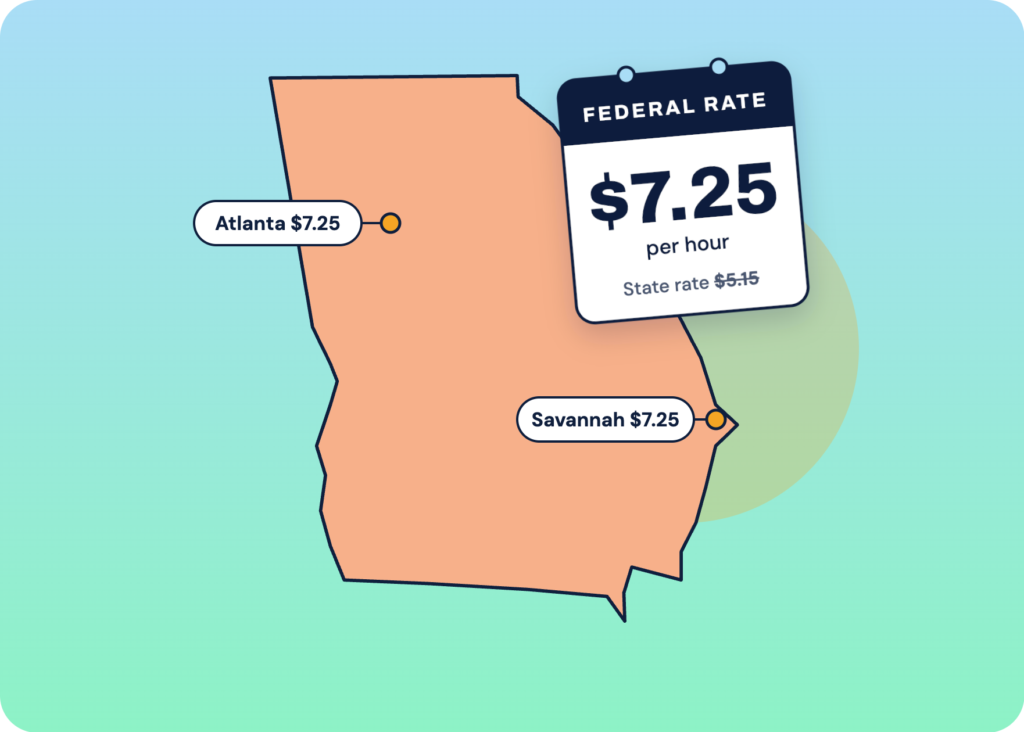
Most Georgia employers must pay the federal minimum wage, not the lower state rate. Georgia’s state minimum wage is $5.15 per hour, but almost every employer in the state must pay the federal $7.25 per hour instead. The federal rate applies to any business covered by the Fair Labor Standards Act (FLSA), which includes companies with $500,000 or more in annual sales, all hospitals and care facilities, and any employee whose work involves interstate commerce.
Georgia’s minimum wage hasn’t changed since 2002, and no increase is scheduled for 2027. Georgia cities and counties are not allowed to set their own minimum wages, so $7.25 is the baseline statewide, including Atlanta.
Below is a complete employer guide to Georgia’s minimum wage for 2026 and 2027, including who is covered, tipped and overtime math, and a payroll checklist. For other states, see our minimum wage by state guide.
Who gets $7.25 and who gets $5.15 in Georgia?
If your business is covered by the federal FLSA, you pay at least $7.25 per hour. Georgia law itself says the $5.15 state rate does not apply to employers covered by the federal minimum wage, so the federal rate wins for most of the state’s workforce.
Your employees are covered by the FLSA, and earn at least $7.25, if any of these apply:
- Your business has $500,000 or more in annual sales. This is called enterprise coverage, and it covers every employee of the business.
- You run a hospital, nursing home, care facility, school, or preschool. These are covered regardless of revenue.
- You’re a public agency. Federal, state, and local government employers are covered.
- Individual employees handle interstate commerce. Even at a small business, an employee is covered if they regularly take out-of-state calls or orders, process credit cards, ship or receive goods across state lines, or travel to other states for work.
Individual coverage is broad. Most modern jobs touch interstate commerce in some way, so the safest default for any Georgia employer is $7.25 per hour.
When the $5.15 state rate applies
The $5.15 rate only applies to an employee who is not covered by the FLSA and works for an employer that Georgia’s law does cover. Georgia’s law applies to employers with 6 or more employees and excludes:
- Employers with $40,000 or less in annual sales
- Employers with 5 or fewer employees
- Domestic employees, such as housekeepers and nannies
- Farm owners, sharecroppers, and land renters
- Employees paid wholly or partly in tips
- High school and college students
- Newspaper carriers
- Certain live-in staff at nonprofit residential facilities for children or adults with disabilities
In practice, very few Georgia workers are paid $5.15. A worker who is exempt under both the federal and state laws has no minimum wage protection at all, but those cases are narrow.
Source: Georgia Department of Labor; O.C.G.A. 34-4-3; FLSA, 29 U.S.C. 203, 206, 213, and 214.
Georgia minimum wage rate history
Georgia’s state minimum wage has been $5.15 per hour since 2002, and the federal rate has been $7.25 since July 24, 2009. The federal rate has been the one that matters for most Georgia employers since 2007, when it first rose above the state rate.
Georgia and federal minimum wage, selected years:
| Year | Georgia state rate | Federal rate |
|---|---|---|
| 2026 | $5.15/hr | $7.25/hr |
| 2009 (July 24) | $5.15/hr | $7.25/hr |
| 2008 (July 24) | $5.15/hr | $6.55/hr |
| 2007 (July 24) | $5.15/hr | $5.85/hr |
| 2002 | $5.15/hr | $5.15/hr |
| 1988 | $3.25/hr | $3.35/hr |
| 1972 | $1.25/hr | $1.60/hr |
Will Georgia’s minimum wage increase in 2027?
No increase is scheduled. Georgia’s minimum wage stays at $5.15 (state) and $7.25 (federal) for 2027 unless the legislature or Congress passes a new law.
Lawmakers have filed several bills to raise it. During the 2025 to 2026 legislative session, these included:
- HB 395: Raise the state minimum wage to $15.00 per hour.
- HB 343: Raise the state minimum wage to $20.00 per hour and extend it to workers with disabilities and incarcerated workers.
- SB 273: Raise the state minimum wage and adjust it every year for inflation.
- HB 394: Set a $15.00 minimum for eligible full-time state employees.
None of these became law. Bills that didn’t pass would need to be refiled when the next session begins in January 2027.
What did change: subminimum wages for workers with disabilities
One Georgia wage law is changing right now. The Dignity and Pay Act (SB 55), signed by Governor Kemp in May 2025, phases out subminimum wages for workers with disabilities:
| Date | What changes |
|---|---|
| July 1, 2025 | No new employers can use federal 14(c) certificates to pay below minimum wage. |
| July 1, 2026 | Employers that already hold a 14(c) certificate must pay at least half the minimum wage ($3.63/hr). |
| July 1, 2027 | Subminimum wages end. All workers with disabilities earn at least the full minimum wage. |
If you hold a 14(c) certificate, budget now for the July 2027 step up to $7.25 per hour.
Does Atlanta have its own minimum wage?
No. Georgia law prevents cities and counties from setting a minimum wage for private employers, so the minimum wage in Atlanta, Savannah, Augusta, and every other Georgia city is the same as the rest of the state: $7.25 per hour for FLSA-covered employers.
That makes Georgia simpler than states like California, where employers track dozens of city rates. A bill to remove this restriction (HB 245) was filed in 2023 but did not pass.
There is one exception to watch. If your Georgia employees work across state lines, they earn the higher rate where the work happens. Hours worked in Florida, for example, must be paid at Florida’s $15.00 minimum wage. See our Florida minimum wage guide for details.
Tipped wages, youth wages, and overtime math in Georgia
Georgia’s minimum wage law excludes tipped employees, so federal rules set the tipped wage. Georgia employers can pay a cash wage of $2.13 per hour and take a tip credit of up to $5.12 per hour, as long as cash wages plus tips reach at least $7.25 for every hour worked.
To use the tip credit, you must tell tipped employees in advance about the cash wage and credit, let them keep all their tips (except through a valid tip pool), and make up any shortfall when tips run light.
Georgia overtime rules
Georgia has no state overtime law, so federal rules apply: 1.5 times the regular rate for hours worked over 40 in a workweek. There is no daily overtime in Georgia.
Georgia overtime rates at the $7.25 minimum wage:
| Employee type | Regular rate | Overtime rate (1.5x) | Tip credit | Cash overtime rate due |
| Standard hourly employee | $7.25/hr | $10.88/hr | $0.00 | $10.88/hr |
| Tipped employee | $7.25/hr | $10.88/hr | $5.12 | $5.76/hr |
Overtime for a tipped employee is calculated on the full $7.25 minimum wage, not the $2.13 cash wage. Calculating tipped overtime as $2.13 x 1.5 ($3.20/hr) underpays by $2.56 per overtime hour.
Youth and student wages
Federal law allows a few lower rates in Georgia:
| Program | Minimum rate | Rules |
| Youth opportunity wage | $4.25/hr | Employees under 20, for their first 90 consecutive calendar days. Can’t displace other workers. |
| Full-time student certificate | $6.17/hr (85%) | Retail, service, agriculture, or higher ed. Requires a DOL certificate. |
| Student-learner certificate | $5.44/hr (75%) | Vocational students 16 and older. Requires a DOL certificate. |
After 90 days or the employee’s 20th birthday, whichever comes first, the youth wage ends and $7.25 applies.
Georgia exempt salary threshold
Salaried employees in Georgia must earn at least $684 per week ($35,568 per year) to be exempt from overtime. Georgia has no state threshold, so the federal level applies.
The Department of Labor’s 2024 rule that would have raised the threshold was struck down by a federal court in November 2024, so the 2019 levels remain in effect:
| Exemption | Minimum salary |
| Executive, administrative, and professional | $684/week ($35,568/yr) |
| Highly compensated employees | $107,432/yr total pay |
Salary alone isn’t enough. The employee must also pass the duties test for the exemption. Up to 10% of the standard threshold can be met with nondiscretionary bonuses or commissions paid at least once a year.
Georgia minimum wage payroll checklist
Georgia’s rate isn’t changing in 2027, but these seven steps keep your payroll compliant and ready for the next change:
- Confirm FLSA coverage. If you’re near the $500,000 sales line or rely on the $5.15 state rate, document why. Most employers should treat $7.25 as the floor.
- Set $7.25 as your system minimum. Configure time and payroll so no hourly rate can fall below $7.25 by mistake.
- Set up tip credits correctly. Pay at least $2.13 cash, give the required tip credit notice, and check each workweek that cash wages plus tips reach $7.25. Calculate tipped overtime at $5.76/hr cash.
- Track youth wage end dates. If you use the $4.25 youth wage, flag each employee’s 90th day and 20th birthday so pay moves to $7.25 on time.
- Plan for July 1, 2027. Employers with a 14(c) certificate move from half the minimum wage to the full rate.
- Map out-of-state work. Employees who work in Florida, or any other state with a higher minimum wage, are paid that state’s rate for those hours. Federal contractors on older contracts may also owe $13.65/hr under Executive Order 13658.
- Display required posters. Post the federal FLSA “Employee Rights” poster where employees can see it, along with any notices the Georgia Department of Labor requires.
How Georgia’s minimum wage affects hourly workforces
With a $7.25 floor, most Georgia employers already pay well above the minimum to hire and keep staff. The bigger payroll risks are coverage, tips, and overtime:
- Health care and long-term care: Hospitals, nursing homes, and residential care facilities are covered by the FLSA regardless of revenue. They can use the 8 and 80 overtime system (overtime after 8 hours a day or 80 hours in 14 days) if employees agree in advance. Home care agencies cannot claim the companionship exemption, so their aides earn minimum wage and overtime.
- Restaurants and hospitality: The $2.13 cash wage only works if tips cover the gap every workweek. Check slow shifts, and calculate overtime on $7.25, not $2.13.
- Construction and field services: Crews that cross into Florida earn $15.00 per hour for those hours. Track hours by job location so out-of-state work is paid at the right rate.
- Staffing agencies: Placements at hospitals and care facilities are FLSA-covered work. Bill rates also need to cover overtime at 1.5 times the regular rate, including shift differentials and bonuses.
- Disability service providers: Organizations using 14(c) certificates need a plan to reach full minimum wage by July 1, 2027, including any changes to funding or contracts.
Penalties for noncompliance
Because federal law sets the wage floor for most Georgia employers, federal FLSA remedies are the main risk:
- Back wages plus an equal amount: Employees or the U.S. Department of Labor can recover unpaid minimum wages and overtime, plus an equal amount in liquidated damages.
- Lookback period: Claims cover 2 years of unpaid wages, or 3 years for willful violations.
- Civil money penalties: The Department of Labor can assess penalties for each repeated or willful minimum wage or overtime violation.
- Attorney’s fees: Employees who win a private lawsuit can also recover attorney’s fees and court costs.
- Retaliation protections: Employers can’t fire or punish employees for filing a complaint or taking part in an investigation.
The easiest way to avoid all of these is accurate time tracking. When every hour is recorded and paid at the right rate, there’s nothing to recover.
Goergia minimum wage FAQs for employers
This article is for general informational purposes only and isn’t legal or tax advice. Minimum wage rules can change. Confirm current requirements with the Georgia Department of Labor, the U.S. Department of Labor, or an employment attorney.
Sources
- Georgia Department of Labor: Minimum Wage
- U.S. DOL: State Minimum Wage Laws
- U.S. DOL: Handy Reference Guide to the FLSA
- U.S. DOL: Government Contracts Minimum Wage (EO 13658)
- Georgia Senate Press Office: Dignity and Pay Act (SB 55) signed
- Official Code of Georgia Annotated, Title 34, Chapter 4 (O.C.G.A. 34-4-3)
- U.S. Department of Labor: FLSA Employee Rights poster (WH1088)
Spend less time on admin and more time growing your business
From onboarding to time tracking and payroll, Fingercheck gives hourly teams one platform to manage it all.