California minimum wage increase 2026: What employers need to know
California’s minimum wage in 2026 is $16.
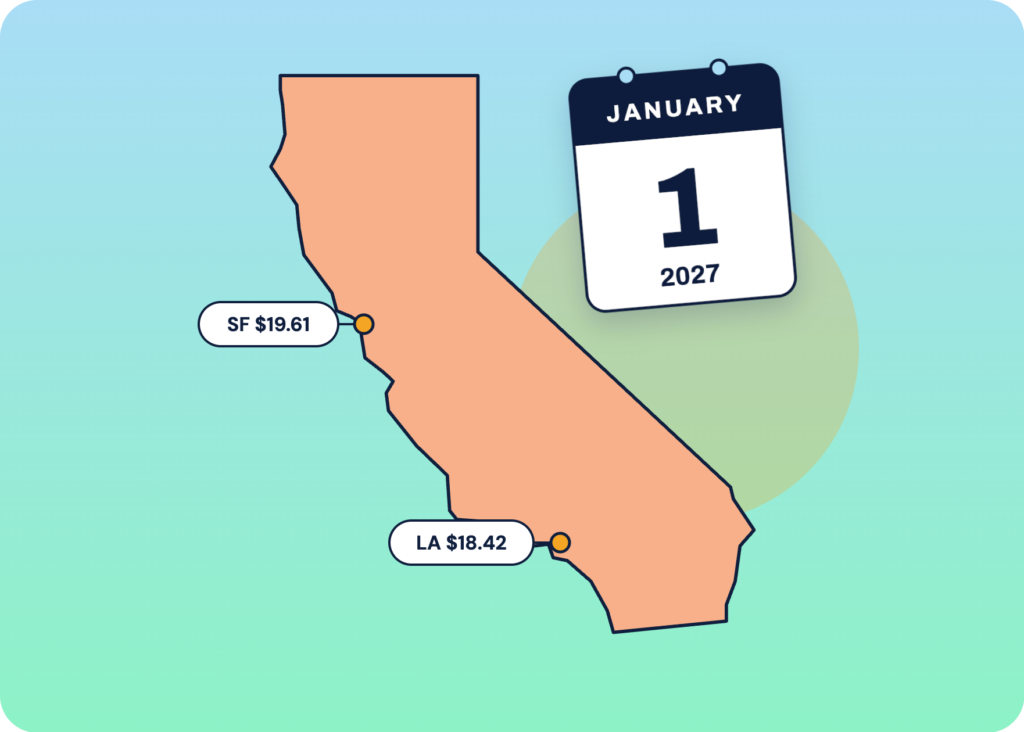
California’s minimum wage in 2026 is $16.90 per hour and rises to $17.40 per hour on January 1, 2027. The new rate applies to every employer in the state, regardless of size, and holds through December 31, 2027.
California does not allow a tip credit, so tipped employees must be paid the full $17.40 before tips. Many workers also earn more than the state rate: 40 cities and counties set higher local minimums, fast food chains pay at least $20.00, and covered health care facilities pay $19.28 to $25.00.
Below is a complete employer guide to California’s minimum wage for 2026 and 2027, including city rates, industry rates, overtime math, and a payroll checklist. For other states, see our minimum wage by state guide.
California minimum wage rate history (2017 to 2027)
California’s minimum wage has risen every January 1 since 2017, from $10.50 to $17.40. Until 2023, small employers (25 or fewer employees) paid a lower rate. Since January 1, 2023, every employer pays the same rate.
California minimum wage by effective date, 2017 to 2027:
| Effective date | 26 or more employees | 25 or fewer employees |
|---|---|---|
| January 1, 2027 | $17.40/hr | $17.40/hr |
| January 1, 2026 | $16.90/hr | $16.90/hr |
| January 1, 2025 | $16.50/hr | $16.50/hr |
| January 1, 2024 | $16.00/hr | $16.00/hr |
| January 1, 2023 | $15.50/hr | $15.50/hr |
| January 1, 2022 | $15.00/hr | $14.00/hr |
| January 1, 2021 | $14.00/hr | $13.00/hr |
| January 1, 2020 | $13.00/hr | $12.00/hr |
| January 1, 2019 | $12.00/hr | $11.00/hr |
| January 1, 2018 | $11.00/hr | $10.50/hr |
| January 1, 2017 | $10.50/hr | $10.00/hr |
The federal minimum wage is still $7.25 per hour, unchanged since July 24, 2009. When federal, state, and local rates differ, California employers must pay the highest one.
Sources: DIR Minimum Wage FAQ; California Labor Commissioner’s Office announcement of the 2027 rate.
Will California’s minimum wage increase in 2027?
Yes. California’s minimum wage rises $0.50, from $16.90 to $17.40 per hour, on January 1, 2027. That is about a 3% increase, and it applies to all employers statewide.
California adjusts its minimum wage every year for inflation. Here is how the next rate gets set:
- By August 1: The California Department of Finance calculates the new rate using the national Consumer Price Index for Urban Wage Earners and Clerical Workers (CPI-W). The 2027 rate was certified on July 31, 2026.
- Built-in limits: The increase is capped at 3.5% per year, and the rate can never go down, even if prices fall.
- January 1: The new rate takes effect statewide.
The 2028 rate will follow the same steps, with an announcement expected by August 1, 2027.
California health care and fast food minimum wages
Two industries in California have their own statewide minimum wage that sits above the general rate. Covered health care workers earn $19.28 to $25.00 per hour, and covered fast food workers earn at least $20.00 per hour.
Health care worker minimum wage (SB 525)
California’s health care minimum wage applies to workers at covered health care facilities, with rates set by facility type. It covers more than nurses: janitors, food service, billing, scheduling, security, and gift shop staff at a covered facility all qualify.
California health care minimum wage by facility type, July 1, 2026:
- Minimum wage: $15.00/hr
- Less maximum tip credit: $3.02
- Cash wage due: $11.98/hr
If a tipped employee’s cash wage plus tips doesn’t average at least $15.00 per hour for the workweek, the employer must pay the difference.
| Facility type | Current rate | Next increase |
|---|---|---|
| Large health systems (10,000+ FTEs), dialysis clinics, large-county facilities | $25.00/hr | Inflation adjustment January 1, 2028 |
| Physician groups with 25+ physicians, hospital-owned skilled nursing, home health agencies, other covered facilities | $23.00/hr | $25.00/hr on July 1, 2028 |
| Community clinics, rural health clinics, and affiliated urgent care | $22.00/hr | $25.00/hr on July 1, 2027 |
| Safety net hospitals and small-county facilities | $19.28/hr | $19.95/hr on July 1, 2027 |
Skilled nursing facilities: A freestanding skilled nursing facility, one not owned, operated, or controlled by a hospital or health system, is not covered yet. Its schedule only starts if the legislature passes a patient care minimum spending requirement for skilled nursing. Hospital-owned skilled nursing facilities are already covered.
Other health care employers that are not covered include practices with 24 or fewer physicians, independent practice associations, congregate living health facilities, and state-run facilities. These employers pay the general state rate or the local rate, whichever is higher.
Fast food minimum wage (AB 1228)
California fast food workers must earn at least $20.00 per hour, a rate in effect since April 1, 2024. It applies to limited-service restaurants that are part of a chain with 60 or more locations nationwide, including franchisees.
Exemptions include restaurants inside large grocery stores, airports, hotels, large event centers, theme parks, and museums, plus restaurants that bake and sell standalone bread. The state’s Fast Food Council can raise the rate once a year by the smaller of 3.5% or inflation.
Sources: DIR Health Care Worker Minimum Wage FAQ; DIR Fast Food Minimum Wage FAQ.
California city and county minimum wages (2026)
Forty California cities and counties set a minimum wage above the state rate, topping out at $20.34 in Emeryville. If you have employees working in one of these places, you pay the local rate for hours worked there.
California local minimum wages as of July 1, 2026:
| City or county | Minimum wage | Effective date |
| Alameda | $17.76/hr | July 1, 2026 |
| Belmont | $18.95/hr | January 1, 2026 |
| Berkeley | $19.61/hr | July 1, 2026 |
| Burlingame | $17.86/hr | January 1, 2026 |
| Cupertino | $18.70/hr | January 1, 2026 |
| Daly City | $17.50/hr | January 1, 2026 |
| East Palo Alto | $17.90/hr | January 1, 2026 |
| El Cerrito | $18.82/hr | January 1, 2026 |
| Emeryville | $20.34/hr | July 1, 2026 |
| Foster City | $17.85/hr | January 1, 2026 |
| Fremont | $18.05/hr | July 1, 2026 |
| Half Moon Bay | $17.91/hr | January 1, 2026 |
| Hayward | $17.79/hr ($16.90 for 25 or fewer employees) | January 1, 2026 |
| Los Altos | $18.70/hr | January 1, 2026 |
| Los Angeles (city) | $18.42/hr | July 1, 2026 |
| Los Angeles County (unincorporated) | $18.47/hr | July 1, 2026 |
| Malibu | $17.91/hr | July 1, 2026 |
| Menlo Park | $17.55/hr | January 1, 2026 |
| Milpitas | $18.50/hr | July 1, 2026 |
| Mountain View | $19.70/hr | January 1, 2026 |
| Novato | $17.46/hr ($17.73 for 100+ employees, $16.90 for 25 or fewer) | January 1, 2026 |
| Oakland | $17.34/hr | January 1, 2026 |
| Palo Alto | $18.70/hr | January 1, 2026 |
| Pasadena | $18.57/hr | July 1, 2026 |
| Petaluma | $18.31/hr | January 1, 2026 |
| Redwood City | $18.65/hr | January 1, 2026 |
| Richmond | $19.18/hr | January 1, 2026 |
| San Carlos | $17.75/hr | January 1, 2026 |
| San Diego | $17.75/hr | January 1, 2026 |
| San Francisco | $19.61/hr | July 1, 2026 |
| San Jose | $18.45/hr | January 1, 2026 |
| San Mateo (city) | $18.60/hr | January 1, 2026 |
| San Mateo County (unincorporated) | $17.95/hr | January 1, 2026 |
| Santa Clara | $18.70/hr | January 1, 2026 |
| Santa Monica | $18.47/hr | July 1, 2026 |
| Santa Rosa | $18.21/hr | January 1, 2026 |
| Sonoma | $18.47/hr ($17.38 for 25 or fewer employees) | January 1, 2026 |
| South San Francisco | $18.15/hr | January 1, 2026 |
| Sunnyvale | $19.50/hr | January 1, 2026 |
| West Hollywood | $20.25/hr | January 1, 2026 |
Most of these rates adjust again on January 1 or July 1 each year. Watch the January 2027 changes closely: the new $17.40 state rate is higher than several small-employer local rates and Oakland’s current $17.34, so the state rate wins until those cities update.
Local rates also stack with industry rates. A covered fast food or health care worker in a city with a higher general minimum gets whichever rate is higher.
Source: UC Berkeley Labor Center inventory of local minimum wages, the list the California Labor Commissioner points employers to. Confirm each rate on the city’s own page before publishing.
Tipped wages and overtime: how to do the math at $17.40/hr
California employers cannot count tips toward the minimum wage, so tipped employees earn at least $17.40 per hour in cash wages in 2027. Tips are paid on top and belong to the employee.
That makes California different from Florida or the federal rule, where employers can pay a lower cash wage and use tips to cover the gap. If your payroll system is set up for multiple states, make sure the tip credit is turned off for California employees.
California overtime rules
California pays overtime by the day, not just the week. Nonexempt employees earn:
- 1.5 times the regular rate for hours over 8 in a workday, over 40 in a workweek, and the first 8 hours on the 7th consecutive day worked in a workweek.
- 2 times the regular rate for hours over 12 in a workday and hours over 8 on the 7th consecutive day.
California overtime rates at the $17.40 minimum wage:
| Employee type | Regular rate | Overtime (1.5x) | Double time (2x) |
| Standard hourly employee | $17.40/hr | $26.10/hr | $34.80/hr |
| Tipped employee | $17.40/hr | $26.10/hr | $34.80/hr |
| Fast food employee (covered) | $20.00/hr | $30.00/hr | $40.00/hr |
| Health care employee at $25.00 | $25.00/hr | $37.50/hr | $50.00/hr |
The most common mistake is only tracking weekly hours. An employee who works four 10-hour shifts in a week stays under 40 hours but still earns 8 hours of daily overtime. Those 8 hours are paid at $26.10 instead of $17.40, which adds $69.60 to the week. Alternative workweek schedules can change this, but only if they were adopted through California’s formal election process.
Remember that the regular rate includes more than the hourly wage. Shift differentials and nondiscretionary bonuses raise the regular rate, so overtime must be calculated on the higher figure.
California exempt salary threshold for 2027
Salaried employees in California must earn at least $72,384 per year in 2027 to be exempt from overtime, up from $70,304 in 2026. The threshold is twice the state minimum wage for a full-time year:
$17.40 x 2 x 40 hours x 52 weeks = $72,384
Salary alone is not enough. The employee must also pass the duties test for the specific exemption (executive, administrative, or professional). Two industries have higher thresholds:
| Industry | 2027 salary threshold | How it’s calculated |
| General (all employers) | $72,384/yr | 2x the $17.40 state minimum |
| Fast food (covered) | $83,200/yr | 2x the $20.00 fast food minimum |
| Health care at $25.00/hr | $78,000/yr | 1.5x the health care minimum, when higher than the state threshold |
If a manager’s salary falls below the threshold on January 1, 2027, either raise the salary or reclassify the role as nonexempt and track hours and overtime.
California minimum wage payroll checklist for January 1, 2027
January 1, 2027, falls on a Friday, so most pay periods that include it need to be split. Use these eight steps to stay compliant:
- Pay by date worked. Minimum wage compliance is based on when the work was performed, not when the paycheck is issued.
- Split pay periods that include January 1. Hours worked through December 31, 2026, are paid at $16.90/hr. Hours worked on or after January 1, 2027, are paid at $17.40/hr.
- Example: A biweekly paycheck with 40 hours worked December 24 to 31 and 40 hours worked January 1 to 6, with no overtime, equals (40 x $16.90 = $676.00) + (40 x $17.40 = $696.00) = $1,372.00 in gross wages. Read our guide on how pay periods work for more on pay period math.
- Map every employee to a work location. Apply the highest of the state, city or county, and industry rate for where each hour is worked. Remote employees follow the rules where they work.
- Update overtime rates. Set minimum overtime at $26.10/hr and double time at $34.80/hr, and confirm your time system flags daily overtime after 8 hours.
- Check exempt salaries. Raise any exempt salary below $72,384 per year, or reclassify the role as nonexempt.
- Turn off tip credits. Tipped employees in California earn the full $17.40 cash wage.
- Post required notices. Display the 2027 California minimum wage order (MW-2027), your industry wage order, any local minimum wage poster, and the federal FLSA poster. Health care and fast food employers also post their industry supplement. Show the new hourly rate on each employee’s pay stub.
- Review wage compression. Check pay for employees earning between $17.40 and $19.50 per hour. Adjusting pay for longer-tenured staff keeps experience-based pay gaps in place.
Employer cost breakdown: wages and payroll tax impact
Moving a full-time employee from $16.90 to $17.40 per hour adds $1,040.00 in annual gross wages (40 hours/week x 52 weeks = 2,080 hours). Employer FICA taxes (6.2% Social Security + 1.45% Medicare = 7.65%) add another $79.56 per year per employee.
Added annual cost of California’s $17.40 minimum wage by number of full-time employees:
| Full-time minimum wage employees | Added annual gross wages | Added employer FICA (7.65%) | Total added annual cost |
| 1 employee | $1,040.00 | $79.56 | $1,119.56 |
| 5 employees | $5,200.00 | $397.80 | $5,597.80 |
| 10 employees | $10,400.00 | $795.60 | $11,195.60 |
| 25 employees | $26,000.00 | $1,989.00 | $27,989.00 |
California unemployment insurance (UI) and Employment Training Tax (ETT) apply only to the first $7,000 of each employee’s annual wages, so the increase won’t raise them for most full-time staff. State Disability Insurance (SDI) is withheld from employee pay, not paid by the employer. Workers’ comp premiums are based on payroll, so expect a small increase there.
How California’s minimum wage affects hourly workforces
The $17.40 rate applies statewide, but the real impact depends on which rate each worker falls under and how you price and staff your work:
- Health care and long-term care: First confirm whether your facility is covered by SB 525. A freestanding skilled nursing facility pays the state or local rate today, while a hospital-owned one pays $23.00 or more. Multi-site operators may run two or three rate tables at once, plus daily overtime for 12-hour shifts.
- Construction and specialty contractors: Fixed-price bids signed in 2026 were likely estimated at $16.90/hr labor. Review active jobs for margin and update job costing rates for new estimates, including daily overtime on long days.
- Field services (HVAC, landscaping, cleaning, pest control): Crews often cross city lines in a single day. Hours worked in Berkeley, San Francisco, or Mountain View must be paid at those cities’ higher rates, so track hours by job location.
- Staffing agencies: Client bill rates need to rise with pay rates to protect margins. A $0.50 pay increase requires more than $0.50 in bill rate, since employer taxes and workers’ comp rise with wages. Placements at covered health care facilities may also trigger the health care minimum.
- Restaurants and businesses with tipped staff: With no tip credit, the full $0.50 increase lands on every tipped hour. Covered fast food chains stay at $20.00 unless the Fast Food Council acts, but check local rates in cities like West Hollywood ($20.25) and Emeryville ($20.34) that already exceed it.
Penalties for noncompliance
Underpaying the minimum wage in California can cost far more than the wages owed. The California Labor Code sets out these remedies:
- Back wages plus interest: Employees can recover the full unpaid minimum wage, interest, and attorney’s fees (Labor Code Section 1194).
- Liquidated damages: Employers may owe an additional amount equal to the unpaid wages and interest (Labor Code Section 1194.2).
- Civil penalties: The Labor Commissioner can assess $100 per underpaid employee per pay period for a first violation and $250 per employee per pay period for later violations (Labor Code Section 1197.1).
- Waiting time penalties: If a departing employee’s final pay is short, the employer can owe up to 30 days of wages (Labor Code Section 203).
- Wage statement penalties: Pay stubs that show the wrong rate can trigger separate penalties (Labor Code Section 226).
- No waivers: An employee cannot agree to work for less than the minimum wage, even in a union contract.
Employees can file a wage claim with the Labor Commissioner, go to court, or use arbitration if their agreement requires it. Employees can also bring claims on behalf of coworkers under the Private Attorneys General Act (PAGA), which adds more penalties.
California minimum wage FAQs for employers
This article is for general informational purposes only and isn’t legal or tax advice. Minimum wage rules can change. Confirm current requirements with the California Labor Commissioner’s Office, your city’s labor standards office, or an employment attorney.
Sources
- California DIR: Minimum Wage FAQ
- California DIR: Health Care Worker Minimum Wage FAQ
- California DIR: Fast Food Minimum Wage FAQ
- UC Berkeley Labor Center: Inventory of US City and County Minimum Wage Ordinances
- California Medical Association: SB 525 increases effective July 1, 2026
- California Labor Commissioner’s Office: 2027 minimum wage announcement ($17.40, exempt threshold $72,384)
- U.S. Department of Labor: FLSA Employee Rights poster (WH1088)
Spend less time on admin and more time growing your business
From onboarding to time tracking and payroll, Fingercheck gives hourly teams one platform to manage it all.