Hospital indemnity, accident & critical illness: The supplemental benefits hourly teams actually use
A hospital stay, a broken wrist, or a cancer diagnosis hits an hourly worker twice.
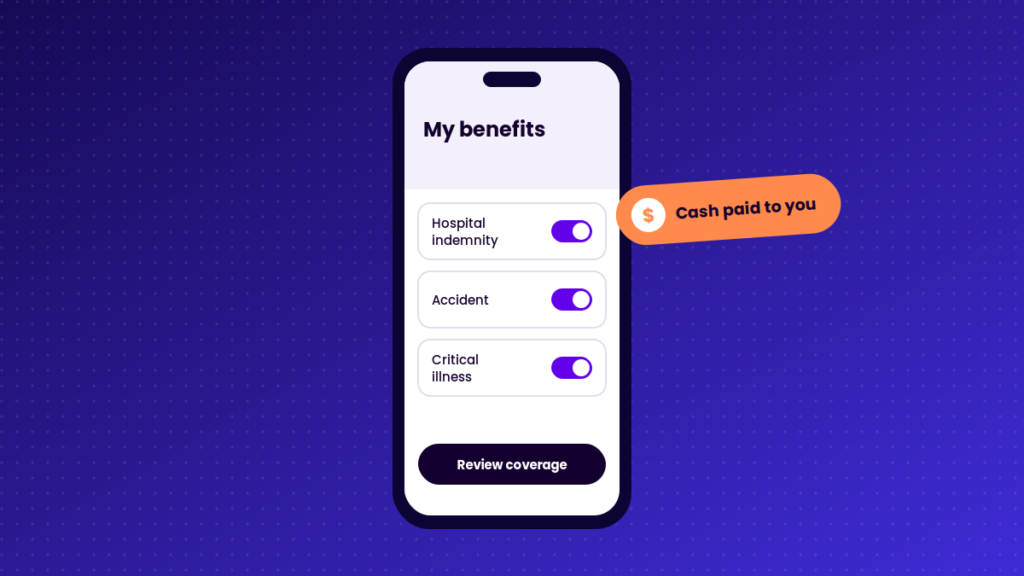
A hospital stay, a broken wrist, or a cancer diagnosis hits an hourly worker twice. First come the medical bills, then the missed shifts. Supplemental benefits for hourly employees are built for that gap: hospital indemnity, accident, and critical illness plans pay cash directly to the worker when something goes wrong.
These three products have another advantage for employers. They’re usually voluntary, which means employees pay the premiums through payroll deduction. You can offer real financial protection to your crew without adding a line to your benefits budget.
This guide covers how each plan works, why they fit hourly and deskless teams, what they actually cost you, and the tax and ERISA choices that decide whether you set them up correctly.
What are supplemental health benefits?
Supplemental health benefits are insurance plans that pay a fixed cash amount when a covered event happens, such as a hospital admission, an accidental injury, or a serious diagnosis. The money goes to the employee, not to a doctor or hospital, and the employee decides how to spend it.
That’s the key difference from a major medical plan where a health plan pays providers for care. A supplemental plan pays the worker a set amount, regardless of what the care costs, so it can cover a deductible, a rent payment, or a week of lost wages.
Under federal rules, these products are “excepted benefits,” which means they’re exempt from the Affordable Care Act’s requirements for comprehensive health coverage. They are designed to sit alongside a health plan, not replace one.
Hospital indemnity, accident, and critical illness at a glance
Each of the three plans pays out on a different trigger. Here’s how they compare:
| Plan | What triggers a payment | How it pays | How workers use it |
|---|---|---|---|
| Hospital indemnity | An inpatient hospital admission or stay | A fixed amount per admission and per day in the hospital | Deductibles, coinsurance, and bills while out of work |
| Accident | A covered accidental injury, such as a fracture, burn, or ER visit | A scheduled amount for each type of injury or treatment | Urgent care, imaging, follow-up visits, and missed shifts |
| Critical Illness | A diagnosis of a covered condition, such as a heart attack, stroke, or cancer | A lump sum, often a set benefit amount chosen at enrollment | Treatment costs, travel to specialists, and household expenses |
Federal regulations define hospital indemnity insurance as coverage that pays a fixed dollar amount per day or other period of hospitalization, regardless of medical expenses incurred. Accident plans pay on injury whereas, critical illness plans, called specified disease coverage, pay on diagnosis.
Benefit schedules, covered conditions, and exclusions vary by carrier and policy. The plan documents always control what gets paid.
Why hourly and deskless teams value supplemental benefits
Hourly workers are less likely to have a health plan to begin with. According to the Bureau of Labor Statistics, 89% of full-time civilian workers had access to employer medical care benefits in September 2026, compared with just 23% of part-time workers.
Even workers with coverage often can’t absorb a surprise bill. In the Federal Reserve’s 2025 Survey of Household Economics and Decisionmaking, 63% of adults said they would cover a $400 emergency expense with cash or its equivalent. That leaves more than a third who would have to borrow, sell something, or go without. The same survey found that 59% of adults had at least one major unexpected expense in the prior 12 months.
For a worker paid by the hour, a medical event usually means lost income on top of the bill. That’s why cash benefits land differently with hourly teams than with salaried staff. A $1,000 hospital admission benefit can be the difference between paying rent on time and falling behind.
Supplemental plans can also fill in for part-time, seasonal, and newer employees who don’t qualify for your health plan, depending on each carrier’s eligibility rules. Ask carriers about their minimum-hours requirement before you assume your whole crew can enroll.
Accident insurance and physically demanding work
Accident insurance tends to resonate most with crews whose work keeps them on their feet. Private industry employers reported 2.5 million nonfatal workplace injuries and illnesses in 2024, according to BLS data. The health care and social assistance sector had a rate of 3.4 cases per 100 full-time workers, well above the private-industry average of 2.3.
Here’s the important distinction: injuries that happen on the job are generally covered by workers’ compensation, which state law requires most employers to carry. Workers’ comp pays medical costs and partial wage replacement for injuries that arise out of and in the course of employment.
Accident insurance fills a different gap. Workers who lift, climb, and drive all day don’t stop getting hurt when they clock out, and an off-the-job injury isn’t a workers’ comp claim. Some accident policies cover injuries only off the job, while others cover injuries around the clock, so check how a policy coordinates with workers’ comp before you offer it.
What supplemental benefits actually cost employers
When supplemental benefits are offered on a voluntary basis, employees pay the full premium. Your costs are administrative: setting up the plans with a carrier or broker, supporting enrollment, and running the payroll deductions every pay period.
These benefits cost you next to nothing. There’s no premium on your books and no annual increase to budget for. The real work is making deductions accurate, especially for hourly workers whose paychecks change from week to week.
Fingercheck runs payroll and time tracking in one platform built for hourly workforces, so recurring benefit deductions run with the same payroll that pays your crew.
You can also choose to contribute toward premiums. Doing so makes the benefits more valuable to employees, but it changes both the tax treatment and the ERISA status of the plan, as the next two sections explain.
Pre-Tax or after-tax? The choice that decides how claims are taxed
Most employers assume pre-tax is always better. For supplemental benefits, it often isn’t. How premiums are paid determines whether the cash benefits an employee receives later are taxable.
According to IRS Publication 15-B, employers can offer accident and health benefits on a pre-tax basis through a cafeteria plan, which is a written plan that lets employees choose between cash and qualified benefits. But IRS guidance on fixed indemnity plans adds a catch. In Chief Counsel Advice 201719025, the IRS explained that when premiums are paid pre-tax or by the employer, fixed cash benefits are taxable to the extent they exceed the employee’s unreimbursed medical expenses.
| How premiums are paid | Tax on premiums | Tax on claim payments |
|---|---|---|
| After-tax payroll deduction | Premiums are paid with wages that were already taxed | Generally not taxable |
| Pre-tax through a section 125 cafeteria plan | Premiums aren’t subject to income tax or FICA | Taxable to the extent benefits exceed unreimbursed medical expenses |
| Paid by the employer | The employer’s contribution isn’t taxed to the employee | Taxable to the extent benefits exceed unreimbursed medical expenses |
In practice, this matters most for critical illness plans. A lump-sum benefit can easily exceed an employee’s medical bills, and the excess becomes taxable income. On a pre-tax plan, the worker who just got a cancer diagnosis may owe tax on part of the check.
The employer’s side of the trade is small. Pre-tax premiums save you the 7.65% employer FICA on the amount deducted, so an employee paying $20 a month saves you about $18 a year. For many employers, that isn’t worth the tax complexity it creates for employees. Chief Counsel Advice memos aren’t binding precedent, so confirm your setup with a tax advisor.
Keeping voluntary benefits voluntary: The ERISA Safe Harbor
Voluntary supplemental plans can fall outside ERISA, the federal law that governs most employer benefit plans, but only if you stay hands-off. Department of Labor regulations at 29 CFR 2510.3-1(j) exclude a group insurance program from ERISA when it meets four conditions:
- No employer contributions. Employees pay the entire premium.
- Completely voluntary participation. No one is enrolled automatically or required to join.
- Limited employer role. You can let the carrier publicize the program and collect premiums through payroll deduction, but you can’t endorse it.
- No consideration. You receive nothing from the carrier beyond reasonable compensation for the administrative work of processing deductions.
Endorsement is where employers most often slip. In an advisory opinion, the Department of Labor said an employer endorses a program if it expresses any positive judgment about it, urges participation, or leads employees to reasonably conclude the program is part of the employer’s own benefits.
If you contribute to premiums or actively promote the plans as your benefits, plan on ERISA’s reporting, disclosure, and fiduciary rules applying. Running premiums pre-tax through a cafeteria plan also involves the employer more directly, and benefits attorneys often treat that as moving a plan outside the safe harbor. Neither path is wrong, but you should choose one deliberately.
Offer supplemental benefits through Fingercheck and Meridio
Most supplemental plans are built for salaried, full-time employees at large companies. Hourly businesses need options that work for part-time, seasonal, and shift-based teams, and a payroll system that can keep deductions accurate when hours change every week.
Through our partnership with Meridio, Fingercheck customers can explore critical illness and hospital indemnity plans alongside health coverage options. Meridio’s team helps you choose plans, enroll employees, and adjust coverage over time, while Fingercheck runs the payroll deductions in the same system you already use for time tracking and payroll.
Supplemental benefits for hourly employees are one of the few ways to give your crew meaningful financial protection without adding to your premium costs. Set them up on purpose, decide early whether premiums run pre-tax or after-tax, and talk to Fingercheck about putting them in place.
Coverage that pays your crew cash
Explore accident, critical illness, and hospital indemnity plans from Meridio built for hourly and part-time crews.
Supplemental Benefits FAQs
This is general information, not tax, legal, or insurance advice. Talk to a licensed benefits professional or tax advisor about how supplemental benefits apply to your business.