New York Minimum Wage 2026: What Employers Need to Know
New York froze its January 2027 minimum wage increase, but a proposed March raise could mean two payroll updates in one quarter New York’s minimum wage is $17.
New York froze its January 2027 minimum wage increase, but a proposed March raise could mean two payroll updates in one quarter
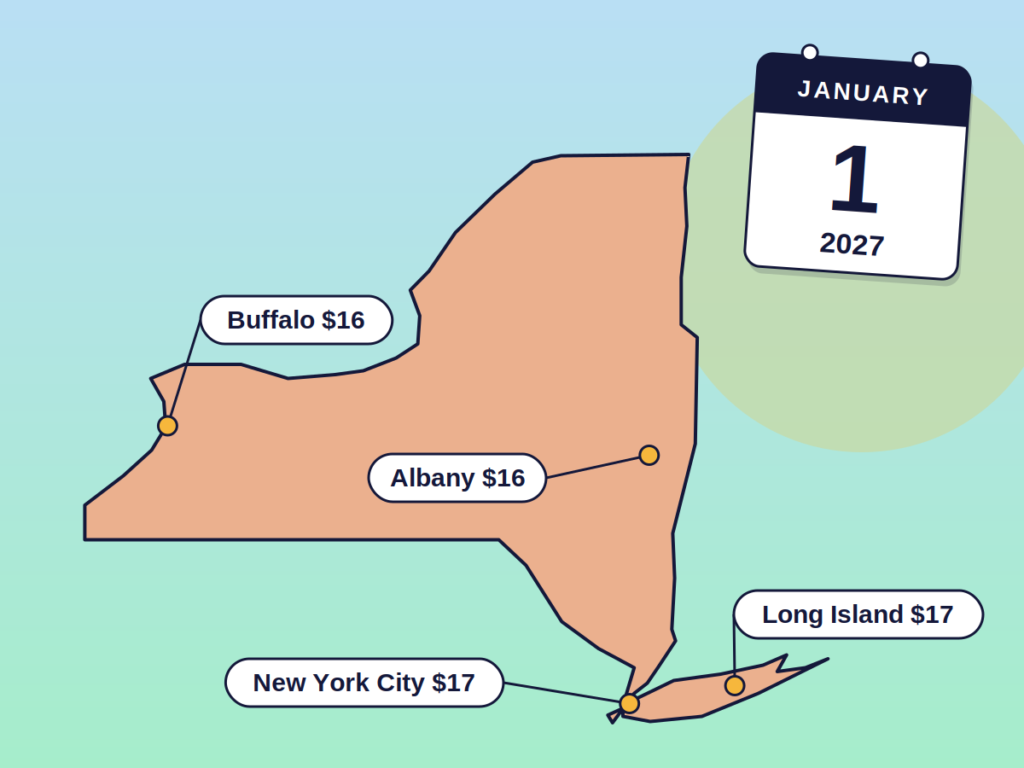
New York’s minimum wage is $17.00 per hour in New York City, Long Island and Westchester County and $16.00 per hour in the rest of the state. Those rates took effect January 1, 2026. The state’s 2023 wage law was scheduled to raise them with inflation in 2027, but an automatic economic off-ramp paused that increase when statewide job numbers slipped.
That pause doesn’t mean payroll stays simple, though. Home care aides still receive a raise on January 1, 2027, and Governor Kathy Hochul has asked lawmakers to approve the inflation increase starting March 1, 2027. If they do, you could be updating your payroll system twice in the first quarter.
This guide covers the current rates by region, what the 2027 freeze means, tipped and industry rates, overtime and exempt salary thresholds, spread of hours pay, pay notices and the penalties New York attaches to each rule. It’s written for small and midsize employers who run hourly payroll in New York and want the rules in one place.
What is the minimum wage in New York in 2026?
New York sets its minimum wage by region instead of using one statewide number. Where your employee physically works decides the rate, not where your business is headquartered. The New York State Department of Labor (NYSDOL) splits the state into two pay regions for the general minimum wage:
- Downstate: New York City (all five boroughs), Long Island (Nassau and Suffolk counties) and Westchester County
- Upstate (remainder of state): every other county in New York
Both regions are well above the $7.25 federal minimum wage, so New York’s rate is the one you pay.
New York minimum wage rates by region, 2024 to 2027
| Effective date | Downstate rate (NYC, Long Island, Westchester) | Upstate rate (remainder of New York) | Notes |
|---|---|---|---|
| January 1, 2027 | $17.00 per hour | $16.00 per hour | No change; jobs off-ramp triggered |
| January 1, 2026 | $17.00 per hour | $16.00 per hour | Last scheduled step increase under the 2023 law |
| January 1, 2025 | $16.50 per hour | $15.50 per hour | Scheduled step increase |
| January 1, 2024 | $16.00 per hour | $15.00 per hour | Scheduled step increase |
If you have employees in more than one county, pay each person the rate for the place they work. NYSDOL’s Minimum Wage Lookup Tool is the quickest way to confirm the right rate for a location or industry.
Is the New York minimum wage going up in 2027?
Not on January 1. In October 2026, the state confirmed that the general minimum wage will stay at $17.00 downstate and $16.00 upstate on January 1, 2027, and remain there unless the law changes. Here’s how that happened and what could still move.
Why New York froze the 2027 minimum wage increase
In 2023, New York passed a law that raised the minimum wage in three steps (2024, 2025 and 2026) and then tied future increases to inflation starting in 2027. The inflation formula lives in New York Labor Law Section 652, and it came with three economic “off-ramps” that can pause an increase. One off-ramp looks at negative inflation, one looks at the state unemployment rate and one looks at seasonally adjusted total nonfarm employment.
The employment off-ramp is the one that tripped. The Governor’s office says private education, hospitality and retail jobs declined slightly, by a monthly 0.07% from January to July 2026, which met the law’s test for a pause. Because the off-ramp is automatic, NYSDOL announced that the minimum wage will not receive an inflation-based increase on January 1, 2027.
How Governor Hochul’s proposal could raise the New York minimum wage on March 1, 2027
Governor Hochul has introduced a program bill that would make the employment off-ramp less sensitive. Instead of comparing raw job counts, it would only pause raises if the median monthly rate of job change falls below negative 0.25%. If the Legislature passes it, recalculated rates would take effect March 1, 2027.
Proposed New York minimum wage rates if the Legislature approves the off-ramp change
| Worker category | Downstate rate on March 1, 2027 (proposed) | Upstate rate on March 1, 2027 (proposed) |
|---|---|---|
| General minimum wage | $17.60 per hour | $16.55 per hour |
| Home care aides | $20.30 per hour | $19.30 per hour |
Until a bill is signed, the January 1, 2027 rates are the legal minimum. The Legislature returns in January, so watch for news in the first weeks of 2027 and keep the Governor’s 2027 minimum wage page bookmarked.
How New York employers can plan for a possible March raise
A freeze in January followed by a raise in March is easier to handle if you plan for both now:
- Budget both scenarios. Price Q1 labor costs at the current rates and at $17.60 or $16.55 so a March change doesn’t surprise you. To see what either rate means for an employee’s take-home pay and your employer taxes, run it through Fingercheck’s New York payroll tax calculator.
- Keep pay notices ready. Hospitality employers must issue a new written pay notice for any rate change, so have updated notices drafted before March.
- Check exempt salaries. New York’s exempt salary threshold moves with the minimum wage, so a March raise could also raise the threshold. NYSDOL hasn’t published guidance on that yet.
- Confirm your payroll system updates mid-year rates. A raise on March 1 lands mid-quarter and possibly mid-pay-period, so make sure hours on either side of the change are paid at the right rate.
Do any New York industries have a different minimum wage?
Yes. Most employers pay the general rate, but a few industries follow their own wage orders or statutes. If you run a home care agency, a fast food chain or a farm, check these rules before you set pay.
New York industry minimum wage rates for 2026 and January 1, 2027
| Worker category | Downstate rate in 2026 | Upstate rate in 2026 | Downstate rate on January 1, 2027 | Upstate rate on January 1, 2027 |
|---|---|---|---|---|
| General minimum wage | $17.00 per hour | $16.00 per hour | $17.00 per hour | $16.00 per hour |
| Fast food workers | $17.00 per hour | $16.00 per hour | $17.00 per hour | $16.00 per hour |
| Home care aides | $19.65 per hour | $18.65 per hour | $20.00 per hour | $19.00 per hour |
Why New York home care aides still get a raise in 2027
Home care aides are covered by a separate statute, Public Health Law Section 3614-f, not the general minimum wage law. Their rate is indexed to inflation too, but the Labor Law off-ramps don’t apply to it. The one limit is a cap: the home care minimum wage can’t be more than $3.00 above the general minimum wage. That’s why aides move to exactly $20.00 downstate and $19.00 upstate on January 1, 2027.
Home care aides include home health aides, personal care aides and similar workers whose main job is helping clients with activities of daily living. NYSDOL also treats them as manual workers who must be paid weekly (more on pay frequency below). The Home Care Aide Minimum Wage Fact Sheet (P105) also covers call-in pay and uniform maintenance pay.
New York fast food workers now earn the general minimum wage
New York once had a separate, faster wage schedule for fast food workers at large chains. Those rates have since merged with the general rate, so fast food workers earn $17.00 downstate and $16.00 upstate. The Fast Food Worker Minimum Wage Fact Sheet (P716) explains who counts as a fast food worker.
Farm worker overtime starts after 52 hours in 2026
Farm workers earn the general regional minimum wage, but their overtime rules are phasing in on a separate schedule. On January 1, 2026, the farm worker overtime threshold dropped from 56 to 52 hours per week. It keeps falling by four hours every other year until it reaches 40 hours in 2032:
New York farm worker overtime threshold schedule
| Effective date | Weekly overtime threshold for farm workers |
|---|---|
| January 1, 2032 | 40 hours |
| January 1, 2030 | 44 hours |
| January 1, 2028 | 48 hours |
| January 1, 2026 | 52 hours |
| January 1, 2024 | 56 hours |
Farm employers can offset part of that overtime cost with New York’s refundable Farm Employer Overtime Credit.
What is the tipped minimum wage in New York?
Only hospitality employers, meaning restaurants and hotels, can count tips toward the minimum wage in New York. Retailers, salons, car washes and other businesses outside hospitality can’t take a tip credit at all and must pay the full minimum wage in cash. Building service employers can’t take one either.
Hospitality employers who do take a tip credit pay a lower cash wage, and tips make up the difference. New York splits tipped workers into two groups with different credits:
- Food service workers serve food or drinks and regularly get tips, like servers, bussers, bartenders and runners.
- Service employees are other hospitality workers who customarily get tips, like bellhops, coat check attendants and doormen.
New York tipped minimum wage for hospitality employers, 2026 and January 1, 2027
| Tipped worker category | Region | Minimum cash wage | Maximum tip credit | Total minimum wage |
|---|---|---|---|---|
| Food service worker | Downstate (NYC, Long Island, Westchester) | $11.35 per hour | $5.65 per hour | $17.00 per hour |
| Food service worker | Upstate (remainder of New York) | $10.70 per hour | $5.30 per hour | $16.00 per hour |
| Service employee | Downstate (NYC, Long Island, Westchester) | $14.15 per hour | $2.85 per hour | $17.00 per hour |
| Service employee | Upstate (remainder of New York) | $13.30 per hour | $2.70 per hour | $16.00 per hour |
These tipped rates stay the same on January 1, 2027 along with the general rate.
When a New York employer loses the tip credit
The tip credit comes with conditions, and missing one means paying the full minimum wage for that time. Under the Hospitality Industry Wage Order, you can’t take the credit:
- On days a tipped worker spends more than two hours, or more than 20% of the shift, on non-tipped work like prep or cleaning
- For service employees whose weekly tips fall below a set average per hour ($3.65 downstate and $3.40 upstate, or $9.55 downstate and $9.00 upstate at resort hotels)
- If you didn’t give the employee a written pay notice that states the tip credit before you started taking it
If tips plus the cash wage don’t reach the full minimum wage in any week, you owe the difference.
How does overtime work for New York minimum wage employees?
New York follows the federal rule for most workers: nonexempt employees earn 1.5 times their regular rate for every hour over 40 in a workweek. New York doesn’t require daily overtime, so a single 12-hour shift doesn’t trigger overtime on its own. Farm workers (52 hours in 2026) and live-in residential employees (44 hours) have higher weekly thresholds.
For an hourly employee at minimum wage, the overtime rate is $25.50 per hour downstate and $24.00 per hour upstate.
How to calculate overtime for tipped employees in New York
This is where hospitality payroll often goes wrong. You can’t multiply the tipped cash wage by 1.5. Instead, multiply the full minimum wage by 1.5 and then subtract the tip credit:
Tipped overtime cash wage = (full minimum wage × 1.5) − tip credit
For a downstate food service worker, that’s ($17.00 × 1.5) minus $5.65, or $19.85 per hour. The tip credit stays the same in overtime hours; it doesn’t grow.
New York overtime cash wage for tipped hospitality workers
| Tipped worker category | Downstate overtime cash wage | Upstate overtime cash wage |
|---|---|---|
| Food service worker | $19.85 per hour | $18.70 per hour |
| Service employee | $22.65 per hour | $21.30 per hour |
What salary makes an employee exempt from overtime in New York?
Paying someone a salary doesn’t make them exempt. To skip overtime, the employee has to meet a duties test and be paid at least New York’s salary threshold. New York sets its own threshold for the executive and administrative exemptions, and it’s much higher than the federal one.
New York exempt salary thresholds for executive and administrative employees
| Region | Weekly salary threshold (2026 and January 1, 2027) | Annual equivalent |
|---|---|---|
| Downstate (NYC, Long Island, Westchester) | $1,275.00 per week | $66,300.00 per year |
| Upstate (remainder of New York) | $1,199.10 per week | $62,353.20 per year |
Because the minimum wage isn’t rising on January 1, 2027, these thresholds stay the same too. New York doesn’t set a separate salary level for the professional exemption, so professional employees follow the federal threshold of $684 per week ($35,568 per year). If you’re unsure how a role should be classified, Fingercheck’s guide to exempt vs non-exempt employees walks through the duties tests.
What is spread of hours pay in New York?
New York has a rule most states don’t: spread of hours pay. When the time between an employee’s first clock-in and last clock-out in a day is more than 10 hours, the employee is owed one extra hour of pay at the basic minimum wage ($17.00 downstate or $16.00 upstate). The spread counts unpaid breaks and time between split shifts.
For example, a line cook who works 10 a.m. to 2 p.m. and then 5 p.m. to 10 p.m. only works nine hours. The spread is 12 hours, though, so the cook gets an extra hour of minimum wage pay that day.
Who qualifies depends on the industry:
- Restaurants and all-year hotels: every employee gets spread of hours pay, regardless of their regular rate of pay. That includes a sous chef earning well above minimum wage.
- Most other industries: the rule mainly protects workers at or near minimum wage. If an employee’s pay for the day already covers minimum wage for every hour worked plus one extra hour, no added pay is owed.
Spread of hours pay isn’t counted in the regular rate for overtime. Fingercheck’s article on New York’s spread of hours law has more examples.
What pay notices, pay schedules and posters do New York employers need?
Paying the right rate is only part of it. New York also expects written notices, pay stubs, a set pay schedule and posters, and most wage claims against small employers involve one of these.
Pay notices under the Wage Theft Prevention Act
The Wage Theft Prevention Act (WTPA) requires a written pay notice for every new hire within 10 business days of their first day. The notice lists the pay rate, overtime rate, regular payday, any allowances like tip credits and the employer’s contact information. You must give it in English and in the employee’s primary language if NYSDOL publishes a template in that language. You can find pay notice templates such as Form LS 54 for hourly employees on the NYSDOL site.
When pay changes, the rules differ by industry:
- Most employers: a raise can be shown on the next pay stub with no new notice. A pay cut needs written notice at least seven days before it takes effect.
- Hospitality employers: any rate change, up or down, requires a new written notice. That includes a tip credit change, which matters if the March 1, 2027 proposal passes.
Every paycheck also needs a wage statement (pay stub) showing hours, rates, gross pay, deductions and net pay. Keep payroll records for at least six years.
How often New York employers must pay employees
New York’s frequency of pay rules are stricter than most states:
- Manual workers must be paid weekly, no later than seven days after the end of the week the wages were earned. NYSDOL counts anyone who spends more than 25% of their time on physical labor as a manual worker, which covers many construction, warehouse, retail, restaurant and home care roles.
- Clerical and other workers must be paid at least twice a month on regular paydays.
In May 2025, New York limited the penalty for a first-time late payment to manual workers who were still paid at least twice a month. For a first violation, damages are now limited to lost interest rather than the full amount of the late wages. Repeat violations can still bring liquidated damages equal to 100% of the late pay, so weekly pay for manual workers is still the safe default.
Which minimum wage posters New York employers must display
New York requires a minimum wage poster in plain view at every worksite. Use the one for your industry:
- Miscellaneous Industries Minimum Wage Poster (LS 207) for most employers
- Hospitality Industry Minimum Wage Poster (LS 207.3) for restaurants and hotels
- Home Care Aide Minimum Wage Poster (LS 207.4) for home care agencies
- Farm Industry Minimum Wage Poster (LS 110) for farms
Since December 2022, New York Labor Law Section 201 also requires you to make every mandatory workplace poster available electronically, either on your website or intranet or by email. You also have to tell employees the digital copies exist. That rule covers remote workers who never see the break room wall. Swap in updated posters whenever rates change, including in March 2027 if the proposal passes.
What happens if a New York employer doesn’t pay minimum wage?
New York wage penalties add up fast because employees can sue directly in state court, and claims reach back six years. An employee who was underpaid can generally recover the unpaid wages plus liquidated damages equal to 100% of what was owed, plus interest and attorney’s fees, unless the employer proves it acted in good faith.
Notice and pay stub mistakes carry their own damages under New York Labor Law Section 198:
New York Wage Theft Prevention Act damages per employee
| Violation | Damages per work day | Maximum per employee |
|---|---|---|
| No written pay notice within 10 business days of hire | $50 | $5,000 |
| Missing or incomplete wage statement (pay stub) | $250 | $5,000 |
Those caps apply per employee, so a missing notice across a 30-person crew could reach $150,000 before any back wages. NYSDOL can also investigate on its own and assess civil penalties.
New York minimum wage compliance checklist for employers
- Confirm each employee’s pay region (downstate or upstate) based on where they physically work
- Keep general minimum wage employees at $17.00 downstate and $16.00 upstate through at least February 2027
- Raise home care aides to $20.00 downstate and $19.00 upstate on January 1, 2027
- Verify tipped cash wages, tip credit notices and non-tipped work limits if you’re a hospitality employer
- Calculate tipped overtime from the full minimum wage, not the cash wage
- Check that executive and administrative exempt employees earn at least $1,275 per week downstate or $1,199.10 per week upstate
- Pay spread of hours when a workday spans more than 10 hours
- Pay manual workers weekly
- Give WTPA pay notices at hire, and to every hospitality employee whenever a rate changes
- Display the right NYSDOL minimum wage poster and share digital copies with all employees
- Watch for the Legislature’s vote on the March 1, 2027 proposal and update rates, notices and posters if it passes
Staying ahead of New York minimum wage changes
For most New York employers, January 1, 2027 is a quiet date for base pay: $17.00 downstate and $16.00 upstate stay in place. The exceptions are home care aides, who move to $20.00 and $19.00, and anyone watching Albany for the March 1, 2027 proposal. Between regional rates, tip credits, spread of hours and weekly pay for manual workers, New York leaves little room for payroll mistakes, so it pays to keep rates, notices and posters current.
Pay every New York employee the right rate
Whether your team works downstate, upstate or across state lines, Fingercheck brings time tracking, scheduling and payroll into one platform so every paycheck matches the hours your team worked.
New York Minimum Wage FAQs
This article is for general informational purposes only and isn’t legal or tax advice. Minimum wage and payroll rules can change. Confirm current requirements with the New York State Department of Labor, the U.S. Department of Labor or an employment attorney.