Can you leave your PEO without losing your health benefits?
Leaving a PEO doesn’t mean your employees lose health coverage, as long as a new plan starts the day the PEO plan ends.

Leaving a PEO doesn’t mean your employees lose health coverage, as long as a new plan starts the day the PEO plan ends. What changes is who sponsors the plan. Instead of joining the PEO’s master health plan through co-employment, your business offers coverage directly.
That answer surprises a lot of owners. The belief that a PEO is the only way a small business can offer decent benefits keeps many companies locked in long after they’ve grown unhappy with the fees or the service. For years, that belief was accurate but since 2014, it mostly isn’t.
This guide covers what actually happens to enrollment, coverage, and cost when you move payroll and HR off a professional employer organization (PEO), why the trade-off used to be real for small employers, and how to time the switch so nobody on your team goes a day without coverage.
Can you leave a PEO and keep your health benefits?
You can leave a PEO and keep offering health benefits, but you can’t take the PEO’s plan with you. A PEO health plan is sponsored by the PEO and covers employees across all of its client companies. When your contract ends, your employees’ enrollment in that plan ends too.
The fix is having replacement coverage lined up before you give notice. When the new plan’s effective date matches the PEO plan’s end date, employees experience a plan change, much like an annual renewal, instead of a coverage gap.
Here’s what does change for your team:
- The plan itself: A new carrier or plan design means new ID cards and possibly a different provider network.
- The enrollment process: Employees enroll in the new plan, even if they pick similar coverage levels.
- Year-to-date deductibles: If you switch partway through a plan year, employees may start over on deductibles and out-of-pocket maximums. Timing solves most of this, which we’ll cover below.
Why leaving a PEO used to mean unpredictable health insurance costs
Before the Affordable Care Act’s small group rules took effect in 2014, the risk of leaving a PEO came down to price, not access. Starting in 1997, federal law under HIPAA required insurers to sell small group coverage to employers with 2 to 50 employees regardless of employee health. Federal law didn’t cover single-employee businesses, though some states extended protection to them.
What insurers could do in most states was set premiums based on a group’s health and claims history. A 15-person company with one employee in cancer treatment could see a renewal increase large enough to make coverage unaffordable.
PEOs solved that problem with scale. By pooling employees from many client companies under one master plan, a PEO could negotiate like a large employer and spread claims risk across a much bigger group. One expensive claim had far less effect on a small client’s renewal. For a small business, joining a PEO was often the most realistic way to get stable and predictable health insurance premiums.
Many owners still think in terms of that trade-off: stay in the PEO’s shared risk pool, or go it alone and hope one serious illness doesn’t price the business out of coverage. For a company with 10, 25, or 40 employees, the choice was real. The rules behind it have since changed.
What changed: how small group health insurance works now
Today, federal rules require insurers to sell fully insured small group coverage to any eligible employer that applies, regardless of employees’ health. This is called guaranteed issue. The bigger change for small employers is how premiums are set. Under the ACA, insurers can’t price small group plans based on your team’s health or claims history. Rates can vary only by age, location, tobacco use and individual versus family coverage.
In most states, the small group market covers employers with 1 to 50 employees. California, Colorado, New York, and Vermont extend it to 100.
| Coverage rule | Small group health insurance before 2014 | Small group health insurance today (ACA) | PEO master health plan |
|---|---|---|---|
| Can an insurer refuse to sell a plan because of employee health? | Generally no for groups of 2 to 50 (HIPAA, since 1997) | No, guaranteed issue | Depends on the PEO’s own client acceptance criteria |
| Can premiums be based on employee health or claims history? | Yes in most states, within any state rating limits | No; rates vary only by age, location, tobacco use and coverage tier | Set by the PEO, often bundled with admin fees |
| Who sponsors the health plan? | Your business | Your business | The PEO |
| Does the plan stay if you change payroll providers? | Yes | Yes | No |
The biggest reason small businesses needed a PEO’s risk pool was protection from premiums tied to employee health. That protection is now built into federal law. A PEO can still offer good plans, but it’s no longer the only path to stable small group pricing.
Some rules still apply to traditional small group plans. Insurance carriers commonly require around 70% of eligible employees to enroll and the employer to cover at least 50% of the employee-only premium. Carriers waive those minimums for one month every year, which the timing section covers below. Some benefits partners, including Meridio, offer plan options outside that carrier model with no minimum group size.
What happens to coverage when you leave a PEO
When you leave a PEO, coverage under its plan typically ends on your contract termination date or at the end of that month, depending on your agreement. Every other part of the transition comes from that date, so confirm it in writing first.
Enrollment
Employees enroll in your new plan during a transition window, usually a few weeks before the new effective date. Since the PEO plan is ending, they aren’t choosing between two plans; they’re choosing a coverage level on the new one. Employees who waived PEO coverage can generally enroll during this window too.
Continuity of coverage
The goal is a same-day handoff: PEO coverage ends on the last day of the month, and new coverage starts on the first day of the next. Lock in the new plan’s effective date, then give the PEO notice based on your contract’s termination clause. Many PEO agreements require written notice well in advance, so read that clause before anything else.
Deductibles and out-of-pocket maximums
A new plan usually means new accumulators. If you switch in July, an employee who already met their deductible on the PEO plan could start back at zero. Some carriers offer deductible credit for groups moving from another plan, so it’s worth asking. The cleanest fix is switching on January 1, when deductibles reset anyway.
COBRA participants
Former employees currently on COBRA continuation coverage through the PEO plan still need a plan to continue on. Depending on your PEO contract, they may stay on the PEO’s plan, or responsibility may move to your new group plan. Ask the PEO how it handles existing COBRA participants when a client leaves, and get the answer in writing.
Payroll deductions
Employee premium contributions have to move from the PEO’s payroll to yours, with the correct pre-tax treatment. This is where errors tend to show up on the first few paychecks, like a doubled deduction or a missed one, when benefits and payroll live in separate systems.
With Fingercheck, health plan contributions are built into the same platform that runs payroll, so each deduction lands on the right paycheck without a second system to reconcile. And our benefits administration handles open enrollment in the same place.
How the cost compares after you leave a PEO
Leaving a PEO changes how you pay for benefits more than whether you pay for them. PEO pricing usually bundles payroll, HR, workers’ comp, and benefits into one fee, charged per employee per month or as a percentage of payroll. That makes it hard to see what the health plan alone is costing you.
When you leave, those costs unbundle:
| Cost Component | Inside a PEO | After leaving a PEO |
|---|---|---|
| Health premiums | Set by the PEO, often blended into one fee | Quoted directly for your group |
| Payroll and HR admin | Built into the PEO fee | Your payroll and HR software subscription |
| Workers’ compensation | Usually through the PEO’s master policy | Your own policy, effective the day you leave |
| Benefits administration | Handled by the PEO | Your benefits partner and payroll platform |
| Cost visibility | One blended number | Line items you can compare and shop |
Unbundling adds a few line items, but it makes each one shoppable. Some businesses discover the PEO’s blended fee was hiding a plan they could replace for less. Others find the PEO was a fair deal. Either way, you only know once you have a direct quote to compare against.
One item owners often miss: workers’ comp. If your coverage runs through the PEO’s master policy, you’ll need your own policy starting the same day the PEO contract ends. Fingercheck offers pay-as-you-go workers’ comp that syncs with payroll, so premiums are based on actual wages instead of estimates, with no large down payment up front.
Leave the PEO. Keep the coverage.
ACA-compliant plans start at $190 a month, with no group minimums, and live right inside Fingercheck.
When to leave a PEO: timing the switch
For most businesses, the best time to leave a PEO is January 1. Deductibles reset for everyone anyway and the date lines up with most plan years. It also avoids a possible mid-year restart of payroll tax wage bases. When a business leaves a PEO partway through the year, Social Security and FUTA wage bases can start over under the business’s own EIN, so wages already taxed under the PEO count again toward the annual caps. The main exception is an IRS-certified PEO (CPEO), where federal successor employer rules generally carry those wage bases over. State unemployment wage bases follow each state’s own rules. Plans with year-round enrollment, like Meridio’s Core Plans, give you more flexibility on the benefits side, but January 1 is still the cleanest date for payroll.
If you have trouble meeting carrier participation or contribution minimums, there’s a more specific window. Every year from November 15 to December 15, insurers must offer small group coverage without those requirements for a January 1 start. For 2027 coverage, that window runs November 15 to December 15, 2026.
Here’s a sample timeline for a January 1, 2027 switch:
| When | What to do |
|---|---|
| Late September–October | Pull your PEO contract and confirm the termination notice period, any exit fees, and how COBRA participants are handled. Request a benefits quote. |
| Before your notice deadline | Choose a plan, set a January 1 effective date, and give the PEO written notice. |
| November | Hold employee enrollment, set up payroll, workers’ comp, and state tax accounts under your own EIN. |
| November 15–December 15 | Use the special enrollment window if you can’t meet participation or contribution minimums. |
| December | Confirm the final PEO payroll, deduction cutoffs, and who issues year-end W-2s. |
| January 1 | New health coverage and payroll go live. |
Mid-year switches are possible too. Plan for deductible resets, ask carriers about deductible credit and ask your PEO whether it’s IRS-certified. Then talk to your accountant about the payroll tax impact before you commit to a date.
When staying with a PEO still makes sense
Leaving isn’t the right call for every business. A PEO can still be a strong fit if you want to share HR liability through co-employment, need hands-on help managing workers’ comp claims in a high-risk industry.
Some businesses also find their PEO’s plan pricing holds up well against direct quotes. The point isn’t that PEOs are a bad deal. It’s that health benefits alone are no longer a reason you have to stay. If the fees or service aren’t working, a direct benefits quote shows you what your options actually are.
How Fingercheck and Meridio support a switch off a PEO
Most health insurance options aren’t built for hourly workers. Traditional small group plans come with participation minimums and eligibility rules that are hard to meet when your team includes part-time, seasonal, or 1099 workers. That’s why Fingercheck partners with Meridio to give hourly businesses health benefits without relying on a PEO’s shared risk pool.
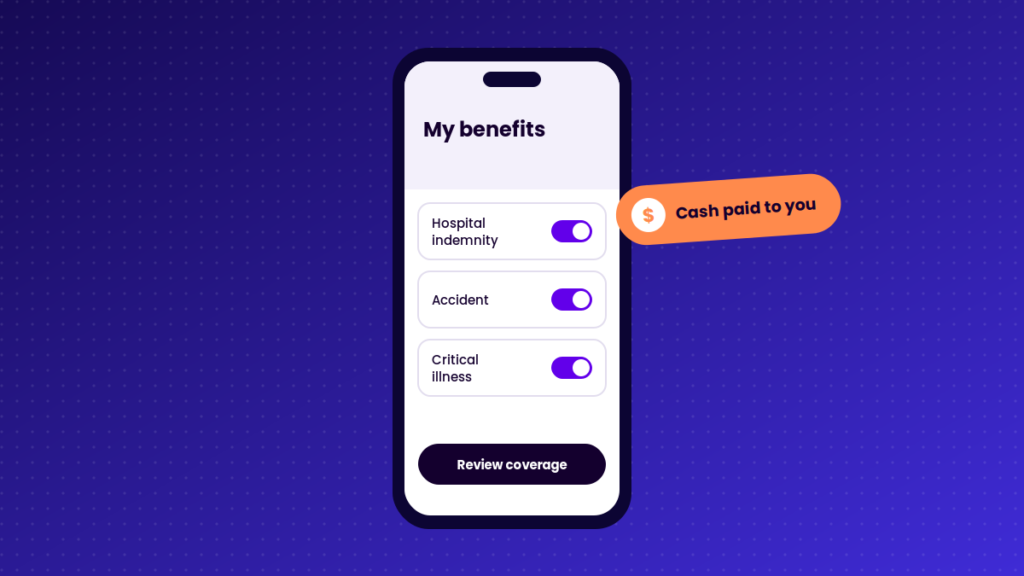
Through Fingercheck, businesses can offer Meridio’s Core Plans: nationwide, ACA-compliant coverage with preventive care and medical options, starting at $190 a month. Core Plans have no minimum group size and no underwriting, and your team can enroll at any time of year. They’re designed for full-time, part-time, seasonal, and 1099 workers alike, and employees can add dental, vision, and extended hospital or critical illness coverage.
The benefits live inside the Fingercheck platform you already use for payroll and time tracking. There’s no new dashboard and no extra login, and contributions flow straight into payroll.
Every business gets a dedicated Meridio customer success manager for ongoing check-ins, backed by licensed benefit guides and a customer care team for year-round support. According to Meridio, businesses save an average of 20% annually on health benefits through competitive plan pricing and smarter benefit design.
Getting a quote doesn’t require leaving your PEO first. You can request a free assessment, compare the coverage and cost against your current PEO plan, and decide from there. If you do move forward, our team can help you switch payroll providers on the same timeline as your new coverage.
Leaving a PEO FAQs
The bottom line on leaving a PEO
Leaving a PEO doesn’t have to mean trading away good health benefits. ACA small group rules removed the medical underwriting that once made a PEO’s risk pool a necessity, so what’s left is a question of cost, service, and timing. If your PEO isn’t working for you, get a direct quote, check your contract, and aim for a clean January 1 handoff.
Fingercheck and Meridio make that switch simpler for hourly businesses, with ACA-compliant plans starting at $190 a month that live right inside your payroll platform. Get your free benefits assessment to see what your team’s coverage could look like after the PEO.
This is general information, not tax, legal, or insurance advice. Talk to a licensed benefits professional or tax advisor about your specific situation.